
Key Highlights
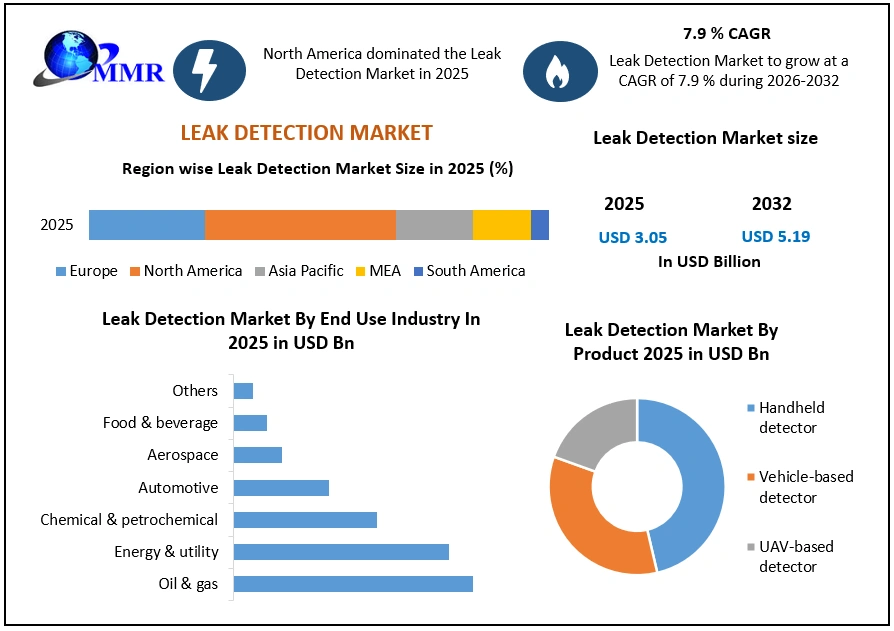
The global Leak Detection Market reached a baseline valuation of USD 3.05 billion in 2025 and is projected to hit USD 5.19 billion by 2032, growing at a 7.9% CAGR.
Handheld detectors dominated the product landscape in 2025 due to low initial costs, portability, and widespread deployment across utility maintenance operations.
Optical Gas Imaging (OGI) captured the largest technology market footprint in 2025, supported by real-time visualization capabilities and broad regulatory approval.
Laser absorption spectroscopy represents the fastest-growing technology segment, driven by an urgent industrial need for high-sensitivity continuous tracking systems.
Asia-Pacific is positioned to dominate global market share through 2032, propelled by escalating regional natural gas production volumes matching 888 billion cubic meters.
Why This Matters Now The structural reorganization of industrial safety protocols has concentrated technical leverage inside the micro-machined sensor fabrication loop. Legacy leak detection relied on periodic, human-led physical checks utilizing mechanical gauges that lacked network connectivity. Modern automated industrial architectures require the absolute deployment of continuous, software-calibrated environmental tracking chips. For electronics original equipment manufacturers (OEMs) and semiconductor foundry managers, this transition creates a steady, high-volume production channel that demands specialized material handling and complex analog-to-digital processing blocks.
As global environmental compliance mandates tighten, industrial plant operators must eliminate unexpected fugitive emissions before they violate regional safety codes. This urgency pushes the burden onto electronics manufacturing services (EMS) providers to supply ruggedized sensor nodes that run predictive maintenance software directly at the asset level. Fabs that allocate sufficient cleanroom capacity to produce specialized micro-electromechanical systems (MEMS) will capture long-term component contracts, while legacy instrumentation providers face shrinking market shares as buyers turn to connected IoT hardware grids.
Market Overview The global Leak Detection Market recorded a verified valuation of USD 3.05 billion in 2025 and is on track to scale to USD 5.19 billion by 2032. This long-term commercial path represents a consistent compound annual growth rate (CAGR) of 7.9% across the designated analytical window. The foundational market force driving this capital movement is the widespread transition from passive reaction strategies to automated predictive analytics. Heavy utility networks, petrochemical processing plants, and manufacturing sites can no longer manage leakage risks through manual spot-checking, making permanently installed, automated detection components the baseline requirement for modern facility construction.
This continuous systematic growth relies directly on advancing the integration of local logic micro-architectures with chemical and pressure-sensitive substrates. By embedding specialized microcontroller units alongside raw sensing cells, component developers create smart edge nodes that filter out environmental noise locally. This micro-scale design optimization lowers the frequency of false alarms, which historically disrupted complex pipeline networks, encouraging industrial buyers to allocate larger capital budgets toward widespread sensor installations.
Key Trends Driving Growth The most critical technical trend accelerating the global market landscape is the extensive utilization of machine learning algorithms and artificial intelligence engines to interpret multi-spectrum sensing data. Traditional hardware configurations simply registered baseline chemical thresholds, often triggering erroneous alerts when ambient conditions fluctuated. Modern systems utilize edge-computing infrastructure to analyze complex gas behavior patterns in real time, executing automated validation workflows right on the processing board. Furthermore, advanced operators are deploying machine learning models that analyze satellite imagery and aerial sensor streams to map ground-level infrastructure vulnerabilities, maximizing inspection efficiency across immense geographic territories.
Concurrently, utility firms and energy providers are scaling up their utilization of Leak Detection and Repair (LDAR) frameworks to minimize product loss and preserve workplace safety. Comprehensive operational metrics reveal that implementing modern detection networks yields a 63% drop in overall emissions for petroleum refineries, alongside a 56% reduction in volatile organic compound releases throughout chemical manufacturing assets. These verified mitigation metrics justify major capital expenses for advanced automated hardware grids, driving continuous demand for low-power transceiver chips and high-purity optical sensing arrays.
Furthermore, processing plants are rapidly moving away from complex wired infrastructure layouts to adopt wireless, self-powered environmental sensing nodes. Wired monitoring networks carry high installation expenses and limited flexibility inside volatile, changing industrial settings. Wireless sensing architectures eliminate these deployment barriers, enabling operators to position sensitive warning modules directly adjacent to critical valves, storage vessels, and high-pressure junctions. This architecture transition fuels secondary volume expansion for energy-harvesting power chips and narrow-band IoT communication modules, lifting revenues for specialized fabless chip suppliers.
𝐃𝐨𝐰𝐧𝐥𝐨𝐚𝐝 𝐏𝐃𝐅 𝐁𝐫𝐨𝐜𝐡𝐮𝐫𝐞 @ https://www.maximizemarketresearch.com/request-sample/96475/
Segment Insights
Handheld Detectors (Dominant Product Segment): This architecture secured the largest global market footprint in 2025. The dominant position is maintained by the low relative procurement cost, ease of operation, and immediate utility during routine localized maintenance sweeps across residential, commercial, and utility infrastructure networks.
Optical Gas Imaging (Dominant Technology Segment): Commanding the leading technology footprint in 2025, this segment benefits from extensive regulatory acceptance across international energy sectors. These devices allow safety teams to visualize gas leaks from safe physical distances, eliminating the need to expose personnel to dangerous working positions during initial triage operations.
Laser Absorption Spectroscopy (Fastest-Growing Segment): Expanding faster than legacy acoustic or mass-balance alternative configurations, this technology leverages high-sensitivity laser configurations to achieve continuous, sub-parts-per-million detection accuracy. This rapid expansion rewards component developers who can scale the production of specialized photonic chips and miniature laser diodes.
Regional Growth Story North America maintains a highly consolidated position in the global compliance landscape, heavily backed by strict regional safety enforcement actions and a mature network of pipeline transmission infrastructure. The regional market focus centers on upgrading legacy industrial facilities with advanced optical imaging tools and integrated cloud-analytics suites. This continuous modernization loop creates a stable market for local semiconductor designers who build high-reliability logic devices capable of enduring harsh outdoor environments.
Asia-Pacific is emerging as the dominant geographic volume engine, projected to capture the largest market share through 2032. Rapid expansion in natural gas usage serves as the primary driver for this regional growth, with APAC natural gas output climbing from 850 billion cubic metres to 888 billion cubic metres. Expanding processing complexes and new pipeline construction initiatives across China, Japan, India, and South Korea require the built-in integration of advanced leak detection equipment from day one of construction. This high manufacturing concentration encourages international foundries to scale up their regional MEMS production capacity, transforming the APAC supply chain into a critical source of specialized environmental components.
Competitive Landscape The competitive field within the Leak Detection Market is defined by intense technological races among a small group of global electronics and engineering conglomerates. Top-tier market entities, including Honeywell International Inc., Emerson Electric Co., Siemens Energy, ABB Ltd., FLIR Systems, Inc., Yokogawa Electric Corporation, Schneider Electric SE, and Xylem Pure Technologies, are competing to deliver complete, software-integrated monitoring platforms. This corporate competition demonstrates that future market victory belongs to companies that can successfully bridge the gap between physical sensor material chemistry and advanced data analytics software.
This competitive dynamic is pushing leading companies to restructure their technology portfolios through direct acquisitions and targeted engineering partnerships. Leading suppliers are aggressively absorbing smaller fabless design teams that possess specialized expertise in edge-computing firmware and micro-spectroscopy chip layouts. This consolidation trend allows major providers to deliver pre-calibrated, multi-gas sensing modules that cut integration friction for industrial system builders, helping top brands maintain strong pricing power while pushing low-cost component assembly firms into commoditized, lower-margin positions.
Recent Developments
Next-generation handheld gas detectors are incorporating localized bluetooth and low-power wide-area network protocols, enabling field technicians to automatically sync localized leak data with enterprise compliance software.
Advanced optical gas imaging systems are integrating dual-sensor layouts that overlay real-time thermal boundaries onto standard color feeds, simplifying leak source location tracking for maintenance engineers.
Industrial monitoring networks are deploying miniature laser spectroscopy arrays that operate continuously on solar-harvesting power modules, cutting down overall battery replacement schedules across remote tracking environments.
Energy infrastructure teams are expanding their utilization of vehicle-mounted gas detection arrays, using roof-mounted sensor clusters to continuously monitor surrounding atmosphere profiles while moving at standard driving speeds.
Strategic Implications The transition toward continuous, automated environmental monitoring fundamentally changes how electronics original equipment manufacturers manage their product layout lifecycles. System designers can no longer design sensor components as isolated analog nodes; they must create integrated edge platforms that combine data acquisition, analog filtration, and network encryption on a uniform substrate. This design trend requires deep collaboration with foundry partners to establish stable process design kits optimized for handling delicate, exposed-die structures without lowering post-packaging yields.
For component supply chain managers, building long-term resilience across raw sensing material lines is now a critical business safeguard. Because modern laser-based and electrochemical sensors rely on specialized crystals and precise chemical elements, any localized shipping disruption can halt entire assembly lines. Enterprise technology buyers are prioritizing hardware brands that demonstrate diversified wafer source tracks and domestic assembly backup options, making supply chain redundancy a vital commercial asset rather than a secondary back-office administrative objective.
Future Outlook As automated industrial parks and unified smart city grids expand globally, the market will depend completely on the successful rollout of software-calibrated sensor arrays and multi-physics chiplet packaging standards. The continuous requirement for absolute emission control and zero-downtime safety performance will drive a widespread transition away from standalone instrumentation toward integrated, zero-power wireless sensing grids. This technical evolution will open up new monetization pathways centered on continuous compliance automation, predictive grid management software, and automated hazard isolation grids. Ultimately, the market will reward integrated semiconductor leaders who successfully embed cognitive processing blocks into ruggedized environmental sensing components, while legacy hardware builders relying on manual, analog testing routines will suffer from prolonged design delays, decreasing operating margins, and total market displacement.
Analyst Perspective “The rapid scaling of the Leak Detection Market marks a permanent transition toward proactive, data-driven facility management across global industrial networks,” states Alpana Patil, Research Analyst at Maximize Market Research. “As modern production sites replace manual checking routines with continuous wireless tracking networks, success depends entirely on hardware-software synchronization. The enterprises that master low-power MEMS packaging while embedding real-time machine learning analytics will capture the next era of industrial internet of things expansion.”
About Maximize Market Research
Maximize Market Research Pvt. Ltd. (MMR) is a global market research and consulting company that provides reliable, data-focused, and practical business insights. The firm serves a wide range of industries, including healthcare, pharmaceuticals, technology, automotive, electronics, chemicals, personal care, and consumer goods. Through market forecasts, competitive analysis, strategic consulting, and industry impact assessments, MMR helps organizations understand changing market conditions, identify growth opportunities, and make informed business decisions for long-term success.
2nd Floor, Navale IT Park Phase 3
Pune Banglore Highway, Narhe
Pune, Maharashtra 411041, India
+91 9607365656
[email protected]