
Key Highlights
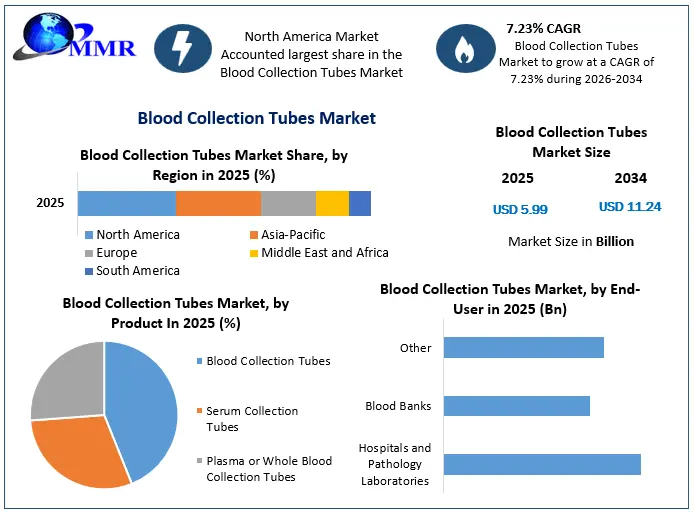
Market valuation expanding from USD 5.99 billion in 2025 to USD 11.24 billion by 2034 at a 7.23% CAGR.
Widespread transition to smart factory architectures to fulfill strict preanalytical testing criteria and eliminate manufacturing defects.
North America establishes regional leadership backed by comprehensive capital investments in automated operational technology.
High-speed robotic integration minimizes manual handling across ultra-sterile filling, vacuum drawing, and color-coded capping processes.
Machine vision inspection systems deliver real-time verification of gel allocation and chemical anticoagulant spray uniformity.
Advanced industrial cybersecurity frameworks secure connected manufacturing execution systems against intellectual property theft and unauthorized batch disruption.
Why This Matters Now
The production of medical consumables has hit an critical inflection point where traditional manufacturing methods can no longer sustain shifting global quality mandates. High-volume blood collection tube fabrication demands flawless precision in chemical additive dosing and exact internal pressure calibration to avoid preanalytical diagnostic errors. For plant managers and automation engineers, this shifts operational priorities from simple volume expansion to real-time process optimization through complete factory digitization.
As global healthcare networks scale up diagnostic testing, a minor variation in chemical coating or vacuum preservation will destroy an entire production batch, inflicting heavy revenue losses. Consequently, the adoption of Industry 4.0 systems, smart manufacturing frameworks, and continuous automated process controls is a core commercial requirement. Manufacturers that continue to rely on manual or semi-automated inspection methods face immediate margin pressure and regulatory non-compliance risks in a fiercely competitive landscape.
Market Overview
The global blood collection tubes market Size was valued at USD 5.99 billion in 2025 and is projected to expand at a compound annual growth rate (CAGR) of 7.23% from 2026 to 2034, reaching USD 11.24 billion. This capital trajectory reflects a fundamental change in how global healthcare suppliers approach high-speed component manufacturing. The market requires billions of sterile units annually, necessitating automated material handling, high-speed injection molding, and continuous chemical treatment lines.
What changed in this market is the strict reliance on automated verification to track internal tube pressures and exact additive concentrations. Why now? The accelerating deployment of rapid automated diagnostic analyzers globally requires blood samples to be drawn and processed under perfect atmospheric conditions. Who benefits from this transition are automated technology buyers and system integrators who implement scalable industrial IoT networks to maximize asset utilization. What happens next is a complete transition toward autonomous industrial operations, where factory machines auto-correct processing parameters without requiring human intervention.
Key Trends Driving Growth
Industrial IoT (IIoT) adoption represents a dominant force across modern medical consumable production facilities. Specialized sensor arrays are now directly integrated into the chemical spraying and tube evacuation stations, feeding performance metrics directly into centralized SCADA platforms. This granular connectivity enables plant operators to monitor micro-level fluctuations in mechanical performance, protecting manufacturing lines against costly structural errors.
Simultaneously, digital twin deployment is rewriting the operational rules for facility scale-up and new line validation. By running real-time virtual simulations of high-speed assembly processes, automation engineers test line dynamics, cycle times, and mechanical interactions before installing physical equipment. This predictive mapping minimizes capital expenditure risks during plant modernization and shortens the commissioning phase of new automated lines.
Predictive maintenance advancements are also eliminating unplanned operational downtime on high-volume production lines. Vibration tracking devices, current monitors, and ultrasonic sensors are embedded within primary injection molding machines, high-speed sorting carousels, and mechanical capping tools. Advanced machine learning algorithms analyze these data streams to predict component failure weeks in advance, allowing engineering teams to replace worn parts during scheduled maintenance windows.
Segment Insights
Serum Collection Tubes (Dominant Segment): This product configuration commands the largest operational footprint, requiring significant investment in automated multi-nozzle spray systems to apply precise clot activator coatings across glass and plastic tube interiors.
Plasma Collection Tubes (Fastest-Growing Segment): Driven by an expanding demand for immediate molecular diagnostics and emergency plasma testing, this segment requires the fast deployment of high-speed robotic systems to handle complex gel separation additives and specialized heparin coatings.
Regional Growth Story
North America dominates the global blood collection tubes market, supported by aggressive capital deployment toward advanced smart factory frameworks. In the United States, medical device manufacturers are rapidly integrating advanced Programmable Logic Controllers (PLC) and cohesive Distributed Control Systems (DCS) into their assembly architectures. This regional focus on automated operational technology ensures total data logging and helps companies comply with stringent FDA quality tracking mandates.
Concurrently, major industrial markets throughout Europe and Asia-Pacific, including Germany, China, Japan, India, and South Korea, are accelerating their smart manufacturing initiatives. These industrial centers are prioritizing automated assembly lines to mitigate rising domestic labor costs and secure regional supply chains. The deployment of advanced machine vision systems and automated material conveyance across these territories is driving down unit production costs while boosting overall factory floor yield.
Competitive Landscape
The competitive landscape is defined by an aggressive push toward complete line automation and modular manufacturing flexibility. Industry leaders are moving away from dedicated, single-product machinery to embrace flexible, robotic cells that can pivot between varying tube sizes and color-coded capping specifications with minimal retooling delays. This strategic shift reflects a broader market directive toward manufacturing agility, ensuring factories remain profitable despite volatile supply chains.
Ecosystem positioning now depends on how tightly a manufacturer integrates its factory-floor Manufacturing Execution Systems (MES) with enterprise resource planning networks. Companies achieving complete synchronization between operational technology (OT) and information technology (IT) gain a major competitive edge through comprehensive batch tracking. This holistic transparency allows operations leaders to adjust production targets instantly based on raw material availability and real-time market shifts.
Recent Developments
Becton, Dickinson and Company continues to expand its market leadership through advanced mechanical separation systems, such as the BD Barricor plasma tube, which uses automated centrifugation compatibility to improve diagnostic lab testing turnaround times.
Global production plants are implementing inline automated vacuum drawing and automated monitoring chambers, utilizing precise pressure sensors to verify internal atmospheric consistency across millions of units.
Advanced system integrators are actively embedding edge-computing nodes directly into high-speed capping lines, enabling rapid defect rejection without overloading centralized factory servers.
Strategic Implications
The deployment of AI-driven automation trends across high-volume assembly floors represents a massive leap forward for operational quality control. Advanced machine vision cameras utilize deep learning algorithms to inspect every single tube for glass micro-cracks, cap placement errors, and additive coating uniformity at speeds exceeding hundreds of units per minute. This continuous automated tracking flags defective items instantly, preventing compromised medical consumables from entering the commercial supply chain.
However, the widespread convergence of factory-floor networks with cloud-based analytics increases exposure to severe operational technology vulnerabilities. Consequently, implementing multi-layered industrial cybersecurity initiatives has become a vital priority for corporate boardrooms to defend proprietary asset configurations. Manufacturers are installing hardware-based firewalls, zero-trust access protocols, and deep packet inspection systems to protect critical PLC and DCS units from hostile external disruption.
Future Outlook
The manufacturing environment for global medical diagnostics will continue its transition toward fully autonomous industrial operations. Over the next decade, production facilities will reduce their reliance on manual line operators, using closed-loop control systems that self-adjust based on live performance metrics. This ongoing evolution will allow top-tier operations to sustain high-yield, round-the-clock production schedules while keeping energy consumption and material waste to an absolute minimum.
Ultimately, the market will separate based on technological integration, leaving behind firms that fail to adapt to modern manufacturing realities. The global medical consumable sector is approaching a clear technology inflection point where comprehensive factory digitization dictates market share. Future market leadership belongs exclusively to operators who build highly automated, software-defined, and cyber-secure smart factories that are optimized for zero-defect production.
Analyst Perspective
“The global blood collection tubes market is entering a transformative phase where factory floor efficiency determines commercial survivability,” states Komal Patil, Research Analyst. “As worldwide demand for rapid diagnostics escalates, manufacturers can no longer rely on legacy production assets. Success requires the rapid adoption of Industry 4.0 principles, leveraging digital twins for production line scaling, and deploying high-speed machine vision systems to eliminate manual inspection errors and maximize manufacturing profitability.”
About Maximize Market Research
Maximize Market Research Pvt. Ltd. (MMR) is a global market research and consulting company that provides reliable, data-focused, and practical business insights. The firm serves a wide range of industries, including healthcare, pharmaceuticals, technology, automotive, electronics, chemicals, personal care, and consumer goods. Through market forecasts, competitive analysis, strategic consulting, and industry impact assessments, MMR helps organizations understand changing market conditions, identify growth opportunities, and make informed business decisions for long-term success.
2nd Floor, Navale IT Park Phase 3
Pune Banglore Highway, Narhe
Pune, Maharashtra 411041, India
+91 9607365656
[email protected]