
Key Highlights
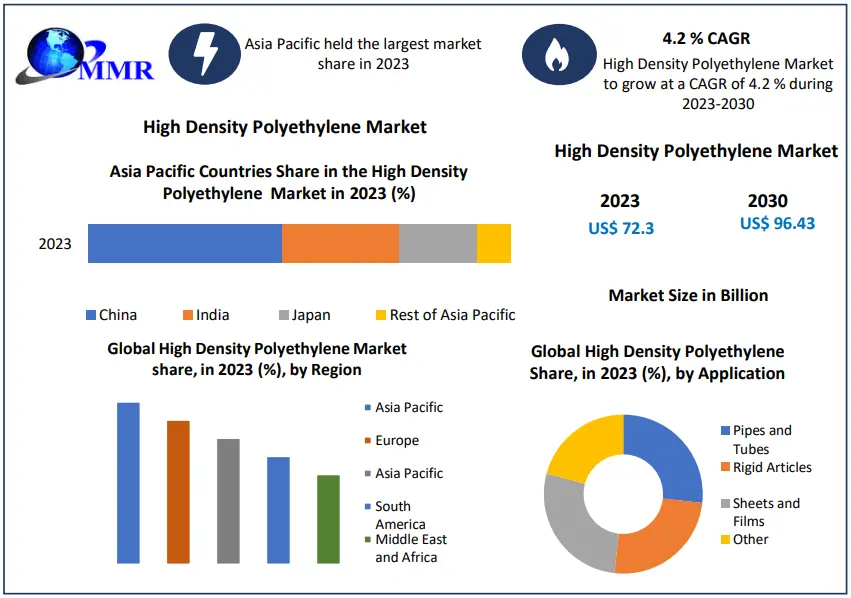
Global market valuation expanding from USD 72.3 billion in 2023 to USD 96.43 billion by 2030.
The industry operates under a 4.2 percent compound annual growth rate across the seven-year forecast window.
Packaging applications command the dominant market share among all downstream end-user industries.
Recycled high density polyethylene represents the fastest-growing market opportunity due to strict sustainability mandates.
Asia Pacific maintains regional market dominance fueled by rapid industrialization in China and India.
Feedstock volatility tied to crude oil prices creates significant margin pressures for global polymer producers.
Why This Matters Now Volatile petrochemical feedstocks and tightening environmental regulations are destabilizing historical polymer margins, forcing chemical executives to re-engineer their production strategies immediately. Industrial buyers face rapid procurement cost shifts as crude oil fluctuations directly alter the pricing structures of virgin thermoplastic resins. Meanwhile, mandatory corporate sustainability targets are causing structural shortages in the recycled polymer supply chain. Companies that fail to secure stable, high-quality recycled feedstock lines risk losing access to premium downstream consumer goods packaging accounts.
Market Overview The global high density polyethylene market reached a valuation of USD 72.3 billion in 2023 and is on track to achieve USD 96.43 billion by 2030. This trajectory represents a steady 4.2 percent compound annual growth rate over the forecast timeline. High density polyethylene remains an essential material in the global plastics economy because of its versatile performance profile. The polymer delivers an exceptional strength-to-density ratio, robust chemical resistance, and high durability across diverse industrial settings.
Downstream consumption continues to expand across packaging, construction, consumer goods, automotive, and agricultural sectors. In the infrastructure arena, the material is replacing traditional piping and geomembranes due to its long-term corrosion resistance and lightweight handling advantages. However, fluctuating crude oil prices create persistent operational risks for manufacturers. Because virgin production relies directly on petroleum feedstocks, geopolitical tensions and supply imbalances immediately pressure corporate profit margins.
Key Trends Driving Growth Accelerating demand in the global packaging sector remains the primary engine driving high density polyethylene volume growth. The material provides excellent barrier protection against moisture, light, and chemical contamination, making it critical for the food, beverage, and pharmaceutical industries. Rigid containers for milk, juices, water, and specialized medicines require strict material integrity that alternative polymers struggle to replicate at scale. This persistent industrial need ensures a stable baseline of consumption regardless of short-term macroeconomic cycles.
Concurrently, the circular economy is transforming from a voluntary corporate goal into a strict regulatory requirement. Governments worldwide are enforcing strict plastic waste reduction targets and mandatory recycling initiatives. This legislative shift has created a massive market opportunity for high-quality recycled resins, which consume less energy and generate fewer greenhouse gas emissions during production than virgin materials. Polymer manufacturers are responding by investing heavily in advanced mechanical and chemical recycling processing lines to satisfy consumer packaging brands.
Segment Insights
Dominant End-User Industry: Packaging applications held the largest share of the global market in 2023. This performance is sustained by the food, beverage, pharmaceutical, and household product sectors requiring high-performance barrier bottles, caps, and protective containers.
Fastest-Growing Segment: Recycled high density polyethylene represents the fastest-growing market segment. Industrial adoption is accelerating rapidly due to rising environmental awareness, strict regulatory penalties for single-use plastics, and shifting consumer preferences toward certified sustainable materials.
Regional Growth Story The Asia Pacific region dominated the global high density polyethylene market in 2023 and maintains its position as the primary hub of production capacity and demand. Rapid industrialization and accelerating urbanization across China and India drive large-scale consumption in infrastructure, packaging, and automotive manufacturing. The region benefits from strong domestic availability of essential feedstocks like ethylene, which provides a competitive cost foundation for local petrochemical facilities. Favorable government infrastructure spending and rising disposable incomes further accelerate regional volume absorption.
North America and Europe are focusing heavily on technical innovation and sustainable circular supply chains. The United States remains a highly competitive manufacturing base due to integrated ethane cracker capacities that hedge against crude oil volatility. In Germany and wider European manufacturing hubs, strict carbon reduction policies are reshaping industrial demand, favoring producers that can supply high-purity recycled grades. These mature markets are shifting investments toward specialty polymer formulations to protect their market share against standard commodity imports.
Competitive Landscape The global high density polyethylene market features a highly competitive structure led by entrenched multi-national chemical organizations. Market leaders such as ExxonMobil, Dow Chemical Company, and Chevron Phillips Chemical Company dominate primary production capacity and control significant distribution networks. These entities leverage integrated upstream assets to optimize raw material costs and sustain high capacity utilization rates during periods of pricing volatility.
To protect their long-term pricing power and navigate intensifying sustainability mandates, these top-tier producers are shifting their strategic focus toward advanced product development. The competitive dynamic is moving away from basic commodity volume competition toward high-performance specialty resins. Companies are dedicating substantial capital to research and development to engineer polymers that offer superior dimensional stability and impact strength while using less material.
Recent Developments
In July 2022, ExxonMobil launched ExxonMobil HMA706, an advanced high density polyethylene grade engineered to deliver high dimensional stability and excellent impact strength.
Petrochemical manufacturers are expanding their industrial partnerships with regional waste management companies to secure long-term access to post-consumer polymer streams.
Global producers are executing targeted capital investments to upgrade existing asset portfolios, enabling legacy production lines to process post-consumer recycled content seamlessly.
Strategic Implications The introduction of high-performance resins like ExxonMobil’s HMA706 signals a critical shift toward value-added product differentiation in the global chemical landscape. By optimizing dimensional stability and impact resistance, producers allow downstream converters to down-gauge products, reducing overall material consumption without sacrificing structural performance. This technical advancement directly alters market structure, raising the entry barriers for smaller commodity players who lack the capital to fund advanced polymer research.
Furthermore, these specialized product rollouts enhance manufacturer pricing power by shielding premium portfolios from the volatile margins of the standard commodity resin market. As downstream buyers face tightening regulatory penalties regarding packaging waste, they are willing to pay a premium for advanced resins that support circular design goals. Consequently, future capacity investments will increasingly favor flexible assets that can quickly pivot between virgin production and recycled material compounding.
Future Outlook The global high density polyethylene market will increasingly polarize into two distinct competitive battlegrounds: asset-heavy commodity scale in low-cost feedstock hubs and high-margin specialty resin engineering in tightly regulated consumer markets. Winners will be defined by their ability to secure resilient, low-carbon feedstock positions while simultaneously scaling high-purity recycled polymer portfolios to satisfy strict corporate sustainability mandates.
Analyst Perspective “The global high density polyethylene market is undergoing a structural transition where performance innovation and circular supply security are replacing simple volume growth as the primary measures of long-term commercial success,” stated Ankita Kagawade, Research Analyst at Maximize Market Research.