
Key Highlights
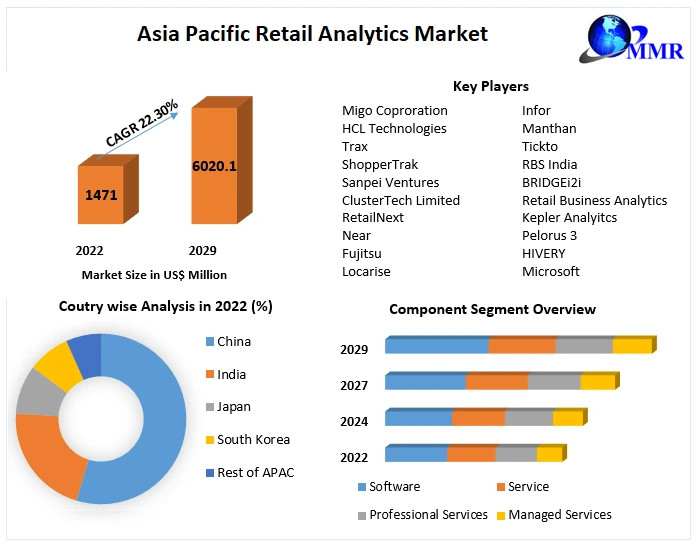
Market scale rising to reach US$ 6020.17 million by 2029.
Regional market revenue compounding at a documented 22.30% CAGR.
Widespread cloud migration across merchant platforms speeds up automated real-time sales reporting.
Big data integration across regional telecom nodes drives targeted local mobile advertising models.
Major enterprise software modernization platforms help brands optimize omni-channel customer experiences.
Why This Matters Now Fierce margin pressures and changing consumer shopping patterns across geographic centers are forcing major commercial enterprises to overhaul legacy inventory setups. Chief information officers, enterprise technology buyers, and cloud providers face immediate revenue losses if they continue to rely on manual demand modeling frameworks. The rapid integration of cloud-native data processing systems enables retail networks to consolidate disconnected point-of-sale data streams into a single source of truth. This technological change allows regional management groups to protect their localized operating margins while responding instantly to unpredictable macro-demand shifts.
Furthermore, the extensive deployment of next-generation connectivity and high-speed mobile networks across developing zones creates huge amounts of consumer behavior records. Corporate technology leaders use this information to deploy advanced predictive customer experience tracking applications that run directly on automated platform networks. Transitioning to subscription-based SaaS business models gives technology strategists immediate scaling advantages, removing expensive localized server upkeep liabilities. For institutional investors and technology developers, investing capital in these flexible analytical platforms provides the baseline security needed to protect asset values against supply disruptions. Ultimately, building out robust data frameworks serves as the primary mechanism for establishing platform economic dominance across highly competitive consumer markets.
Market Overview Asia Pacific Retail Analytics Market Size Expanding consumer preferences for immediate product availability and seamless purchasing channels are prompting merchant organizations to invest heavily in automated retail analytics infrastructure. The Asia Pacific retail analytics market is expanding at a compound annual growth rate (CAGR) of 22.30% during the forecast period, positioning the total regional revenue to reach US$ 6020.17 million by 2029. This large deployment of corporate capital indicates an industrial shift toward automated decision-making platforms, where historical sales metrics connect with predictive algorithms to eliminate structural delivery friction.
What changed across the regional business footprint is the structural removal of isolated operational systems that separate supply chain data from real-time customer transactions. Why now? The rapid rollout of localized 5G infrastructure, paired with heavy data center investments across major technology hubs, provides the continuous processing power needed to evaluate complex target demographics instantly. This deep network virtualization benefits large enterprise hypermarkets, online digital platforms, and distributed convenience networks by raising total store productivity. Who benefits immediately are the agile multi-site retail operators who can leverage automated predictive software to prevent stockouts while optimizing their localized supply chain logistics. What happens next is a broader push toward complete autonomous operations, where self-monitoring inventory control networks issue replenishment orders directly to supplier networks without manual intervention.
Key Trends Driving Growth Escalating physical real estate maintenance expenses and the widespread optimization of hybrid cloud strategies are driving corporate technology buyers to install centralized analytics applications over legacy software tools. To capture growing customer segments, systems developers are embedding advanced machine learning capabilities directly into active multi-tenant application suites. This tactical transition allows store management teams to analyze real-time consumer traffic patterns, standardize logistics tracking, and execute automated store performance reviews across multiple territories.
Simultaneously, the high adoption rate of personal mobile devices and the availability of affordable high-bandwidth internet connectivity have redefined consumer shopping dynamics. Merchant firms are exploiting these changing behavioral trends by deploying highly automated cloud platforms that continuously match specific user demographics with customized brand messaging. By identifying purchasing friction points before they trigger customer defection, these intelligent systems increase average transactional value while protecting critical data properties through advanced cybersecurity resilience protocols. Additionally, the ongoing construction of global edge computing nodes allows cloud providers to deliver rich analytical dashboards directly to local store terminals without experiencing network latency or performance lag.
Segment Insights
Dominant Segment: Retail analytics software platforms secure the leading position within the core technology segment. This primary deployment footprint expands because large corporate retail organizations require comprehensive data orchestration systems that integrate multiple inventory layers into unified dashboards without structural delay.
Fastest-Growing Segment: Cloud-delivered predictive analytics services represent the fastest-expanding model across the application landscape. This rapid adoption occurs because modern decentralized merchants require immediate customer management tracking, optimized merchandising insights, and automated supply chain routing tools to handle shifting market conditions.
Regional Growth Story The Asia Pacific marketplace exhibits the most rapid technological modernization across the global landscape, sustained by extensive telecom infrastructure expansion and deep digital transformation initiatives. Within this expanding geographical footprint, China stands as a primary engine of market development, driven by massive investments in nationwide data center networks and automated digital commerce systems. Widespread mobile application integration among Chinese consumers creates deep pools of transaction data, allowing local enterprise technology buyers to run complex customer experience transformation campaigns.
Concurrently, India represents a major high-growth zone within the regional market architecture, supported by rapid corporate cloud adoption and intense network modernization initiatives. The continuous proliferation of affordable mobile connectivity and government-backed digital payment frameworks across India has accelerated the buildout of advanced supermarket digital infrastructure. Similarly, established technology centers like Japan and South Korea are focusing heavily on advanced machine learning deployment to optimize their highly compressed urban logistics chains. These major East Asian markets leverage edge computing retail platforms and network virtualization to manage high-density retail distribution centers smoothly.
Competitive Landscape The competitive structure of the Asia Pacific retail analytics market features prominent technology specialists and enterprise software giants, alongside major global providers including Microsoft Corporation, Oracle Corporation, Salesforce, Inc., SAS Institute Inc., QlikTech International AB, MicroStrategy Incorporated, Field Agent Inc, and clickworker GmbH. The ongoing strategic deployments of these leading market participants signal a clear industry transition away from simple descriptive reporting tools toward comprehensive predictive platform ecosystems. Technical leadership is no longer judged solely on baseline software functionalities, but on a vendor’s capacity to deliver flexible API ecosystems that connect seamlessly with external supply chain databases.
Market dominance and corporate pricing power are increasingly tied to a provider’s capability to offer secure hybrid cloud hosting options alongside long-term predictive data management subscriptions. Dominant market participants are leveraging their massive global cloud frameworks to establish high technological barriers, leaving smaller regional software vendors to focus on highly specialized niche applications. As international enterprise software demands continue to consolidate, providers offering standardized global software frameworks paired with certified regional data sovereignty architectures are winning key corporate accounts from legacy IT providers.
Recent Developments
Global enterprise software creators have increased the deployment of predictive customer management modules to automate targeted promotional distributions across multi-channel retail setups.
Advanced platform providers have expanded native integration between local point-of-sale systems and centralized cloud data layers to minimize operational synchronization lag.
Technology vendors have launched localized edge computing analytics tools engineered to track consumer store movement patterns patterns without violating updated regional privacy regulations.
Strategic Implications For chief technology officers, corporate strategists, and institutional investors, the exponential scaling of the Asia Pacific retail analytics market dictates an immediate upgrade of corporate data pipelines. Relying on legacy, disconnected internal databases introduces severe transaction friction, undermining digital transformation investments and eroding overall operational productivity. Corporate leaders must view retail analytics deployment as a mandatory requirement for executing scalable multi-site enterprise modernization strategies.
Allocating substantial capital toward integrated cloud software allows modern enterprises to build highly responsive, self-correcting business models that reduce technical debt while stabilizing long-term inventory management expenses. Furthermore, investors evaluating the digital infrastructure space must thoroughly analyze the data processing capabilities of target corporations, as future financial returns depend entirely on executing high-volume cloud migrations smoothly across highly distributed physical ecosystems.
Future Outlook The global trajectory of the retail software market will be defined by the absolute integration of physical storefront automated nodes with highly scalable, cloud-hosted platform networks. As multi-site corporate business models require continuous asset oversight and real-time process optimization, software operations will shift toward intelligent, self-monitoring ecosystems that execute workflow adjustments autonomously.
The divide between future corporate market participants will be absolute: digital leaders will exploit highly automated, cloud-linked analytics platforms to achieve unmatched transaction velocity and superior resource efficiency, while digital laggards will suffer from escalating operational expenses, technical data blindness, and prohibitive maintenance costs associated with legacy legacy architectures.
Analyst Perspective “The convergence of heavy digital transformation requirements and real-time data needs is forcing a wholesale reconfiguration of corporate software deployment models,” states Yash Ghosalkar, Research Analyst at Maximize Market Research. “Enterprise value is migrating rapidly away from traditional on-premise systems toward automated, platform-wide cloud networks that process transaction, inventory, and collaboration data instantly at the global edge.”
About Maximize Market Research
Maximize Market Research Pvt. Ltd. (MMR) is a global market research and consulting company that provides reliable, data-focused, and practical business insights. The firm serves a wide range of industries, including healthcare, pharmaceuticals, technology, automotive, electronics, chemicals, personal care, and consumer goods. Through market forecasts, competitive analysis, strategic consulting, and industry impact assessments, MMR helps organizations understand changing market conditions, identify growth opportunities, and make informed business decisions for long-term success.
2nd Floor, Navale IT Park Phase 3
Pune Banglore Highway, Narhe
Pune, Maharashtra 411041, India
+91 9607365656
[email protected]