
- Market Overview
- Changing Consumer Preferences Fuel Market Expansion
- Key Growth Drivers of the Food Subscription Market
- Challenges Affecting Market Growth
- Technology Trends Transforming the Food Subscription Industry
- Sustainability and Environmental Impact
- Regional Analysis
- Competitive Landscape
- Future Outlook
- Media Contact
Market Overview
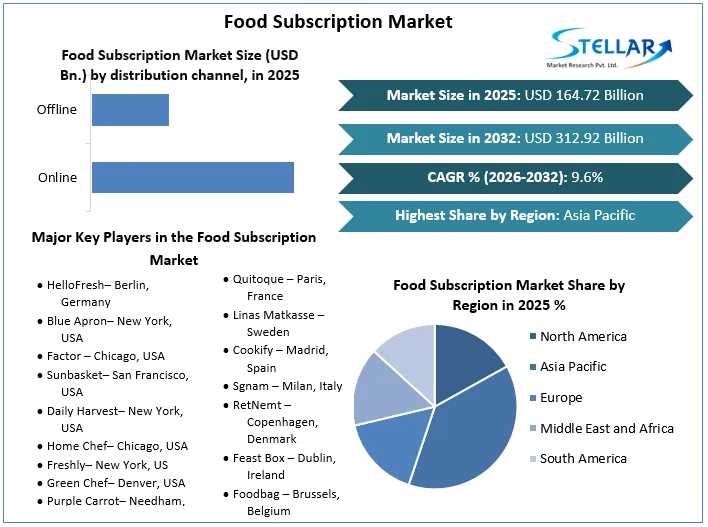
Food Subscription Market was valued at USD 164.72 Bn. in 2025 and the revenue is expected to grow by 9.6% CAGR from 2026 to 2032
The global Food Subscription Market is experiencing rapid transformation as consumers increasingly seek convenient, personalized, and technology-enabled food solutions. Food subscription services provide customers with recurring deliveries of meals, ingredients, snacks, beverages, and specialty food products based on their preferences and lifestyle needs. The growing adoption of digital platforms, changing eating habits, and rising demand for convenient meal solutions are creating strong growth opportunities for businesses operating in this sector.
Food subscription models have evolved beyond simple meal deliveries. Today, companies are offering personalized nutrition plans, ready-to-cook ingredient kits, organic food packages, diet-specific meals, and premium culinary experiences. These services appeal to busy professionals, health-conscious consumers, families, and individuals seeking affordable alternatives to traditional food purchasing methods.
The increasing penetration of smartphones, growth of e-commerce, improved logistics networks, and rising consumer interest in customized food experiences are major factors supporting the expansion of the Food Subscription Market. Companies are leveraging technology, data analytics, and automation to improve customer engagement and create long-term subscription relationships.
Download Free PDF Brochure: https://www.stellarmr.com/report/req_sample/Food-Subscription-Market/2634
Changing Consumer Preferences Fuel Market Expansion
Consumer behavior has significantly changed in recent years, with convenience becoming a major factor influencing food purchasing decisions. Urban lifestyles, longer working hours, and increasing demand for time-saving solutions have encouraged consumers to adopt subscription-based food services.
Meal kit subscriptions, ready-to-eat meal plans, and specialty food subscriptions allow consumers to access high-quality products without spending significant time on shopping and meal preparation. This convenience factor has made food subscriptions particularly popular among younger consumers and working professionals.
Health and wellness trends are also influencing market growth. Consumers are increasingly interested in nutrition-focused food options, including high-protein meals, organic products, plant-based foods, and personalized dietary solutions. Subscription companies are responding by offering customized plans designed around specific health goals and dietary preferences.
Key Growth Drivers of the Food Subscription Market
Increasing Demand for Convenience-Based Food Solutions
The rising need for convenient meal options is one of the strongest drivers of the food subscription industry. Consumers are looking for solutions that reduce preparation time while maintaining food quality and variety.
Meal subscription services provide pre-portioned ingredients, chef-designed recipes, and ready-to-consume meals, making them attractive to consumers with busy schedules. The growth of urban populations and increasing disposable incomes are further supporting demand for these services.
Food subscription platforms also provide flexibility through customizable plans, allowing users to modify delivery frequency, food preferences, and subscription options according to their needs.
Growth of E-Commerce and Digital Food Platforms
The expansion of online food platforms has created a favorable environment for subscription-based food businesses. Digital ordering systems, mobile applications, and online payment solutions have made it easier for consumers to access recurring food services.
Companies are using artificial intelligence and data analytics to understand customer preferences, recommend products, and improve retention rates. Personalized recommendations based on previous purchases, dietary preferences, and consumption patterns are helping businesses enhance customer experiences.
The integration of technology into food delivery operations is also improving inventory management, demand forecasting, and supply chain efficiency.
Rising Interest in Personalized Nutrition
Personalized nutrition is becoming an important trend within the food subscription industry. Consumers are moving away from generic food choices and seeking products that align with their health objectives and lifestyle requirements.
Subscription providers are introducing customized meal plans based on factors such as calorie requirements, fitness goals, allergies, and dietary restrictions. This trend is creating opportunities for companies to combine food services with nutrition technology and health-focused solutions.
The increasing awareness of preventive healthcare and healthy eating habits is expected to further support demand for personalized food subscriptions.
Challenges Affecting Market Growth
Despite strong growth prospects, the Food Subscription Market faces several challenges. Customer retention remains a major concern, as consumers may cancel subscriptions due to changing preferences, pricing concerns, or delivery issues.
Maintaining consistent product quality and freshness is another challenge, particularly for companies dealing with perishable food products. Efficient supply chain management and reliable delivery networks are essential for ensuring customer satisfaction.
High competition within the online food sector is also creating pressure on companies to differentiate their offerings. Businesses must continuously innovate through unique products, improved services, and competitive pricing strategies.
Technology Trends Transforming the Food Subscription Industry
Technology is playing a central role in reshaping food subscription services. Artificial intelligence and machine learning are being used to analyze customer behavior, optimize recommendations, and improve operational efficiency.
Mobile applications have become essential tools for subscription management, allowing users to select products, customize plans, track deliveries, and manage payments easily.
Automation is also improving food production and logistics processes. Advanced inventory management systems help companies reduce food waste, improve forecasting accuracy, and manage supply chains more effectively.
Smart packaging technologies and temperature-monitoring solutions are gaining importance, particularly for companies delivering fresh and temperature-sensitive products. These innovations help maintain food safety and product quality throughout the delivery process.
Sustainability and Environmental Impact
Sustainability has become a major focus area within the Food Subscription Market. Consumers are increasingly concerned about environmental impact, packaging waste, and responsible sourcing practices.
Food subscription companies are adopting eco-friendly packaging materials, reducing plastic usage, and implementing sustainable delivery methods. Many businesses are also focusing on locally sourced ingredients and transparent supply chains to attract environmentally conscious customers.
Meal kit services can contribute to reducing food waste by providing accurately measured ingredients based on planned consumption. This approach helps minimize excess food compared with traditional grocery purchasing methods.
Companies that prioritize sustainability are expected to gain stronger customer loyalty as environmental awareness continues to influence purchasing decisions.
Regional Analysis
North America represents a significant market for food subscription services due to high digital adoption, strong e-commerce infrastructure, and increasing consumer demand for convenient meal solutions. The United States has witnessed strong growth in meal kit services, ready-to-eat meal subscriptions, and specialty food platforms.
Europe is another important region, supported by growing interest in healthy eating, sustainable food practices, and premium food experiences. Countries such as the United Kingdom, Germany, and France are witnessing increased adoption of subscription-based food models.
Asia Pacific is emerging as a high-growth region due to rising internet penetration, expanding middle-class populations, and changing consumer lifestyles. Countries such as China, India, Japan, and South Korea are experiencing increased demand for online food services and personalized meal solutions.
The growth of digital payment systems, improved logistics networks, and increasing urbanization is expected to create significant opportunities across emerging markets.
Competitive Landscape
The Food Subscription Market includes a combination of established food delivery companies, meal kit providers, specialty food brands, and technology-driven startups. Companies are focusing on product diversification, partnerships, customer personalization, and digital innovation to strengthen their market positions.
Leading businesses are expanding their offerings by introducing health-focused meals, premium products, flexible subscription models, and sustainable packaging solutions. Strategic collaborations with nutrition experts, food producers, and logistics providers are also becoming common strategies.
Companies that successfully combine convenience, personalization, quality, and sustainability are expected to achieve stronger growth in the competitive landscape.
Download Free PDF Brochure: https://www.stellarmr.com/report/req_sample/Food-Subscription-Market/2634
Future Outlook
The future of the Food Subscription Market will be shaped by digital innovation, personalized nutrition, and evolving consumer expectations. As customers continue prioritizing convenience, health, and sustainability, subscription-based food services are expected to become an increasingly important part of the global food industry.
Artificial intelligence, automation, and advanced analytics will continue improving personalization and operational efficiency. Companies that develop flexible subscription models, sustainable practices, and customer-focused experiences will be better positioned for long-term success.
With continued growth in e-commerce adoption and changing food consumption patterns, the Food Subscription Market is expected to expand significantly, creating new opportunities for businesses, investors, and consumers worldwide.
Media Contact
Stellar Market Research
Website: Stellar Market Research – Global Research Reports & Consulting
Email: [email protected]