
Key Highlights
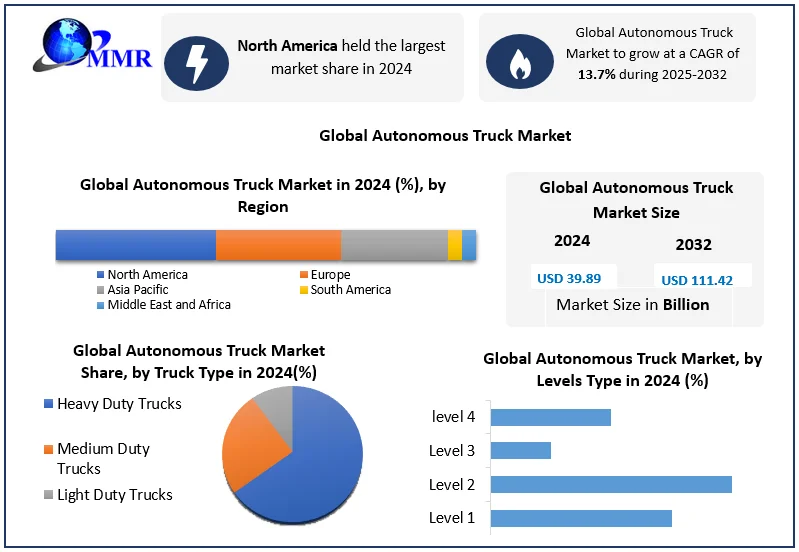
Market Scale: The market was valued at USD 39.89 billion in 2024 and is forecast to reach USD 111.42 billion by 2032.
Growth Velocity: The industry is expanding at a robust CAGR of 13.7% between 2025 and 2032.
Dominant Segment: Heavy-Duty Trucks are the primary focus, representing the most compelling ROI for long-haul freight automation.
Technological Bedrock: LiDAR sensors currently dominate the sensor landscape with a 50% market share as of 2024, providing the precision necessary for high-speed highway operation.
Strategic Driver: The global shortage of approximately 80,000 drivers in the U.S. alone has made autonomous trucking the only sustainable path to long-term logistics resilience.
Why This Matters Now
The trucking industry is facing a dual crisis: a chronic, worsening shortage of human operators and an unrelenting demand for faster, 24/7 delivery cycles. Autonomous trucking is no longer a futuristic concept—it is a strategic necessity. By enabling continuous operations and mitigating the impact of mandatory rest hours, autonomous systems are transforming the economics of freight from a labor-constrained model to one defined by asset utilization and throughput.
Market Overview
Valued at USD 39.89 billion in 2024, The Autonomous Truck Market is undergoing a fundamental shift from experimental pilots to commercial-grade deployment. The industry is moving beyond basic driver-assist features toward SAE Level 4 autonomy, where trucks can navigate defined highway corridors without human intervention. This shift is being driven by heavy investments from both legacy OEMs and AI-focused startups, all competing to capture the efficiency gains inherent in autonomous long-haul logistics.
Key Trends Driving Growth
The convergence of AI, deep learning, and advanced sensor fusion is the primary engine of market acceleration. Real-time monitoring and predictive maintenance, powered by vehicle-to-everything (V2X) connectivity, are slashing downtime—the silent killer of logistics profitability. Furthermore, the industry is seeing a tactical shift toward “hub-to-hub” autonomous models, which simplify the operational design domain (ODD) by focusing on highway segments where the navigation is predictable and safety metrics are easiest to validate.
Segment Insights
Dominant Segment: Heavy-Duty Trucks (Class 8). These vehicles account for the bulk of autonomous investment. Because they dominate long-haul ton-miles, the cost savings from reduced labor and increased uptime are most immediate and substantial here.
Fastest-Growing Segment: Level 4 Autonomous Systems. While Level 1 and 2 features are currently ubiquitous, the commercial launch of driver-out capability is the fastest-growing frontier, signaling a transition from “driver-assist” to “driver-replacement” for specific freight corridors.
Regional Growth Story
North America leads the global landscape, holding roughly 40% of the market share. A combination of mature telematics, progressive regulatory frameworks, and a critical need for driverless solutions has made it the primary testing ground for the world’s leading autonomous software firms. While Asia-Pacific is rising rapidly due to massive government-backed investments in smart city and autonomous infrastructure, North America remains the leader in the operational “proof of concept” that is now scaling to global markets.
Competitive Landscape
The market is characterized by a “platform-first” approach. Players like Aurora Innovation, PACCAR Inc., and Navistar International are no longer competing in isolation; they are forging deep partnerships to integrate autonomous stacks into production-ready chassis. Aurora Innovation’s successful “driver-out” shipments for FedEx on the Dallas-to-Houston corridor signal a watershed moment: the technology is now performing at commercial speeds and reliability standards.
This environment favors firms that can demonstrate “software-as-a-service” scalability. Legacy OEMs who can successfully partner with specialized AI firms—as seen with Volvo’s investment in Waabi—are positioning themselves to dominate. The market is shifting away from simple manufacturing prowess toward a model of “intelligent platform delivery,” where the truck is viewed as a high-compute data center that happens to carry freight.
Recent Developments
June 2025: Aurora Innovation completed its first commercial, driver-out freight shipment, confirming that Level 4 technology is ready for real-world interstate operations.
Strategic Investment: Major OEMs like PACCAR and Navistar are aggressively integrating high-compute platforms, signaling that “software-defined” hardware is now the baseline requirement for all new heavy-duty vehicle designs.
Strategic Implications
For freight operators and investors, the “cost-versus-reliability” calculation is nearing an inflection point. While the upfront investment in LiDAR-dense, AI-enabled trucks is significant, the projected USD 4.75 billion in annual freight cost savings by 2032 makes this an essential strategic move. The bottleneck is no longer technology readiness, but regulatory alignment and fleet integration. Fleet operators that begin pilot programs today will establish the data pipelines and operational expertise required to dominate the “driverless” corridors of the late 2020s.
Future Outlook
The next decade of trucking will be defined by the “driver-out” corridor—a hyper-efficient network of interstate lanes where automated trucks operate with near-zero downtime. The divide in the industry will widen between those who invest in autonomous integration now and those who continue to rely solely on human-operated, labor-intensive legacy models. Future market leaders will be the companies that successfully treat autonomous trucking not as an add-on feature, but as the core operating system of their entire supply chain, relegating human-led transport to specialized, highly localized, or high-complexity niches.
Analyst Perspective
“We are witnessing the transformation of the heavy-duty truck from a mechanical asset into a data-driven, autonomous logistics platform,” says Tejaswini Kakade, Analyst at Maximize Market Research. “The transition from Level 2 driver assistance to true Level 4 autonomy is not just a technological step forward—it is the solution to the most pressing operational bottleneck in the global supply chain.”
About Maximize Market Research
Maximize Market Research Pvt. Ltd. (MMR) is a global market research and consulting company that provides reliable, data-focused, and practical business insights. The firm serves a wide range of industries, including healthcare, pharmaceuticals, technology, automotive, electronics, chemicals, personal care, and consumer goods. Through market forecasts, competitive analysis, strategic consulting, and industry impact assessments, MMR helps organizations understand changing market conditions, identify growth opportunities, and make informed business decisions for long-term success.
2nd Floor, Navale IT Park Phase 3
Pune Banglore Highway, Narhe
Pune, Maharashtra 411041, India
+91 9607365656
[email protected]