
Key Highlights
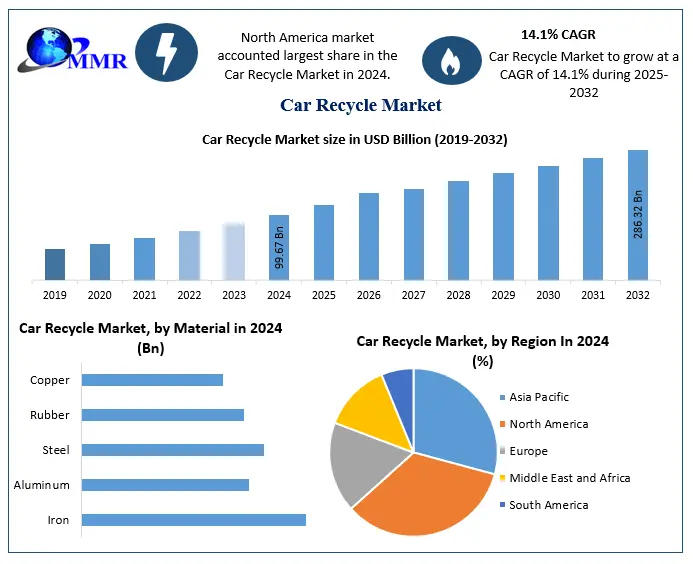
The Car Recycle Market was valued at USD 99.67 billion in 2024, confirming ELVs as a major revenue and materials pool rather than a compliance afterthought.
Market revenue is expected to reach nearly USD 286.32 billion by 2032, at a CAGR of 14.1% from 2025 to 2032, signaling rapid professionalization and consolidation of vehicle recycling supply chains.
Rising volumes of end‑of‑life vehicles (ELVs) are pushing recyclers to move from manual dismantling to technology‑intensive sorting, boosting demand for advanced equipment and data‑driven yard operations.
Europe today dominates vehicle recycling thanks to stringent ELV regulations and mature infrastructure, shaping global standards for recovery rates and producer responsibility.
Asia‑Pacific is the fastest‑growing region, powered by expanding vehicle fleets in China, India, and other markets, turning ELV management into a strategic industrial policy priority.
Why This Matters Now
Car recycling is shifting from waste management to a core pillar of automotive profitability and resource security. With the market expected to grow from USD 99.67 billion in 2024 to nearly USD 286.32 billion by 2032, access to ELV flows now directly affects steel, aluminum, and component cost curves for OEMs and suppliers.
At the same time, EV scaling, emissions rules, and circular economy mandates mean regulators are transferring more lifecycle responsibility back onto manufacturers. OEMs that lack clear end‑of‑life strategies risk higher compliance costs, weaker materials bargaining power, and growing scrutiny from investors and customers on sustainability metrics.
Market Overview
The global Car Recycle Market size of USD 99.67 billion in 2024 places vehicle end‑of‑life alongside core upstream segments such as steelmaking and primary metals in economic relevance. The forecast CAGR of 14.1% through 2032 positions car recycling among the faster‑growing parts of the broader automotive value chain, driven by rising ELV volumes and tighter regulation.
Recycling value creation comes from four main streams: ferrous and non‑ferrous metals recovery, usable parts harvesting, plastics and other materials processing, and data‑enabled optimization of scrap flows. As EV penetration increases, high‑value components such as batteries, power electronics, and rare‑earth‑bearing parts will add new revenue layers, but also new complexity and risk, to recycling operations.
Key Trends Driving Growth
Regulation is the primary accelerator. Stringent environmental rules and circular economy mandates are forcing higher ELV collection and recycling rates, especially in Europe and other mature markets. Extended producer responsibility policies are making OEMs accountable for vehicles across their lifecycle, stimulating demand for traceable, efficient, and compliant recycling partners.
Second, the global vehicle parc continues to expand, and the first large waves of aging vehicles from rapid motorization years are now hitting end‑of‑life, generating a predictable and growing scrap pipeline. This volume is encouraging investment in automated dismantling, advanced shredders, and sensor‑based sorting to increase metal recovery and reduce landfill.
Third, manufacturers and metal producers face resource scarcity and price volatility for steel, aluminum, and critical materials. High‑quality recycled feedstock improves cost stability and reduces Scope 3 emissions, making secure access to ELVs a strategic hedge for both OEMs and Tier‑1s.
Request a Free Sample Copy or View Report Summary https://www.maximizemarketresearch.com/request-sample/52805/
Segment Insights
Dominant Segment — Metals Recovery
Steel and ferrous metals, followed by aluminum and other non‑ferrous materials, remain the primary value drivers in car recycling, forming the bulk of revenue from ELVs.
For OEMs and steelmakers, this segment determines the availability of recycled input for low‑carbon steel and lightweight aluminum parts, directly influencing decarbonization roadmaps and cost structures.
Fastest‑Growing Segment — Advanced ELV Processing and Circular Solutions
Investments are rising in high‑tech shredding, sensor‑based sorting, and process innovations that recover more metals, specialized plastics, and complex components from each vehicle.
These capabilities will be critical for processing EVs and software‑rich vehicles where disassembly and material streams are far more complex than traditional ICE cars.
Other Critical Segments
Parts reuse and remanufacturing are gaining traction as repair markets seek lower‑cost, lower‑carbon alternatives to new components, reshaping aftermarket economics.
Emerging focus on EV battery recycling and power electronics recovery is creating a specialized niche where chemistry expertise, safety protocols, and partnerships with OEMs become decisive.
Regional Growth Story
Europe currently dominates the global car recycling landscape, with a strong regulatory framework mandating high recovery rates, advanced facilities, and a long history of industrial recycling. This dominance shapes global technology benchmarks and provides a template for producer responsibility and circularity schemes elsewhere.
Asia‑Pacific, led by China, India, and Japan, is the fastest‑growing regional market. Rapid vehicle ownership growth, urbanization, and tightening environmental policies are pushing governments to formalize ELV flows and invest in modern dismantling and processing. China in particular is moving from fragmented, low‑tech operations to automated facilities supported by circular economy initiatives, attracting capital and technology alliances.
North America and other mature markets are also scaling recycling capacity as fleets age, EV adoption increases, and metal demand intensifies. For India, the rise of organized scrappage policies and industrial corridors offers opportunities to integrate modern car recycling into broader manufacturing and logistics ecosystems.
Competitive Landscape
Major recyclers and scrap processors are racing to expand geographic footprints, invest in advanced technologies, and secure long‑term access to ELV volumes. Their strategies—acquisitions, plant upgrades, and partnerships—signal a shift toward scale‑driven cost leadership and higher value‑added processing, rather than pure tonnage trading.
For OEMs, strategic partnerships with recyclers are becoming an avenue to guarantee stable access to recycled metals, support take‑back schemes, and pilot EV end‑of‑life solutions. This can strengthen negotiation leverage with primary metal suppliers and improve compliance and ESG scores.
Tier‑1 suppliers and material companies that move early into design‑for‑recycling, closed‑loop metals programs, and component take‑back will gain technology leadership and pricing resilience. The long‑term risk is clear: companies that stay outside emerging recycling ecosystems may face both higher input costs and regulatory penalties.
Recent Developments
Investments in new or upgraded shredding and sorting facilities to improve recovery yields and handle growing ELV volumes.
Expansion of regional operations by leading recyclers into high‑growth Asia‑Pacific markets through acquisitions and joint ventures.
Growing focus on EV battery and high‑voltage component recycling as early EV fleets approach end‑of‑life.
Policy moves toward stricter ELV regulations and producer responsibility in multiple regions, aligning recycling with national circular economy goals.
Increased collaboration between recyclers, steelmakers, and OEMs to develop closed‑loop supply chains for metals and key components.
Strategic Implications
For OEMs, car recycling is becoming a core strategic capability, not an outsourced afterthought. Reliable access to recycled metals, especially in a world of EV and lightweighting, supports cost control, decarbonization, and supply‑chain resilience. Designing vehicles with easier disassembly and higher material purity will directly impact end‑of‑life economics and brand ESG performance.
Tier‑1 suppliers must embed recyclability into product development and plan for component take‑back or remanufacturing models. This shift can protect share in an aftermarket increasingly influenced by circular solutions and regulatory pressure.
Recyclers and scrap processors need to move up the value chain by embracing automation, data analytics, and specialized EV capabilities. Those that secure strong relationships with OEMs, fleets, and insurers will sit at the center of future ELV flows, while pure commodity players risk margin compression.
Future Outlook
With the Car Recycle Market forecast to reach nearly USD 286.32 billion by 2032 at a 14.1% CAGR, capital will flow into modern plants, regional consolidation, and EV‑ready processing lines. Regulatory momentum around ELVs and circular economy goals is unlikely to reverse, making recycling an embedded part of automotive product and supply‑chain strategy.
As EV volumes rise, end‑of‑life management for batteries, power electronics, and high‑tech components will determine who controls the most valuable material streams. Future market leaders will be the OEMs, suppliers, and recyclers that treat end‑of‑life as a design requirement and a profit pool—laggards will find themselves paying more for inputs, scrambling for compliance, and watching competitors monetize the metals and components they chose to discard.
Related Reports
Global Bike and Scooter Rental Market https://www.maximizemarketresearch.com/market-report/global-bike-and-scooter-rental-market/75164/
Global Automotive Side Window Sunshades Market https://www.maximizemarketresearch.com/market-report/global-automotive-side-window-sunshades-market/93134/
Global Automotive Retreaded Tires Market https://www.maximizemarketresearch.com/market-report/global-automotive-retreaded-tires-market/69245/
Analyst Perspective
“The rapid growth of the Car Recycle Market shows that end‑of‑life vehicles are no longer a cost center but a strategic asset in an era of resource constraints and strict regulation,” said Tejaswini Kakade, Analyst at Maximize Market Research. “Players that integrate recycling into product design, sourcing, and EV strategy will not only lower risk but also unlock new revenue and differentiation across the automotive value chain.”
About Maximize Market Research
Maximize Market Research Pvt. Ltd. (MMR) is a global market research and consulting company that provides reliable, data-focused, and practical business insights. The firm serves a wide range of industries, including healthcare, pharmaceuticals, technology, automotive, electronics, chemicals, personal care, and consumer goods. Through market forecasts, competitive analysis, strategic consulting, and industry impact assessments, MMR helps organizations understand changing market conditions, identify growth opportunities, and make informed business decisions for long-term success.
2nd Floor, Navale IT Park Phase 3
Pune Banglore Highway, Narhe
Pune, Maharashtra 411041, India
+91 9607365656
[email protected]