
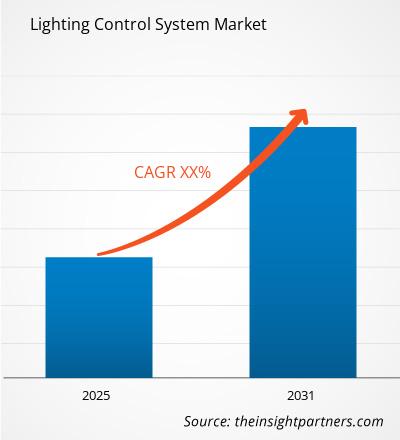
Modern lighting control systems enable users to manage illumination more efficiently through automated controls, connected devices, sensors, software, and communication technologies. These solutions support energy optimization, customized lighting experiences, remote management, and integration with smart buildings and homes. Increasing adoption of connected infrastructure and energy-efficient technologies is creating new opportunities for advanced lighting management solutions.
According to The Insight Partners, the Lighting Control System Market was valued at US$ 41.65 billion in 2025 and is projected to reach US$ 122.81 billion by 2034, registering a CAGR of 12.77% during 2026–2034. Increasing demand for smart lighting solutions, energy-efficient systems, connected buildings, and user-centric lighting experiences is expected to support market expansion.
Key Market Insights
- Market Size in 2025: US$ 41.65 Billion
- Projected Market Size by 2034: US$ 122.81 Billion
- CAGR (2026–2034): 12.77%
- Total Addressable Market (2026–2034): Approximately US$ 717.02 Billion
- Key Components: Hardware, Software, Services
- Key Communication Technologies: Wired, Wireless
- Key Applications: Residential, Commercial, Highways
- Forecast Period: 2026–2034
Get a Sample PDF of the Report: https://www.theinsightpartners.com/sample/TIPRE00010767
Smart Lighting Adoption Drives Growth
The growing adoption of smart lighting systems is a major factor supporting demand for lighting control technologies. Consumers, businesses, and infrastructure operators are increasingly seeking solutions that can automatically adjust lighting based on occupancy, time, ambient conditions, and user preferences.
Connected lighting systems can also integrate with broader building automation platforms, enabling centralized management of lighting alongside HVAC, security, energy monitoring, and other building functions. This integration is supporting the transition toward intelligent and connected buildings.
Energy Efficiency Supports Market Expansion
The increasing focus on energy efficiency is creating significant opportunities for lighting control solutions. Automated controls, occupancy sensors, daylight harvesting, and programmable lighting systems can help reduce unnecessary energy consumption by adjusting illumination according to actual requirements.
Commercial buildings, offices, retail facilities, and public infrastructure are increasingly adopting these technologies to improve operational efficiency and support sustainability objectives. Energy-efficient lighting management is also becoming increasingly relevant as organizations seek to control operating costs and meet environmental targets.
Connected Technologies Transform Lighting Management
Advancements in wireless communication and connected technologies are changing how lighting systems are installed and managed. Wireless solutions can simplify deployment in existing buildings by reducing the need for extensive cabling, while wired systems continue to support applications requiring reliable and centralized communication.
Software platforms and cloud connectivity are also enabling remote monitoring, scheduling, diagnostics, and performance analysis. These capabilities allow users and facility managers to gain greater visibility into lighting operations and optimize systems according to changing requirements.
Lighting Control System Market Segmentation
Based on component, the Lighting Control System Market is divided into Hardware, Software, and Services. Hardware includes lighting control devices, sensors, switches, and related components, while software supports system configuration, monitoring, automation, and analytics.
By communication, the market is categorized into Wired and Wireless. Wireless communication is gaining attention because of its installation flexibility and suitability for smart home and retrofit applications, while wired technologies remain important for large-scale and reliability-focused installations.
By application, the market includes Residential, Commercial, and Highways. Residential applications are supported by smart home adoption, while commercial applications benefit from energy management and building automation initiatives. Highway applications include intelligent roadway and outdoor lighting systems.
Get the Premium Research Report @ https://www.theinsightpartners.com/buy/TIPRE00010767
Regional Outlook
North America represents a significant regional opportunity, supported by increasing adoption of smart buildings, connected infrastructure, energy-efficient technologies, and advanced automation systems. The US remains a key market as residential and commercial users increasingly invest in intelligent lighting solutions.
Europe is supported by sustainability initiatives, energy-efficiency requirements, smart building development, and increasing deployment of connected infrastructure. Demand for automated lighting solutions is expected to remain strong as businesses and public infrastructure operators focus on energy management and operational efficiency.
Asia Pacific is expected to offer substantial growth opportunities due to rapid urbanization, expanding construction activity, smart city initiatives, and increasing adoption of connected technologies. China, Japan, India, South Korea, and other economies are investing in smart infrastructure and modern building systems.
South and Central America and the Middle East and Africa are also expected to witness increasing adoption as commercial construction, urban development, smart infrastructure, and energy-efficiency initiatives expand.
Competitive Landscape
Competition is increasingly focused on smart connectivity, energy efficiency, automation, interoperability, software integration, and user experience. Leading companies are developing lighting solutions that can integrate with smart homes, commercial buildings, industrial facilities, and connected infrastructure.
Key companies analyzed include:
- ACUITY BRANDS LIGHTING, INC
- Eaton
- Honeywell International Inc.
- Hubbell Incorporated
- Ideal Industries, Inc.
- Legrand
- Lutron Electronics Co., Inc.
- OSRAM GmbH
- Schneider Electric
- Signify Holding (Philips Lighting)
Future Outlook
The Lighting Control System Market is expected to maintain strong growth through 2034 as lighting becomes increasingly integrated with smart homes, intelligent buildings, connected infrastructure, and energy management platforms. The combination of sensors, wireless communication, automation, software, and data analytics is expected to create new opportunities across residential, commercial, and infrastructure applications.
Future adoption is likely to be supported by smart city development, energy-efficient building initiatives, connected home technologies, and demand for personalized lighting experiences. Companies that provide scalable, interoperable, energy-efficient, and easy-to-manage lighting control solutions are expected to strengthen their competitive position as users increasingly prioritize intelligent and sustainable lighting environments.
Related Market Research Reports
Law Enforcement Biometrics Market Size, Share & Growth by 2034
Touch Probe Market Trends, Share & Demand by 2034
Circular Push Pull Connectors Market Size, Trends & Demand by 2034
Silicon Photonics Market Growth, Size & Forecast by 2034
About The Partners
The Insight Partners is a Insight global leader in market research, delivering comprehensive analysis and actionable insights across diverse industries. The company empowers decision-makers with data-driven intelligence to navigate evolving markets and accelerate growth.
Contact Us:
- Contact Person: Ankit Mathur
- E-mail: [email protected]
- Phone: +1-646-491-9876
Also Available in :