
Key Highlights
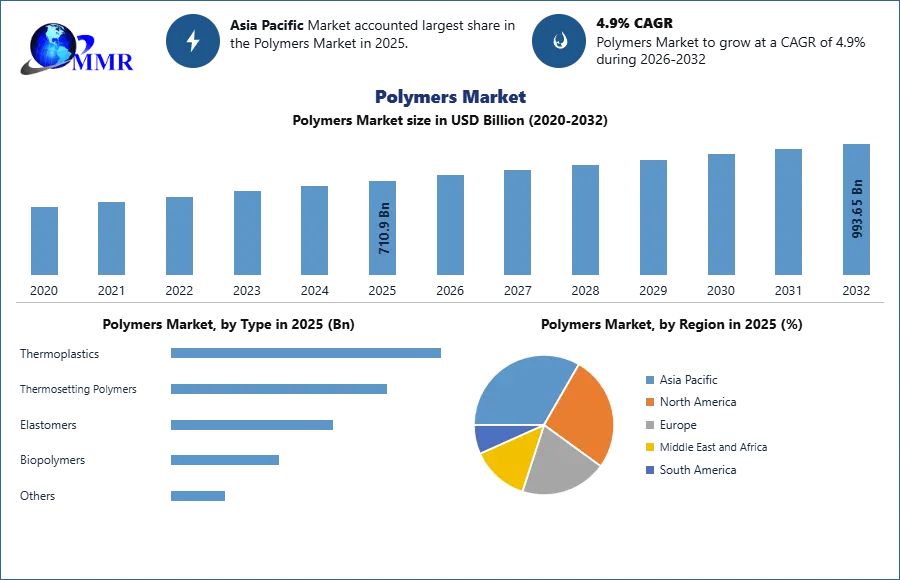
The global polymers market for cosmetic ingredients is projected to reach USD 993.65 billion by 2032, up from USD 710.9 billion in 2025, expanding at a 4.9% CAGR.
On March 18, 2026, BASF SE implemented a major price increase of up to 30% for its home care and industrial polymer portfolio in Europe to offset soaring logistics costs.
Synthetic polymers represent the largest structural market segment due to lower production costs, large-scale manufacturing uniformity, and extended shelf life.
Natural polymers have secured the position of second-largest market segment, driven by shifting consumer health awareness and multi-functional performance profiles.
The Asia-Pacific region represents the primary focus zone for international brands, driven by rising per capita disposable incomes and increasing foreign brand adoption across key hubs.
Why This Matters Now
Sudden, double-digit price hikes from Tier-1 chemical manufacturers are upending cost structures across the downstream personal care and cosmetic ingredient supply chains. When market leaders like BASF SE push a 30% price increase through an entire regional polymer portfolio, procurement budgets face immediate inflation risks that cannot easily be passed down to consumers. This pricing disruption forces industrial buyers to completely re-evaluate their contract frameworks and explore alternative localized suppliers to maintain margin stability. What changed is the baseline cost of logistical movement and regulatory compliance, which has removed historical margin buffers from specialty chemical formulations.
Why now? Tightening environmental regulations on synthetic inputs are converging with shifting consumer preferences, giving chemical companies narrow windows to transition their asset bases toward sustainable materials. This structural shift penalizes slow-moving operations that rely exclusively on legacy commodity plastics while creating substantial capital opportunities for companies that can deliver scalable, biodegradable functional polymers. Industrial buyers must adapt immediately or risk being locked out of key retail markets due to sudden ingredient bans or severe supply chain bottlenecks.
Market Overview
The global polymers market for cosmetic ingredients was valued at USD 710.9 billion in 2025 and is projected to reach USD 993.65 billion by 2032, expanding at a 4.9% CAGR. Advanced developments in nano-science and polymer material engineering have transformed these specialty chemicals into critical agents that directly dictate the shelf life, viscosity, and sensory performance of personal care products. Formulators utilize synthetic, organic, and natural polymers to expand the functional capacity of active ingredients, creating stable delivery systems across multi-phase consumer emulsions.
The industry relies on these macromolecules to serve as emulsifiers, foam stabilizers, anti-microbial agents, associative thickeners, hair fixatives, and rheology modifiers. The Food and Drug Administration (FDA) provides targeted regulatory approvals for specified polymer ingredients, validating their safety profile for long-term topical usage. However, the market faces clear headwinds, as growing consumer awareness regarding the potential long-term human health impacts of certain synthetic formulations restricts historical application pathways.
Key Trends Driving Growth
Rapid innovations in material engineering are driving new commercial avenues, allowing manufacturers to move beyond traditional thickeners into highly functional specialty matrices. For example, the emergence of advanced 3-D makeup printing technologies, such as the Mink 3D printer, utilizes specialized polymer matrices to synthesize customized color cosmetics on demand. This shift toward digital, automated formulation requires chemical suppliers to deliver highly uniform, precisely calibrated liquid polymer inputs that match advanced printing hardware specifications.
Concurrently, researchers are pioneering smart, responsive polymer networks, transforming simple ingredients into active, thermally responsive systems and complex star copolymers. These advanced materials provide controlled release of active nutrients, optimize skin adhesion, and form superior barriers against external environmental factors. Furthermore, the industry-wide focus on biodegradable alternatives acts as a major catalyst for co-development partnerships between polymer suppliers and cosmetic brands, helping to address growing microplastic pollution concerns.
Segment Insights
Synthetic Polymers (Dominant Product Segment): This category remains the primary volume and value driver in global cosmetic formulations due to distinct economic and processing advantages. Manufacturers prefer synthetic variants because they are significantly cheaper than natural alternatives, offer large-scale production uniformity, and guarantee an extended shelf life. The most common varieties found in modern cosmetics include acrylic acid-based polymers, polyacrylamides, silicones, polyvinyl pyrrolidone, polyacrylates, polyurethanes, and alkaline oxide-based copolymers.
Natural Polymers (Second-Largest Segment): Driven by escalating consumer health awareness and clean-label trends, this segment has established a strong second-place market position. Formulators extensively deploy natural hydrocolloids like xanthan, pectin, agar, carrageenan, and various polysaccharides as clean-label thickening agents to adjust viscosity.
Skincare and Sun Care (Dominant Application Segment): Large-scale consumer consumption of daily skincare lotions, protective creams, toiletries, and hair fixatives drives steady volume demand for polymer ingredients. These applications require high-purity polymers to preserve structural emulsion stability across variable storage temperatures.
Regional Growth Story
The Asia-Pacific region is the primary engine for new market volume and strategic capital investments. Key manufacturing and consumer hubs, including India, China, Malaysia, Vietnam, and South Korea, are experiencing significant expansions in their localized personal care ecosystems. A defining trend within these countries is that consumer adoption of foreign brands outpaces local regional brands, creating an entry point for multinational chemical corporations to establish dedicated regional supply chains.
Rising per capita disposable incomes and increasing wellness awareness across these Asian nations provide a clear commercial incentive for chemical suppliers to optimize local manufacturing assets. However, every regional production environment presents distinct challenges, requiring companies to carefully balance localized labor costs against the availability of advanced processing technologies. To optimize margins, major players are structuring specialized vendor networks in the Asia-Pacific zone to minimize long-distance trade friction and bypass European logistical bottlenecks.
Competitive Landscape
The global competitive landscape features a distinct divide between integrated Tier-1 multinational chemical companies and specialized regional suppliers. Twelve key players dictate global capacity allocations, leveraging advanced research and development budgets to build proprietary polymer technologies that protect their pricing power. These dominant market leaders focus on shifting their product portfolios away from low-margin commodity plastics and toward high-value, specialized functional ingredients that resist downward price pressures.
To capture long-term contracts, these companies are forming direct development partnerships with consumer brands, integrating their custom polymers into proprietary consumer formulations. This strategy builds high switching costs for downstream buyers, as changing an ingredient supplier requires expensive reformulation and new regulatory reviews. Meanwhile, mid-tier market followers are expanding their capacity for natural and biodegradable polymers to capture the rapid demand generated by changing environmental compliance frameworks.
Recent Developments
On 18 March 2026, BASF SE announced a significant price increase of up to 30% for its entire home care and industrial polymer portfolio within the European market.
The rapid commercial introduction of the Mink 3D printer has forced ingredient suppliers to scale up production of specialized, print-compatible color polymer matrices.
Leading polymer labs have accelerated the commercial scale-up of natural polysaccharides and starch derivatives to counter rising regulatory restrictions on traditional silicones.
Major chemical entities have relocated technical service centers to the Asia-Pacific region to provide faster, localized formulation support to high-growth cosmetic brands.
Strategic Implications
The aggressive 30% price hikes deployed by major suppliers in early 2026 demonstrate that relying on single-source, long-distance supply lines leaves downstream producers vulnerable to immediate margin erosion. Procurement leaders must re-engineer their raw material sourcing portfolios by qualifying local vendors and securing long-term volume commitments to insulate operations from volatile transport costs. What changed is that transport logistics and feedstocks are no longer predictable variables, making supply chain resilience a critical competitive advantage.
For manufacturers, the strategic priority must shift toward upgrading legacy batch reactors to handle both synthetic and natural polymer bases. As consumer sentiment moves toward eco-friendly products, companies reliant solely on acrylic acid derivatives face asset underutilization. Investing in flexible, multi-product manufacturing lines allows chemical companies to quickly pivot production schedules based on real-time regulatory shifts and localized ingredient availability.
Future Outlook
The future structure of the polymers market for cosmetic ingredients will be defined by how efficiently producers can scale natural, biodegradable polymers to match the performance and cost structures of traditional synthetics. While synthetic variants will maintain their dominance in value-oriented consumer lines due to their long shelf life and processing uniformity, regulatory restrictions will steadily restrict their usage in premium formulations. Chemical companies that successfully commercialize cost-effective, sustainable alternatives will capture a leading share of global market value, while unhedged producers face intensifying margin pressures and stricter environmental penalties.
Analyst Perspective
“The sudden cost inflation across European polymer portfolios is forcing a complete reassessment of downstream procurement frameworks,” said Ankita Kagawade, Research Analyst at Maximize Market Research. “To secure long-term profitability, forward-thinking chemical manufacturers are rapidly diversifying away from high-emission synthetic materials and scaling up high-performance, bio-based polymer alternatives that comply with emerging global sustainability benchmarks.”
About Maximize Market Research
Maximize Market Research Pvt. Ltd. (MMR) is a global market research and consulting company that provides reliable, data-focused, and practical business insights. The firm serves a wide range of industries, including healthcare, pharmaceuticals, technology, automotive, electronics, chemicals, personal care, and consumer goods. Through market forecasts, competitive analysis, strategic consulting, and industry impact assessments, MMR helps organizations understand changing market conditions, identify growth opportunities, and make informed business decisions for long-term success.
2nd Floor, Navale IT Park Phase 3
Pune Banglore Highway, Narhe
Pune, Maharashtra 411041, India
+91 9607365656
[email protected]