
Key Highlights
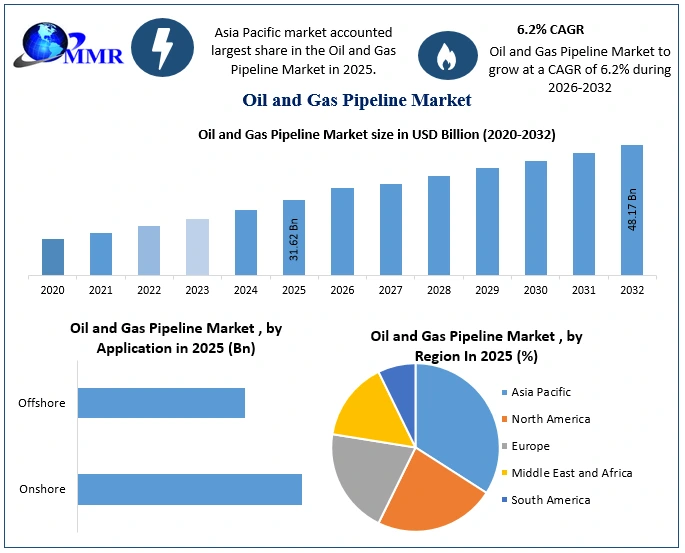
Global Market Scale and Valuation: The Global Oil and Gas Pipeline Market was valued at USD 31.62 Billion in 2025.
Forward Projection: Anticipated to scale to USD 48.17 Billion by 2032, expanding at a strong compound annual growth rate (CAGR) of 6.2%.
Fuel Segment Leader: The Natural Gas segment dominates the market by product type, propelled by environmental benefits, global LNG trade expansion, and transitioning power sectors.
Midstream Infrastructure Focus: The Midstream segment holds absolute sector dominance, serving as the essential logistical link connecting upstream exploration with downstream refining and distribution.
Primary Regional Locomotive: Asia Pacific maintains the leading market position, driven by soaring baseload demands, nationwide gas grid expansions, and massive underground installation pipelines across major developing economies.
Why This Matters Now
The financial viability of multi-billion-dollar midstream pipelines depends heavily on minimizing component degradation across a 25-to-30-year operational lifecycle. As extreme weather events increase and utility companies face tightening operational margins, standard legacy networks no longer provide sufficient insulation against early-stage asset failure. Power producers, infrastructure investors, and industrial energy users are realizing that marginal savings on upstream midstream materials can lead to catastrophic long-term yield losses or severe structural leakages. Upgrading pipeline integrity and digital monitoring strategies has shifted from a technical preference to a core risk-mitigation mandate for capital preservation in global energy portfolios.
Market Overview
The oil and gas pipeline market acts as a vital anchor for global industrialization and energy transition cycles. Midstream infrastructure involves transporting crude resources and refined products through extensive steel networks, shielding sensitive supply chains from environmental volatility and logistical constraints. Valued at USD 31.62 Billion in 2025, the market’s projected expansion to USD 48.17 Billion by 2032 highlights an intensive worldwide investment phase focused on establishing long-distance energy routes and stabilizing cross-border resource deliveries.
What changed is the baseline expectation for midstream asset performance. In previous investment cycles, simple physical transport was adequate for regional distribution networks. Today, the rapid installation of high-pressure, long-distance infrastructure requires pipeline configurations with superior tensile strength, advanced anti-corrosion chemistry, and integrated analytical monitoring. This evolution aligns closely with grid modernization initiatives and transmission upgrades, as regulators demand predictable, ultra-safe product injections into localized energy networks.
Key Trends Driving Growth
The core driver of the market is the global shift toward advanced asset monitoring technologies, specifically the integration of artificial intelligence (AI), data science, and cloud computing. These advanced architectures allow midstream operators to process real-time structural metrics, introducing predictive, prescriptive, and cognitive analytics that mitigate vulnerability to corrosion or damage before field failures occur.
Another primary catalyst is the exponential growth of natural gas networks across major consumption hubs like China, India, and European corridors restructuring their energy supply lines. As an effective transitional fuel with lower carbon emissions than coal, natural gas demands continuous pipeline system expansion. This structural shift requires specialized transmission networks to transport massive volumes directly to stationary power generation engines, industrial complexes, and municipal export terminals.
Furthermore, energy security initiatives and strategic infrastructure commitments are driving massive utility investments into offshore environments, including deepwater and ultra-deepwater exploration zones. These harsh geographies expose transport hardware to severe pressure variations, thermal cycling, and high salt corrosive environments. The immediate business implication is a stricter screening process by independent engineers and underwriters, who now mandate smart, high-integrity pipeline solutions before approving project financing.
Segment Insights
Natural Gas Pipelines [Dominant Segment]: This type commands the largest share of historical volume due to rising demand for clean energy alternatives, booming cross-border LNG export trades, and expanding city gas distribution systems. Its dominance makes it the baseline priority for public-private utility partnerships looking to reduce aggregate emissions.
Midstream Sector [Dominant Segment]: This vertical leads global market share by industry sector. Representing the physical backbone of transmission networks, midstream investment dominates because connecting remote extraction sites to central processing plants and end markets requires thousands of kilometers of newly certified, heavy-gauge steel infrastructure.
Regional Growth Story
Asia Pacific continues to dictate the raw volume dynamics of the oil and gas pipeline market, driven by massive manufacturing capacity and aggressive infrastructural build-outs. China’s unparalleled industrial scaling and India’s domestic energy connectivity targets—such as expanding cross-country national gas grids up to tens of thousands of kilometers—are creating massive, centralized demand hubs for heavy steel pipe extruders and engineering developers.
In North America and Europe, the market is increasingly shaped by regulatory influences, energy security priorities, and asset modernizations. The North American market is experiencing steady expansion through offshore Gulf exploration connectivity and domestic oilfield updates. In Europe, recent geopolitical realignments have forced urgent redesigns of transmission paths, accelerating investments into new liquid natural gas (LNG) regasification linkages and pipeline safety upgrades to guarantee stable baseload performance across aging infrastructure.
Competitive Landscape
The competitive architecture of the oil and gas pipeline industry signals a distinct shift toward vertical integration and advanced engineering expertise. Leading international pipeline developers and material extruders are expanding their localized engineering structures to align with shifting project pipelines. This industrial activity indicates that low-tier manufacturers will face severe margin compression as utility-scale developers consolidate their procurement with tier-one vendors capable of offering multi-year supply guarantees and smart diagnostic integration.
Furthermore, technology leadership is becoming the primary battleground for cost competitiveness. Companies that control the upstream supply of specialized anti-corrosion coatings and inline diagnostic tools (like smart pigs) are gaining significant leverage over pure-play construction contractors. This dynamic forces a structural evolution where long-term strategic partnerships between polymer scientists, metallurgical engineers, and midstream operators are necessary to secure project pipelines and insulate against volatile commodity pricing trends.
Recent Developments
AI-Enabled Predictive Diagnostics Integrated (2026): Midstream operators globally roll out cloud-integrated AI diagnostic platforms across major pipelines, embedding real-time predictive analytics to systematically eliminate localized pressure drops and early-stage structural stress.
Large-Scale Indian Pipeline Networks Expanded (2026): Public energy corporations in India scale active operations to expand national pipeline grids toward a 21,000 km threshold, aiming to elevate domestic throughput capacities to over 100 million tonnes per annum.
Offshore E&P Infrastructure Investments Surge (Late 2025): International engineering consortiums announce major funding allocations directed at deepwater extraction networks, directly driving market volumes for high-pressure subsea offshore pipelines.
Global LNG Supply Route Realignments Executed (2025): Geopolitical developments reshape regional logistics, driving massive construction surges for European and Asian natural gas pipeline networks to connect to new coastal LNG import installations.
Strategic Implications
For utility executives and asset owners, the strategic implications of pipeline deployment choices are tied directly to the levelized cost of transport and financial risk management. Utilizing suboptimal materials or manual monitoring solutions raises the risk of premature cracking, weld delamination, or environmental contamination, which reduces throughput and drops power output. This degradation impairs the asset’s cash flow generation, directly hurting infrastructure investors and power sector decision-makers who modeled their returns on stable asset performance.
For component manufacturers, material selection dictates access to high-value markets. As major energy developers implement stringent procurement checklists, manufacturers using uncertified or legacy structural blends will find themselves excluded from major utility-scale project pipelines. Investing in high-performance, high-strength steels and smart automated diagnostic interfaces is therefore a mandatory commercial strategy to preserve global market access and brand equity.
Future Outlook
The trajectory of the oil and gas pipeline market will be defined by its ability to keep pace with rapid digital grid innovations and escalating high-voltage energy demands. As the energy transition accelerates toward higher-density networks and complex processing dynamics, transport pipelines will evolve into multi-functional protective systems rather than simple physical channels. Future market integration will favor advanced metallurgical formulations and internal sensor layouts that actively enhance product flow monitoring while providing absolute environmental isolation under escalating climate volatility. Ultimately, the market will split along clear lines of operational resilience: future market leaders will secure dominant market shares through advanced material technology and vertically integrated digital supply chains, while laggards relying on commoditized, low-spec materials will be marginalized as obsolete components in a high-efficiency grid ecosystem.
Analyst Perspective
“The oil and gas pipeline market is no longer a simple discussion about raw material costs; it has transformed into a critical conversation about long-term asset survival and structural risk mitigation,” states an Analyst at Maximize Market Research. “As power producers and midstream operators aggressively transition to high-capacity networks and expand installations into extreme offshore environments, high-performance automated pipeline systems represent the primary defense line protecting billions of dollars in global energy infrastructure investments.”
About Maximize Market Research
Maximize Market Research is a high-growth market research and business consulting firm serving global clients with deeply quantified institutional insights across high-technology supply chains, energy systems, and advanced materials. For an exhaustive breakdown of localized data, structural segment forecasts, and granular competitive intelligence, the complete official study can be accessed via the verified source report: Oil and Gas Pipeline Market.
2nd Floor, Navale IT Park Phase 3
Pune Bangalore Highway, Narhe
Pune, Maharashtra 411041, India
+91 9607365656