
Shortening Market: Innovation, Health-Conscious Formulations, and Sustainable Sourcing Drive Industry Growth
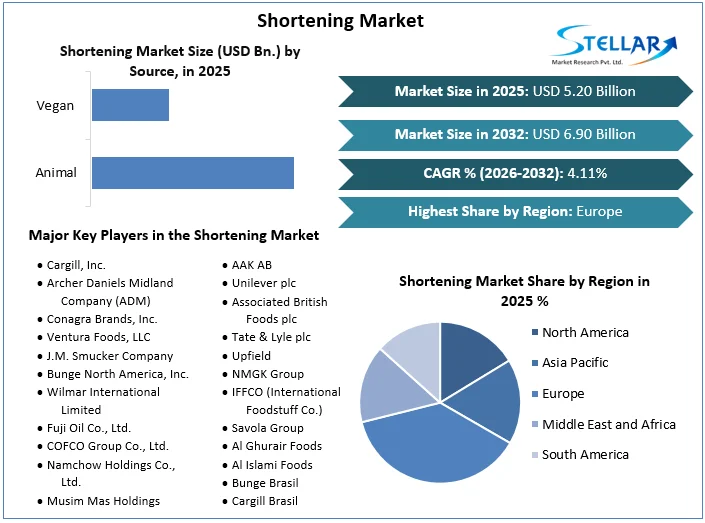
Shortening Market was valued at USD 5.20 Bn in 2025, and the total revenue is expected to grow at a CAGR of 4.11% from 2026 to 2032, reaching nearly 6.90 Bn by 2032.
The Shortening Market is undergoing a significant transformation as food manufacturers respond to changing consumer preferences, evolving regulatory standards, and growing demand for healthier bakery ingredients. Traditionally used to improve the texture, stability, and shelf life of baked goods, shortenings remain an essential ingredient in commercial baking, confectionery, processed foods, and foodservice applications. Today, the industry is shifting beyond conventional formulations toward trans-fat-free, plant-based, and sustainably sourced alternatives that align with modern dietary trends.
The increasing popularity of packaged bakery products, ready-to-eat foods, and premium confectionery is creating new opportunities for shortening manufacturers worldwide. As consumers seek products that combine taste, quality, and nutritional value, food companies are investing in innovative shortening solutions that deliver excellent functionality while supporting clean-label and healthier product formulations.
Download Free PDF Brochure: https://www.stellarmr.com/report/req_sample/shortening-market/2674
- Rising Demand from the Global Bakery Industry
- Health-Conscious Consumers Are Reshaping Product Development
- Technological Innovation Enhances Manufacturing Efficiency
- Sustainability Becomes a Strategic Priority
- Expanding Applications Beyond Traditional Baking
- Regional Market Outlook
- Competitive Landscape
- Emerging Trends Shaping the Future
- Future Outlook
- Media Contact
Rising Demand from the Global Bakery Industry
The bakery sector remains the largest consumer of shortening products, accounting for a significant share of global demand. Bread, cakes, pastries, biscuits, cookies, donuts, and laminated dough products rely on shortening to improve softness, flakiness, moisture retention, and overall product consistency.
Urbanization, busy lifestyles, and changing eating habits have increased demand for packaged bakery products that offer convenience without compromising taste. Commercial bakeries are also expanding production capacity to meet growing consumer demand, further driving the need for high-performance bakery shortenings.
The rapid growth of quick-service restaurants, cafés, and food delivery services has strengthened demand for bakery ingredients capable of supporting consistent product quality in high-volume production environments.
Health-Conscious Consumers Are Reshaping Product Development
Consumer awareness regarding nutrition has significantly influenced the shortening industry. Regulatory restrictions on partially hydrogenated oils and trans fats have encouraged manufacturers to develop healthier alternatives using vegetable oils, palm oil blends, sunflower oil, canola oil, and other plant-based ingredients.
Food manufacturers are increasingly introducing trans-fat-free, low-saturated-fat, and non-hydrogenated shortenings to meet changing consumer expectations. Clean-label products featuring recognizable ingredients and minimal processing are becoming increasingly attractive to both commercial food producers and retail consumers.
The growing popularity of vegan and plant-based diets has further accelerated innovation, encouraging ingredient suppliers to develop shortenings that deliver superior baking performance while supporting sustainable and ethical food production.
Technological Innovation Enhances Manufacturing Efficiency
Advancements in food processing technologies have enabled manufacturers to produce shortening products with improved functionality, longer shelf life, and enhanced stability. Modern interesterification techniques are replacing traditional hydrogenation processes, allowing manufacturers to achieve desired fat structures without generating harmful trans fats.
Automation throughout production facilities has improved quality control, consistency, and operational efficiency. Digital monitoring systems enable manufacturers to optimize production parameters while reducing waste and improving energy efficiency.
Research and development activities continue to focus on improving heat stability, oxidation resistance, texture enhancement, and ingredient compatibility for a wide range of bakery and food processing applications.
Sustainability Becomes a Strategic Priority
Sustainability has become one of the defining trends influencing the global shortening industry. Consumers and food manufacturers increasingly prefer responsibly sourced vegetable oils that minimize environmental impact while supporting ethical agricultural practices.
Many companies are investing in certified sustainable palm oil, reducing greenhouse gas emissions, improving water management, and adopting recyclable packaging materials. Environmental, Social, and Governance (ESG) initiatives are becoming central to long-term corporate strategies as manufacturers seek to strengthen brand reputation and comply with evolving sustainability regulations.
Circular economy practices, including waste reduction and resource-efficient manufacturing, are also gaining importance across the food ingredient industry.
Expanding Applications Beyond Traditional Baking
Although bakery products remain the primary application, shortening is finding increasing use across several food categories. Manufacturers utilize specialized shortenings in confectionery products, frozen desserts, ready-to-eat meals, snack foods, and processed foods requiring improved texture and stability.
The growing popularity of frozen bakery products has further increased demand for shortenings capable of maintaining product quality throughout freezing, storage, transportation, and reheating. Foodservice operators also rely on shortening for frying applications due to its thermal stability and consistent cooking performance.
These expanding applications are helping manufacturers diversify product portfolios while reducing dependence on traditional bakery markets.
Regional Market Outlook
North America continues to represent a mature and technologically advanced shortening market, supported by a strong commercial baking industry and widespread demand for packaged convenience foods. Consumer preference for healthier ingredients is encouraging continuous innovation throughout the region.
Europe remains an important market driven by strict food safety regulations, premium bakery consumption, and increasing adoption of sustainable food production practices. Manufacturers are focusing on clean-label formulations and reducing saturated fat content to comply with evolving regulatory standards.
The Asia-Pacific region is expected to record the fastest market growth over the coming years. Rapid urbanization, rising disposable incomes, westernization of dietary habits, and expanding bakery industries across China, India, Japan, and Southeast Asia continue to stimulate demand for shortening products.
Emerging economies in Latin America and the Middle East & Africa are also witnessing increased consumption of processed foods and bakery products, creating additional opportunities for ingredient manufacturers.
Competitive Landscape
The Shortening Market remains highly competitive, with global ingredient suppliers and regional manufacturers investing heavily in product innovation, production capacity expansion, and sustainable sourcing initiatives.
Key industry participants include:
- AAK AB
- Unilever plc
- Associated British Foods plc
- Tate & Lyle plc
- IFFCO (International Foodstuff Co.)
- Savola Group
- Al Ghurair Foods
Download Free PDF Brochure: https://www.stellarmr.com/report/req_sample/shortening-market/2674
Emerging Trends Shaping the Future
Several important trends are expected to influence the future development of the Shortening Market:
Rising demand for trans-fat-free shortening formulations
Growing adoption of plant-based and vegan bakery ingredients
Expansion of premium and artisanal bakery products
Increased investment in sustainable palm oil sourcing
Automation and digital quality control in food manufacturing
Clean-label product innovation
Growth of frozen bakery and ready-to-eat food segments
Development of customized shortening solutions for commercial food processors
These trends demonstrate how innovation and sustainability are becoming central to future market growth.
Future Outlook
The global Shortening Market is expected to maintain steady growth as manufacturers continue to balance product performance with evolving consumer health expectations. Continuous advances in food processing technology, ingredient science, and sustainable sourcing practices will support the development of next-generation shortening products capable of meeting increasingly complex industry requirements.
Growing investments in bakery production, expanding demand for convenience foods, and rising popularity of clean-label ingredients will create new opportunities across developed and emerging markets. Companies that prioritize innovation, regulatory compliance, operational efficiency, and sustainability will be well positioned to strengthen their market presence in the years ahead.
As consumer preferences continue to evolve, shortening manufacturers will play an increasingly important role in helping the global food industry deliver high-quality bakery and processed food products that combine excellent taste, functionality, nutritional value, and environmental responsibility.
If you’d like, I can also produce an SEO version of this blog with a meta title, meta description, FAQ section, schema-ready headings, and focus keywords for better search engine performance.
Media Contact
Stellar Market Research
Website: http://stellarmr.com/
Email: [email protected]