
Key Highlights
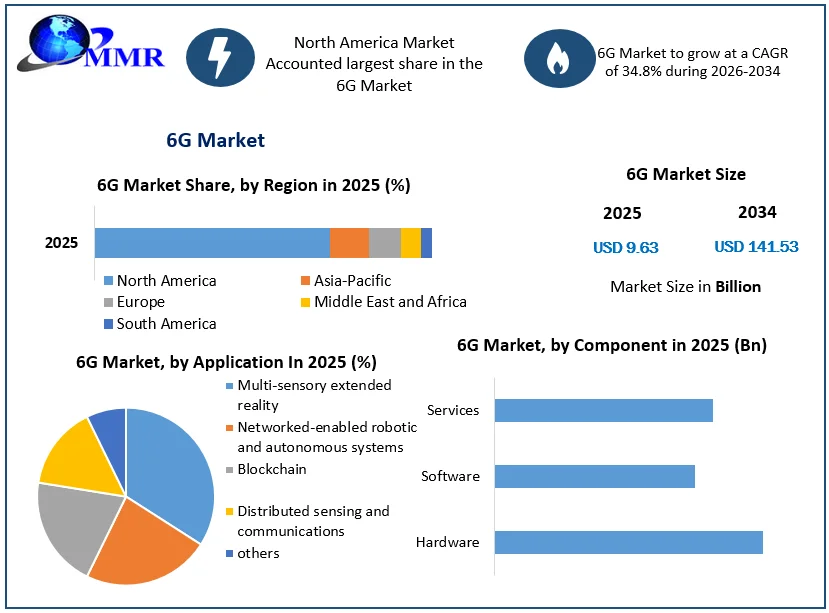
- 6G is moving from research agenda to strategic infrastructure race as telecom operators, AI hardware companies and network vendors compete to define the next wireless architecture. The 6G Market was valued at USD 9.63 Bn in 2025 and is expected to reach nearly USD 141.53 Bn by 2034, creating a major opportunity for AI-RAN platforms, network infrastructure vendors, device makers and telecom operators.
- The 6G market is forecast to grow at a 34.8% CAGR from 2026 to 2034, signaling an unusually fast transition cycle for next-generation connectivity and network intelligence.
- 6G is expected to support data-heavy applications such as augmented reality, autonomous vehicles, IoT, remote surgery, industrial automation and vehicular communication, making latency and capacity core business requirements.
- AI and edge computing are central to the architecture, with 6G expected to enable intelligent decision-making at the network edge and AI-driven network optimization.
- The public page does not disclose a dominant segment or fastest-growing segment by component, application, device or end user, so no segment-level leadership is inferred.
Why This Matters Now
6G is becoming the next control layer for AI, autonomous systems, immersive media and machine-to-machine communication. Network speed alone will not define the market; the winning architecture will combine ultra-low latency, AI automation, edge processing, terahertz spectrum and intelligent beamforming.
The shift matters because 5G-era networks were built for broadband and mobile scale, while 6G is being designed for trillions of connected devices and real-time responsiveness. That changes network procurement, spectrum policy, chip design, edge infrastructure and operator monetization.
Market Overview
6G market is the next generation of wireless connectivity after 5G, built around faster data rates, higher capacity, ultra-low latency and deeper integration with AI, IoT and edge computing. The 6G market includes hardware, software and services, with applications across multisensory extended reality, network-enabled robotic and autonomous systems, blockchain, distributed sensing and communications, and other use cases.
Deployment devices include smartphones, tablets, wearables, IoT devices and others, while end users include consumer connectivity and experience, healthcare, government, smart cities and public services, and industrial sectors. That structure positions 6G as a full digital infrastructure market rather than only a telecom upgrade.
The public page contains a header inconsistency: the top panel lists USD 9.63 Bn as forecast market size, while the overview and scope table state USD 9.63 Bn in 2025 and USD 141.53 Bn by 2034. This article uses the overview and scope-table figures because they match the supplied market-size statement.
Key Trends Driving Growth
Unprecedented data demand is the first growth driver. AR, VR, ultra-HD streaming and IoT are creating pressure for networks that can deliver faster data rates and seamless real-time experiences.
AI-native networking is the second driver. 6G is expected to integrate AI and edge computing into its architecture, enabling decision-making closer to users and devices while reducing latency and improving network responsiveness.
Terahertz communication is a third technology shift. 6G is expected to use higher frequency bands, including THz frequencies, which provide bandwidth for ultra-high data rates but require advances in materials, components and signal processing.
Network modernization will depend on advanced antennas. Massive MIMO and intelligent adaptive beamforming are expected to support focused and efficient communication in complex environments, giving equipment vendors a new performance battleground.
The main risks are engineering complexity, spectrum regulation, infrastructure investment, standardization, energy consumption, cybersecurity, privacy and workforce skills. These barriers make 6G a policy, standards and capital-allocation challenge as much as a telecom technology shift.
Start Your Market Research Journey with a Free Sample Report
Segment Insights
- Dominant Segment: The public MMR page does not identify a dominant component, application, deployment-device or end-user segment by share. No segment dominance is inferred.
- Fastest-Growing Segment: The page does not disclose usable segment-level CAGRs for hardware, software, services, devices, applications or end users. No fastest-growing segment is inferred.
- Application Signal Networked Robotic and Autonomous Systems: 6G’s ultra-low latency and high reliability are expected to support industrial automation, robotics, autonomous vehicles and smart factories.
- End-User Signal Healthcare: Remote medical imaging, telemedicine, remote patient monitoring and remote surgery are identified as healthcare opportunities that can benefit from 6G’s low-latency communication.
- Device Scope IoT Devices: IoT devices are included in the deployment-device scope, and 6G is expected to connect trillions of devices across smart cities, wearables, industrial sensors and autonomous systems.
Regional Growth Story
North America is cited in the FAQ as the region expected to hold the highest share. The region benefits from a strong technology ecosystem, innovation-driven companies, research institutions, supportive regulatory activity and U.S. leadership through companies such as Qualcomm and Intel.
The United States is also central to spectrum policy because Federal Communications Commission decisions are expected to influence spectrum allocation and 6G network expansion. That makes regulation a direct factor in network readiness and competitive timing.
Asia Pacific is also highlighted as expected to hold the largest share within the forecast-period narrative, creating a visible inconsistency with the FAQ. China, Japan and South Korea are identified as powerhouses for 6G research and development, with Huawei, Samsung, LG, NTT DOCOMO and NEC cited as active participants.
Europe is positioned around Ericsson, Nokia, research institutions, Horizon Europe, cross-border consortiums and regulatory influence on spectrum, data privacy and network security. That gives Europe a standards and governance role in the 6G ecosystem.
Competitive Landscape
Key players include Nokia, Samsung Electronics, Huawei, Ericsson, Qualcomm, ZTE, NTT DOCOMO, Intel, LG Electronics, SK Telecom, Apple, Cisco, Sony, Xiaomi, AT&T, Verizon, Siemens, IBM, Toshiba and NEC. The field spans telecom infrastructure, semiconductors, devices, operators, industrial technology and enterprise computing.
Huawei is using its 5G experience to push 6G research and development, while Samsung is positioning 6G around AI, virtual reality and IoT advancement. Nokia and Ericsson are competing on network infrastructure, standards, mission-critical applications, sustainability and efficiency.
NVIDIA’s partnership activity signals a new competitive layer: AI compute inside radio access networks. The shift from hardware-defined networks to software-defined, AI-native networks could change pricing power toward vendors that control accelerated computing, RAN software and edge AI services.
Recent Developments
- 28 October 2025 NVIDIA and Nokia: The companies established a strategic partnership to embed the 6G-ready NVIDIA Aerial RAN Computer platform into Nokia’s infrastructure portfolio, enabling operators to transition from 5G-Advanced to software-defined 6G networks while hosting edge AI services on commercial sites.
- 11 December 2025 Samsung Electronics: Samsung partnered with KT Corporation to validate user-level AI-based RAN optimization in a live commercial network, marking progress toward intelligence-led 6G architectures and automated signal management.
- 20 February 2026 Samsung, KT and Keysight: The companies verified X-MIMO technology using the 7 GHz frequency band, proving feasibility for ultra-high-speed data transmission and enhanced reliability.
- 22 February 2026 Ericsson: Ericsson conducted a live pre-standard 6G OTA wireless field trial in Texas, demonstrating capacity for AI-driven robotics control and high-density video streaming.
- 01 March 2026 NVIDIA: NVIDIA mobilized telecom leaders including Cisco, Ericsson, Nokia and SoftBank to build open, secure and AI-native 6G platforms, signaling cross-vendor alignment against software fragmentation.
Strategic Implications
For telecom operators, 6G will test capital discipline and architecture choices. New base stations, antennas, backhaul networks and upgrades to existing 5G or 4G infrastructure will require substantial investment.
For cloud and AI infrastructure providers, edge computing becomes the commercial bridge into telecom. If AI services run directly on commercial network sites, operators can move beyond connectivity and support low-latency enterprise workloads.
For policymakers, 6G readiness depends on spectrum allocation, standards coordination, privacy rules, cybersecurity controls and energy-efficient deployment. Fragmented standards or incompatible regional approaches could limit global scale.
Future Outlook
The 6G Market is forecast to grow from USD 9.63 Bn in 2025 to nearly USD 141.53 Bn by 2034 at a 34.8% CAGR. Growth will come from AI-RAN, terahertz communication, edge computing, IoT, autonomous systems, smart cities, remote healthcare, industrial automation, distributed sensing and software-defined networks.
The next phase will decide whether 6G becomes a fragmented research race or a standardized AI-native network platform. Future digital leaders will control the edge-intelligent connectivity layer behind automation, robotics and immersive services; laggards will remain trapped in 5G-era economics while competitors turn 6G into programmable infrastructure advantage.
Analyst Perspective
“6G is becoming a strategic technology race as telecom operators, AI infrastructure providers and network equipment vendors prepare for ultra-low-latency, AI-native and edge-enabled connectivity,” said Yash Ghosalkar, Analyst at Maximize Market Research. “The strongest players will combine spectrum strategy, AI-RAN capability, edge computing, standards participation, cybersecurity readiness and scalable network infrastructure.”
About Maximize Market Research
Maximize Market Research Pvt. Ltd. (MMR) is a global market research and consulting company that provides reliable, data-focused, and practical business insights. The firm serves a wide range of industries, including healthcare, pharmaceuticals, technology, automotive, electronics, chemicals, personal care, and consumer goods. Through market forecasts, competitive analysis, strategic consulting, and industry impact assessments, MMR helps organizations understand changing market conditions, identify growth opportunities, and make informed business decisions for long-term success.
Contact Us
2nd Floor, Navale IT Park Phase 3
Pune Banglore Highway, Narhe
Pune, Maharashtra 411041, India
+91 9607365656
[email protected]