
Key Highlights
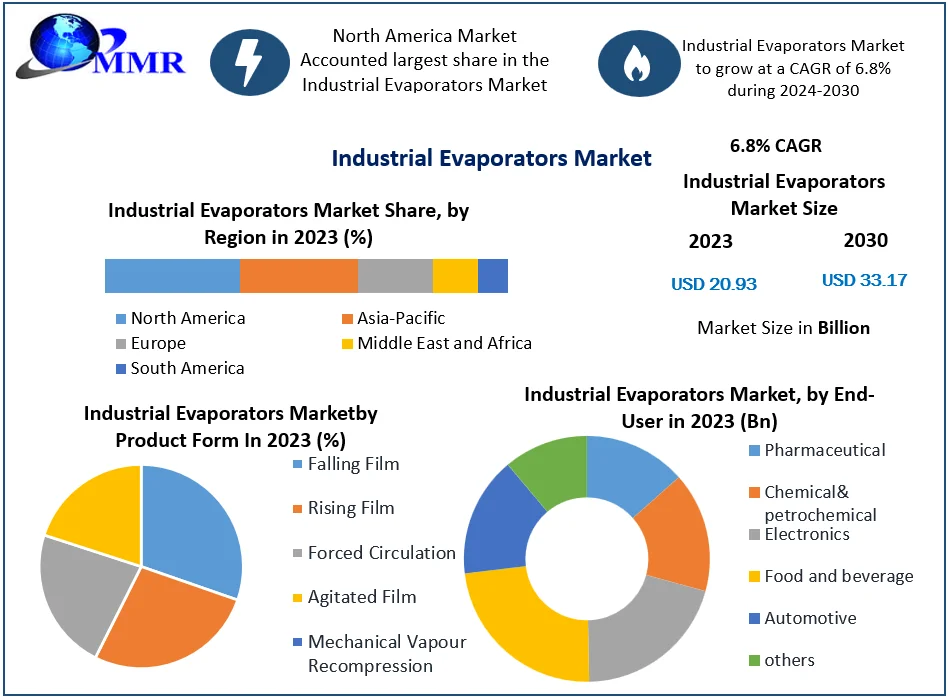
- The Industrial Evaporators Market was valued at USD 20.93 billion in 2023 and is projected to reach USD 33.17 billion by 2030.
- Revenue is expected to grow at a CAGR of 6.8% from 2024 to 2030, creating sustained demand for high-efficiency liquid separation and concentration systems.
- Plate evaporators held the largest construction-type share in 2023 because of high heat-transfer coefficients, compact size, expandable capacity and easier cleaning.
- Food and beverage held a 54% end-user share in 2023 and is also expected to be the fastest-growing segment.
- Asia Pacific is both the largest and fastest-growing regional market, supported by industrialization, food-processing investment and manufacturing expansion.
- Wastewater treatment is the market’s key demand driver as industries seek to reduce liquid volumes, remove contaminants and comply with environmental standards.
- High capital expenditure and ongoing maintenance remain the principal barriers to adoption.
Why This Matters Now
Industrial processors face a direct operating challenge: reduce water consumption, energy use and waste without slowing production. Evaporation systems are moving to the centre of that response because they concentrate products, recover liquids and reduce wastewater volumes within one industrial process.
The Industrial Evaporators Market expected increase from USD 20.93 billion in 2023 to USD 33.17 billion by 2030 signals continued investment across food, pharmaceuticals, chemicals and water treatment. The 6.8% CAGR gives equipment manufacturers an opportunity to compete through thermal efficiency, lower fouling, modular capacity and reduced lifetime operating costs.
Market Overview
Industrial evaporation removes the liquid component from a solution or mixture by applying heat, pressure or both. The process converts the liquid into vapour while concentrating or separating the remaining material.
Industrial evaporators operate continuously or in batches depending on the application. They handle large liquid volumes across food and beverage processing, pharmaceutical production, chemical manufacturing, wastewater treatment, electronics and automotive operations.
Their commercial value comes from process efficiency. Evaporators can reduce waste, lower transportation and storage requirements, recover valuable materials and increase product concentration. This makes the technology relevant to both production economics and environmental compliance.
The market includes plate and shell-and-tube construction types. Functional configurations include falling film, rising film, forced circulation, agitated thin film and mechanical vapour recompression systems. Each configuration addresses different viscosity, heat sensitivity, fouling and throughput requirements.
Key Trends Driving Growth
Wastewater treatment is the strongest growth catalyst. Industrial evaporators remove contaminants and impurities, making water safer for reuse or discharge. They also reduce wastewater volume, lowering the cost and complexity of transport, treatment and final disposal.
This creates a clear business case for industries operating under stricter water-management requirements. Companies can use evaporation systems to reduce environmental exposure while recovering water for internal operations. Developing markets offer further opportunity where access to safe water and sanitation remains limited.
Pharmaceutical and chemical production is another major demand source. Evaporators remove solvents and impurities from antibiotics, painkillers, antiviral drugs, polymers, resins and plastics. Better separation improves purity, product quality and production efficiency.
Food processing creates an equally important expansion path. Evaporators remove moisture from jams, juices, dairy products and protein formulations. Concentration extends shelf life, reduces refrigerated storage requirements and lowers the space needed to store and transport liquids.
Changing consumer demand strengthens this segment. Packaged foods, concentrated juices, ready-to-prepare products and flavoured milk require consistent moisture reduction and concentration. Equipment suppliers that can handle high-viscosity fluids while limiting fouling and simplifying cleaning can gain an advantage.
Energy efficiency is shaping technology selection. Plate evaporators offer high heat-transfer coefficients and compact designs, while mechanical vapour recompression is included among the market’s key functional technologies. Buyers are increasingly likely to assess total energy consumption rather than equipment price alone.
Customization is also becoming more important. Food processors, chemical plants and wastewater operators manage different feed compositions, viscosities and contamination levels. Suppliers must therefore adapt capacity, materials, heat-transfer design and cleaning requirements to the customer’s process.
The report does not provide specific evidence on artificial intelligence, generative AI, machine learning, cloud computing, 5G, edge computing, data centres or cybersecurity within industrial evaporator operations. These themes have therefore not been presented as verified market drivers.
Start Your Market Research Journey with a Free Sample Report
Segment Insights
- Dominant Construction Segment Plate Evaporators: Plate systems held the largest revenue share in 2023. Their compact footprint, high thermal efficiency, expandable capacity and easier cleaning support adoption across food, beverage and chemical processing.
- Dominant End-User Segment Food and Beverage: The segment held a 54% share in 2023. Product concentration, moisture removal, longer shelf life and reduced refrigeration-space requirements create direct operational value.
- Fastest-Growing End-User Segment Food and Beverage: The report identifies food and beverage as the fastest-growing segment during the forecast period, supported by packaged foods, dairy products, concentrated juices and ready-to-prepare products.
- Pharmaceutical Opportunity: Evaporators support solvent removal and purity improvement in medicine production, including antibiotics, painkillers and antiviral drugs.
- Chemical and Petrochemical Opportunity: Industrial evaporators remove solvents and impurities during the production of polymers, resins, plastics and other chemical products.
- Functionality Opportunity: Falling film, rising film, forced circulation, agitated thin film and mechanical vapour recompression systems allow suppliers to address different product and process conditions.
Regional Growth Story
Asia Pacific is the largest and fastest-growing regional market. Rapid industrialization, urbanization and population growth are increasing demand for processed foods, pharmaceuticals, chemicals and wastewater-treatment infrastructure.
China and India are the region’s key markets. Manufacturers are establishing production facilities in both countries to serve rising local demand and benefit from lower labour costs, supportive government policies and expanding industrial infrastructure.
Food processing is central to the regional opportunity. Governments are increasing investment in the sector, while equipment suppliers are offering systems designed for high-viscosity materials, low fouling and easier cleaning. This strengthens demand for customized evaporators across dairy, juice and packaged-food production.
The report also covers Japan, South Korea, Australia, Indonesia, Malaysia, Vietnam, Taiwan, Bangladesh and Pakistan. It does not disclose individual country shares or growth rates, so unsupported rankings have been omitted.
North America includes the United States, Canada and Mexico, while Europe includes the United Kingdom, Germany, France, Italy, Spain, Sweden and Austria. The report provides geographic coverage but does not publish specific regional shares for these markets.
Competitive Landscape
Competition is increasing as manufacturers improve product portfolios and expand distribution through partnerships and collaboration. The market includes Alfa Laval, Belmar Technologies, Coilmaster Corporation, Colmac Coil Manufacturing, De Dietrich Process Systems, GEA Group, Praj Industries, ENCON Evaporators, SPX Flow, SUEZ Water Technologies and Veolia Water Technologies.
The strategic contest centres on efficiency and lifecycle economics. Suppliers that reduce energy use, simplify cleaning and extend maintenance intervals can defend pricing better than companies competing only on initial equipment cost.
Large and medium-sized companies are also broadening customer service. This signals a shift from equipment sales toward longer-term relationships involving installation, maintenance, process optimization and replacement parts.
Acquisitions and partnerships can accelerate access to specialized technologies and regional distribution. Lone Star completed its acquisition of SPX Flow in 2022, indicating continued consolidation around process-equipment capabilities.
Veolia Water Technologies received a contract from Smurfit Kappa to install an HPD concentration and evaporation system. The project was intended to increase liquor-treatment capacity and improve recovery-boiler efficiency, showing how evaporator suppliers can position equipment as part of wider plant-performance programs.
Recent Developments
- Veolia Water Technologies was awarded a Smurfit Kappa contract to increase liquor-treatment capacity through an HPD concentration and evaporation system.
- The Veolia installation was also designed to optimize recovery-boiler operating efficiency, linking evaporation investment with plant-level energy performance.
- Lone Star completed its acquisition of SPX Flow in 2022, expanding consolidation within process and flow technology.
- Manufacturers are increasing research and development to improve equipment efficiency, product portfolios and customer-specific designs.
- Suppliers are expanding through partnerships, collaborations, mergers, acquisitions and distribution-network development.
- Leasing and rental models are emerging as ways to reduce the high upfront cost of industrial evaporators.
Strategic Implications
Industrial buyers should evaluate evaporators on total ownership cost, not purchase price. Energy demand, maintenance, cleaning frequency, downtime and replacement components can determine whether a lower-priced system delivers real savings.
Maintenance capability is equally important. Regular inspection, calibration and replacement of worn components are required to sustain efficiency and prevent breakdowns. Training operators can extend equipment life and reduce unplanned production losses.
Leasing and rental models may widen adoption among companies unable to commit substantial capital. Suppliers that offer flexible financing alongside technical support can reach smaller processors and lower-margin industries.
Equipment manufacturers should prioritize modular designs and application-specific engineering. Customers will increasingly favour systems that can expand with production capacity and adapt to changing feedstocks.
Future Outlook
Industrial evaporators will become more closely tied to water recovery, product concentration and plant energy strategy. Plate systems, customized designs and advanced vapour-recovery configurations will shape purchasing decisions as companies pursue lower waste and higher process efficiency.
Future industrial leaders will treat evaporation as a strategic resource-recovery platform; laggards will continue absorbing avoidable energy, water and waste costs into every production cycle.
Analyst Perspective
“Industrial evaporators are becoming central to water management, product concentration and resource efficiency across process industries. Companies that prioritize high thermal performance, lower fouling and lifecycle maintenance can reduce operating costs, while facilities relying on inefficient equipment will face rising pressure from water, energy and compliance requirements,” said Yash Ghosalkar, Analyst at Maximize Market Research.
About Maximize Market Research
Maximize Market Research Pvt. Ltd. (MMR) is a global market research and consulting company that provides reliable, data-focused, and practical business insights. The firm serves a wide range of industries, including healthcare, pharmaceuticals, technology, automotive, electronics, chemicals, personal care, and consumer goods. Through market forecasts, competitive analysis, strategic consulting, and industry impact assessments, MMR helps organizations understand changing market conditions, identify growth opportunities, and make informed business decisions for long-term success.
Contact Us
2nd Floor, Navale IT Park Phase 3
Pune Banglore Highway, Narhe
Pune, Maharashtra 411041, India
+91 9607365656
[email protected]