
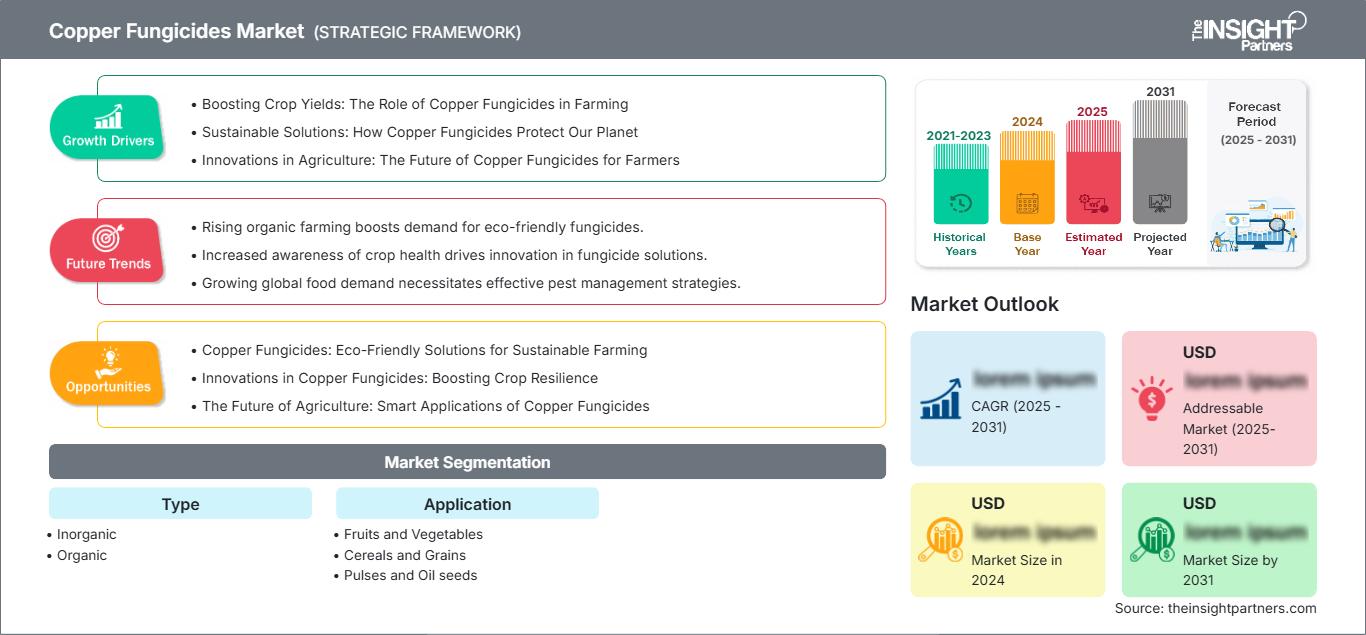
Growers across the world are leaning harder on copper-based crop protection as fungal and bacterial pressure intensifies alongside a global push toward organic-compliant agriculture. The Copper Fungicides Market is valued at US$ 516.33 Million in 2025 and is projected to reach US$ 806.49 Million by 2034, expanding at a 5.08% CAGR between 2026 and 2034. That trajectory reflects a steady, structural shift rather than a short-lived spike, as copper fungicides remain one of the few multi-site mode-of-action tools that fungal pathogens have struggled to outmanoeuvre through resistance.
What Is the Copper Fungicides Market?
Copper fungicides are crop protection formulations built around copper compounds such as copper sulphate, copper oxychloride, and copper hydroxide, applied to control fungal and bacterial diseases across fruits, vegetables, cereals, and oilseeds. The market covers both inorganic and organic copper-based formulations, sold through agrochemical distribution networks to commercial farms, orchards, and organic growing operations worldwide.
Request a Sample Copy of the Report: https://www.theinsightpartners.com/sample/TIPRE00015931
Market Drivers
Copper fungicides occupy a unique position in modern crop protection. Unlike many synthetic single-site fungicides that pathogens can eventually adapt around, copper works on multiple cellular targets at once, which keeps resistance development low even after decades of continuous use. That durability is becoming more valuable, not less, as regulators in Europe and parts of Asia tighten restrictions on several synthetic fungicide classes and push growers toward alternatives with a cleaner residue profile.
Organic farming is doing much of the heavy lifting behind this growth. Copper compounds are approved under most major organic certification schemes, and as consumer demand for organic fruits, vegetables, and export-grade produce keeps climbing, growers are turning to copper-based protection to meet certification requirements without sacrificing yield. This is not just a trend, it is a structural shift in how disease management is approached on organic and transitioning farms.
Fruit and vegetable cultivation, in particular, is a major demand pull. Crops like grapes, potatoes, tomatoes, and citrus are highly susceptible to downy mildew, late blight, and bacterial canker, all of which copper fungicides address effectively. Export-oriented production in Latin America, Southern Europe, and parts of Asia Pacific has added further urgency, since importing countries increasingly enforce strict residue tolerances that copper-based products can meet more comfortably than some synthetic alternatives.
Cereals, grains, pulses, and oilseeds add a second growth layer, particularly in regions where smallholder and mid-scale farms are scaling up input use to close yield gaps. Government-backed agricultural modernisation programmes across South Asia and parts of Africa are widening access to affordable copper formulations, bringing a large base of previously under-protected acreage into the addressable market. So, what is driving this acceleration across so many crop categories at once? It comes down to copper’s dual identity: it is both a legacy chemistry trusted by generations of growers and a compliant option for the sustainability standards shaping agriculture today.
Segmentation Overview
By Type: Inorganic copper fungicides, including copper sulphate and copper oxychloride, dominate usage due to their low cost, wide availability, and long field history across major row crops.
Organic copper formulations are gaining share faster, driven by certified organic farming requirements and buyer demand for residue-compliant produce in premium export markets.
By Application: Fruits and vegetables account for the largest application share, given their high vulnerability to fungal and bacterial disease and the value at stake in export-grade quality.
Cereals and grains are expanding steadily as governments in Asia Pacific and Latin America support broader adoption of crop protection inputs to secure food output.
Pulses and oil seeds represent a smaller but growing segment, supported by rising acreage under protein and edible oil crops in emerging economies.
Other applications, including ornamentals and plantation crops, contribute a modest but stable share of overall demand.
By Geography: North America, Europe, Asia Pacific, and South and Central America each bring distinct demand drivers, from regulatory-led organic adoption in Europe to acreage expansion across Asia Pacific.
Key Market Players
- ADAMA Agricultural Solutions Ltd
- Albaugh, LLC
- Bayer AG
- Industrias Químicas del Vallés (IQV)
- UPL Limited
- Nufarm Limited
- Isagro S.p.A.
- Nordox AS
- Corteva Agriscience
- Certis USA L.L.C.
Bayer AG continues to refine copper fungicide formulations for improved coverage and efficiency across large-scale row crop operations. Albaugh, LLC has focused on cost-effective, high-volume products tailored to broad-acre farming, while Nordox AS and Isagro S.p.A. have built strong footholds in organic and European markets respectively. ADAMA and Industrias Químicas del Vallés continue to expand distribution reach across Asia Pacific and Latin America, where smallholder demand is rising fastest.
Sustainability and Innovation Trends
Manufacturers are investing in particle-size engineering to improve copper’s adhesion and rainfastness on leaf surfaces, reducing the frequency of reapplication and, by extension, total copper load on soil. This matter because regulators are watching copper accumulation in soil closely, and formulation innovation is becoming the industry’s answer to staying compliant without losing efficacy. Micronised and low-dose copper formulations are increasingly positioned as the bridge between traditional reliability and next-generation environmental standards. Beyond formulation science, companies are pairing copper fungicides with integrated pest management programmes, helping growers rotate actives intelligently and extend the useful life of every crop protection tool in their arsenal.
Buy Premium Report: https://www.theinsightpartners.com/buy/TIPRE00015931
Regional Outlook
Europe’s organic farming mandates and tightening synthetic fungicide restrictions are reinforcing copper’s role as a compliant, dependable alternative, particularly across vineyards and orchards in Southern Europe. North America shows steady demand tied to specialty crop production and expanding organic acreage, with growers favouring newer low-particle-size formulations. Asia Pacific is emerging as the fastest-growing region, propelled by expanding fruit and vegetable cultivation in India and China, government support for sustainable farming, and rising awareness of copper’s disease-control value among smallholders. South and Central America, anchored by Brazil and Argentina’s large export-oriented fruit and cereal sectors, continues to see copper fungicides embedded deeply into standard crop protection programmes, particularly where residue compliance is tied to export contracts.
Related Reports:
Agricultural Biologicals Market
Water-Soluble Fertilizers Market
About The Insight Partners
The Insight Partners is among the leading market research and consulting firms in the world. We take pride in delivering exclusive reports along with sophisticated strategic and tactical insights into the industry. Reports are generated through a combination of primary and secondary research, solely aimed at giving our clientele a knowledge-based insight into the market and domain. This is done to assist clients in making wiser business decisions. A holistic perspective in every study undertaken forms an integral part of our research methodology and makes the report unique and reliable.
Contact Us:
If you have any queries about this report or if you would like further information, please contact us:
Phone: +1-646-491-9876
E-mail: [email protected]
Also Available in: Korean German Japanese French Chinese Italian Spanish