
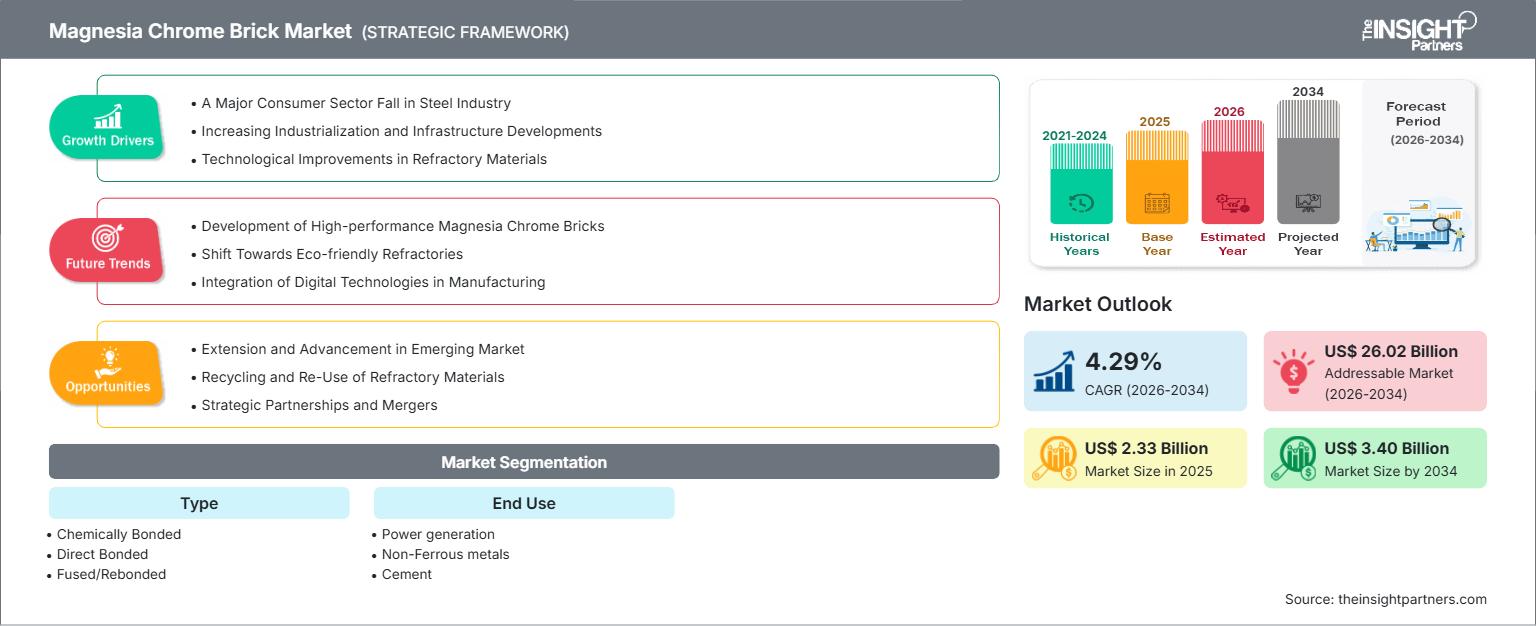
Steel furnaces run at temperatures that would melt most materials in minutes. Cement kilns operate around the clock under similar extremes. Something has to line these systems and survive the heat, year after year. That is the job of the Magnesia Chrome Brick Market. The market was valued at US$ 2.33 Billion in 2025 and is projected to reach US$ 3.40 Billion by 2034, growing at a CAGR of 4.29% from 2026 to 2034. That pace reflects an industry tied directly to global heavy manufacturing output.
What Is the Magnesia Chrome Brick Market?
Magnesia chrome bricks are refractory materials made from magnesia and chrome ore. They are built to withstand extreme heat and chemical stress inside industrial furnaces. Steel, cement, and glass producers depend on these bricks to keep high-temperature equipment running safely.
Market Drivers
What is pushing this market forward? Steel production sits at the centre of it. Global steel output keeps climbing as infrastructure projects expand across Asia, the Middle East, and parts of Africa. Every tonne of steel produced requires furnace linings that can survive repeated thermal cycles, and magnesia chrome bricks remain a preferred choice for their durability.
Request a Sample Copy of the Report: https://www.theinsightpartners.com/sample/TIPRE00040373
Power generation adds another strong pull. Coal and industrial power plants use refractory linings in boilers and combustion chambers. As emerging economies expand power capacity to meet rising electricity demand, refractory material consumption rises right alongside it.
Cement production tells a similar story. Kilns run continuously at high temperatures, and downtime is expensive. Plant operators favour refractories with long service life, since replacing linings means halting production entirely. This is not a market driven by novelty, it is driven by reliability.
Non-ferrous metal processing also plays a role. Copper, nickel, and other metal smelting operations expose refractory linings to aggressive chemical environments. Fused and rebonded brick types perform particularly well here, offering resistance where standard materials would fail quickly. Beyond heavy industry demand, one more factor matters: replacement cycles. Even in years of flat new construction, existing furnaces still need periodic relining, which keeps baseline demand steady no matter the economic climate.
Segmentation Overview
Segments Covered
By Type: Direct Bonded bricks hold a strong position for their balance of cost and performance. Chemically Bonded, Fused/Rebounded, and Fused Cast types serve more specialised applications where extreme thermal or chemical resistance is required.
By End Use: Iron and Steel dominates demand, given the scale of global steel production. Cement and Power Generation follow as significant consumers, while Glass and Non-Ferrous Metals round out the remaining application base.
Key Market Players
- Calderys
- Gita Refractories
- HarbisonWalker International
- JBTC
- KT Refractories
- Lanexis
- Liaoning Lian Refractories Co., Ltd.
- Magnezit Group
- Mayerton Refractories
- Puyang Refractories Group Co., Ltd.
This market includes a mix of global refractory specialists and strong regional producers, particularly from China, where much of the world’s steel and cement capacity is concentrated. Harbison Walker International and Magnezit Group maintain broad product portfolios across multiple brick types, while producers like Puyang Refractories Group serve high-volume domestic demand.
Sustainability and Innovation Trends
Environmental scrutiny around chromium is reshaping product development. Hexavalent chromium formation during brick disposal has drawn regulatory attention in several regions, pushing manufacturers to improve recycling processes and develop safer formulations.
Recycling of spent refractory bricks is gaining momentum. Rather than sending used bricks to landfill, some producers now recover and reprocess magnesia chrome material for reuse, cutting raw material costs and reducing environmental impact.
Longer-life formulations are another area of focus. Manufacturers are refining bonding techniques to extend brick service life, which reduces the frequency of furnace shutdowns. Fewer relining cycles mean lower operating costs for steel and cement producers, making this a genuine selling point rather than a marketing claim.
Buy Premium Report: https://www.theinsightpartners.com/buy/TIPRE00040373
Regional Outlook
Asia Pacific dominates the market by a wide margin, driven by massive steel and cement production in China and India. Ongoing infrastructure investment across the region keeps refractory demand consistently high.
North America shows steady demand, supported by established steel manufacturing and power generation infrastructure. Replacement and maintenance cycles form the bulk of regional consumption.
Europe follows a more measured growth path. Stricter environmental regulations around chromium use are shaping product choices, while steel production levels remain relatively stable compared to Asia Pacific.
South and Central America contributes a smaller share, with demand tied to steel and cement output in Brazil and neighbouring economies.
Related Reports:
Wear Resistant Steel Plate Market
About The Insight Partners
The Insight Partners is among the leading market research and consulting firms in the world. We take pride in delivering exclusive reports along with sophisticated strategic and tactical insights into the industry. Reports are generated through a combination of primary and secondary research, solely aimed at giving our clientele a knowledge-based insight into the market and domain. This is done to assist clients in making wiser business decisions. A holistic perspective in every study undertaken forms an integral part of our research methodology and makes the report unique and reliable.
Contact Us:
If you have any queries about this report or if you would like further information, please contact us:
Phone: +1-646-491-9876
E-mail: [email protected]
Also Available in: Korean | German | Japanese | French | Chinese | Italian | Spanish