
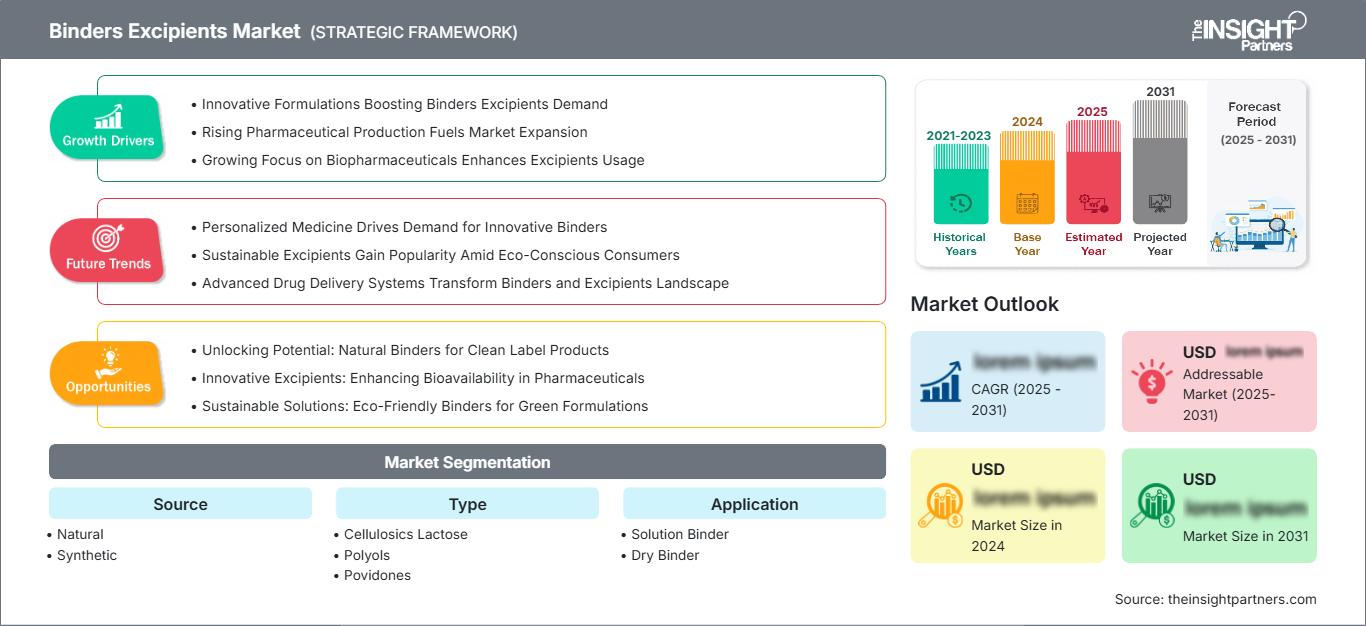
Solid dosage form manufacturing depends on a class of functional ingredients that rarely get headlines but are critical to every tablet and capsule that reaches a patient. The Binders Excipients Market is projected to grow from US$ 1.42 Billion in 2025 to US$ 2.1 Billion by 2034, registering a CAGR of 4.46% during the forecast period 2026–2034. Rising global pharmaceutical output, expanding nutraceutical consumption, and continuous innovation in drug delivery technologies are collectively driving this above-average growth trajectory for pharmaceutical binders and excipients.
What Are Binders Excipients?
Binders excipients are inactive substances used in tablet and capsule manufacturing to hold active pharmaceutical ingredients together, ensuring consistent granule formation, mechanical strength, and uniform drug release. They are applied either in solution form during wet granulation or in dry form during direct compression, with selection depending on the drug’s sensitivity, solubility, and desired release profile. Common pharmaceutical binder excipients include cellulose derivatives, povidones, starches, lactose, and polyols, each offering distinct binding efficiency and compatibility characteristics.
Request a Sample Copy of the Report: https://www.theinsightpartners.com/sample/TIPRE00013369
What Is Driving Growth in the Binders Excipients Market?
Global pharmaceutical production is the primary engine behind binders excipients demand. As governments in emerging economies expand healthcare access and generic drug manufacturing scales up across India, China, and Southeast Asia, the volume of tablets and capsules produced annually climbs steadily. Every oral solid dosage unit requires carefully selected pharmaceutical binder excipients to pass disintegration, dissolution, and stability testing. The sheer scale of generic drug launches worldwide, combined with a robust branded pharmaceutical pipeline, ensures that demand for high-performance binders tracks pharmaceutical output reliably over the forecast period.
The nutraceutical sector is adding a fast-growing incremental demand stream. Dietary supplements, functional food tablets, protein capsules, and vitamin formulations all rely on binder excipients to achieve the compressibility and shelf stability that consumers and regulators expect. As preventive health awareness rises globally, nutraceutical companies are investing in sophisticated formulation capabilities that match pharmaceutical-grade quality standards, pulling demand toward the same high-purity cellulosic and starch-based binders used in prescription drug manufacturing. This convergence of pharma and nutraceutical formulation standards is widening the addressable market for excipient suppliers considerably.
Continuous manufacturing adoption is reshaping how pharmaceutical binders are specified and sourced. Traditional batch wet granulation is giving way to continuous direct compression lines in leading pharmaceutical facilities, creating fresh demand for dry binder excipients optimised for high-speed tableting. Cellulose-based dry binders and speciality polyols engineered for direct compression perform reliably under the consistent mechanical stress of continuous production, and suppliers investing in these grades are well-positioned to capture procurement from manufacturers modernising their solid dosage operations.
Regulatory scrutiny of excipient quality is also intensifying. The US FDA’s guidance on excipient qualification and the International Pharmaceutical Excipients Council (IPEC) standards are raising documentation and purity expectations across the supply chain. This is a meaningful competitive filter. Suppliers with robust quality management systems, pharmacopoeial compliance, and full traceability documentation are capturing specification approvals from major pharmaceutical companies that smaller, less-compliant suppliers cannot obtain. Quality-driven consolidation is strengthening the market positions of established excipient manufacturers while creating barriers against lower-quality competition.
Segmentation Overview
The binders excipients market is analysed across source, type, application, and end-user segments, reflecting the material’s broad formulation versatility.
By Source:
- Natural
- Synthetic
By Type:
- Cellulosics
- Lactose
- Polyols
- Povidones
- Starch and Polysaccharides
- Others
By Application:
- Solution Binder
- Dry Binder
By End-User:
- Pharmaceutical Companies
- Nutraceutical Companies
- Others
Key Market Players
- Ashland
- BASF SE
- BENEO
- BPSI Holdings LLC
- DFE Pharma
- Dow Chemical
- Ingredion
- JRS PHARMA
- Kerry Inc.
- Lonza Group
These companies compete through portfolio breadth, regulatory compliance credentials, and technical application support. Leaders such as BASF, Ashland, and Lonza Group invest heavily in application laboratories that help pharmaceutical customers select and qualify the right binder grade for each formulation, building long-term specification relationships that create durable competitive advantages in the pharmaceutical excipients supply chain.
Sustainability and Innovation Trends
Bio-based and natural-source binder excipients are gaining ground as pharmaceutical and nutraceutical companies respond to sustainability commitments and consumer preference for cleaner-label products. Plant-derived starches, cellulose from sustainably managed forests, and fermentation-derived polysaccharides are being positioned as credible alternatives to synthetic povidones and petrochemical-derived binders in applications where performance requirements allow substitution. Suppliers are investing in documentation to support green procurement claims without compromising pharmacopoeial compliance.
On the formulation innovation side, multifunctional excipients that combine binding, disintegration, and flow enhancement in a single ingredient are attracting strong interest from tablet manufacturers seeking to simplify their formulation complexity and reduce the number of raw material suppliers they manage. Co-processed excipients, which physically combine two or more functional ingredients at the particle level, offer performance advantages over physical blends and are commanding premium pricing in the pharmaceutical binders segment.
Buy Premium Report: https://www.theinsightpartners.com/buy/TIPRE00013369
Regional Outlook
North America holds a leading share of the global binders excipients market, supported by the United States’ position as the world’s largest pharmaceutical market and its concentration of innovative drug manufacturers that set global formulation standards. The presence of major excipient suppliers and contract development and manufacturing organisations (CDMOs) in the region creates a dense, interconnected demand base.
Asia Pacific is the fastest-growing region, driven by India’s dominance in generic pharmaceutical exports and China’s rapidly expanding domestic pharmaceutical manufacturing capacity. Both countries are investing in upgraded formulation capabilities and quality systems, pulling demand toward premium-grade pharmaceutical binder excipients that meet US and European regulatory requirements. Japan and South Korea add sophisticated demand from their innovative pharmaceutical sectors.
Europe benefits from stringent regulatory standards that favour high-quality, well-documented excipients. Germany, Switzerland, and the UK host leading excipient manufacturers and pharmaceutical companies whose procurement standards set a high baseline for product quality across the region. The nutraceutical markets of Germany, France, and the Netherlands are also significant contributors to regional binders excipients demand.
Related Reports:
Pulp and Paper Chemicals Market
Polyurethane (PU) Microspheres Market
About The Insight Partners
The Insight Partners is among the leading market research and consulting firms in the world. We take pride in delivering exclusive reports along with sophisticated strategic and tactical insights into the industry. Reports are generated through a combination of primary and secondary research, solely aimed at giving our clientele a knowledge-based insight into the market and domain. This is done to assist clients in making wiser business decisions. A holistic perspective in every study undertaken forms an integral part of our research methodology and makes the report unique and reliable.
Contact Us:
If you have any queries about this report or if you would like further information, please contact us:
Phone: +1-646-491-9876
E-mail: [email protected]
Also Available in: Korean | German | Japanese | French | Chinese | Italian | Spanish