
Key Highlights
- Cryogenic valves are becoming strategic assets within LNG, industrial gas, healthcare, chemical, and energy infrastructure projects.
- Growing investments in process automation are increasing demand for high-reliability valve technologies.
- LNG expansion remains one of the strongest demand drivers across global industrial markets.
- Digital process control systems are increasing the importance of intelligent flow management solutions.
- Industrial operators are prioritizing uptime, safety, and predictive maintenance capabilities.
- Asia-Pacific continues to emerge as a major growth center due to industrialization and energy infrastructure investments.
- Smart manufacturing initiatives are reshaping procurement priorities across process industries.
Why This Matters Now
Industrial operators are redesigning process infrastructure around automation, reliability, and energy efficiency. Every unplanned shutdown in a cryogenic environment carries significant operational and financial consequences.
That reality is elevating the role of cryogenic valves from mechanical components to strategic process-control assets. As LNG facilities, industrial gas plants, healthcare infrastructure, and advanced manufacturing facilities expand capacity, demand is rising for flow-control technologies that can operate reliably under extreme low-temperature conditions while integrating into increasingly digital operating environments.
Market Overview
The Cryogenic Valve industry sits at the intersection of energy transition, industrial automation, and global infrastructure investment.
Demand is being driven by industries that depend on precise handling of liquefied gases and ultra-low-temperature media. LNG facilities, air separation units, petrochemical complexes, power generation facilities, healthcare gas networks, and advanced manufacturing operations all require highly reliable cryogenic flow-control systems.
What changed is the role these valves now play within broader automation architectures. Historically, cryogenic valves were selected primarily for mechanical performance. Today, industrial buyers increasingly evaluate them based on operational reliability, lifecycle costs, maintenance requirements, safety performance, and compatibility with automated process control systems.
This shift is creating opportunities for manufacturers capable of supporting digital industrial operations while maintaining stringent performance standards in demanding environments.
Key Trends Driving Growth
The expansion of LNG infrastructure remains one of the most significant catalysts reshaping the market.
Countries seeking energy diversification are investing heavily in LNG import terminals, liquefaction facilities, storage infrastructure, and transportation networks. Every new LNG project requires extensive cryogenic flow-control systems capable of operating under extreme thermal conditions. The business implication is clear: valve reliability directly influences operational continuity and safety performance.
Industrial automation is creating another structural growth driver.
Process industries increasingly deploy advanced PLC, DCS, and SCADA platforms to improve visibility and optimize production. Cryogenic valves must function seamlessly within these automated environments. As operators pursue autonomous process control strategies, component reliability becomes increasingly important because equipment failures can trigger costly process interruptions.
Industrial IoT adoption is further changing procurement decisions.
Connected facilities now collect operational data from critical assets throughout the production lifecycle. While cryogenic valves remain fundamentally mechanical devices, operators increasingly seek solutions that support predictive maintenance initiatives and integrate into broader asset management strategies.
Smart manufacturing investments are reinforcing this trend. Facilities focused on digital transformation aim to reduce downtime, improve workforce productivity, and increase operational efficiency. Reliable cryogenic flow control contributes directly to these objectives by minimizing maintenance interventions and supporting stable process performance.
Energy transition investments are also creating new opportunities. Hydrogen, LNG, industrial gases, and advanced energy infrastructure projects require specialized cryogenic technologies, expanding the addressable market for valve manufacturers capable of serving next-generation industrial applications.
Get A Free Sample Now:https://www.maximizemarketresearch.com/request-sample/24374/
Segment Insights
Dominant Segment: LNG Applications
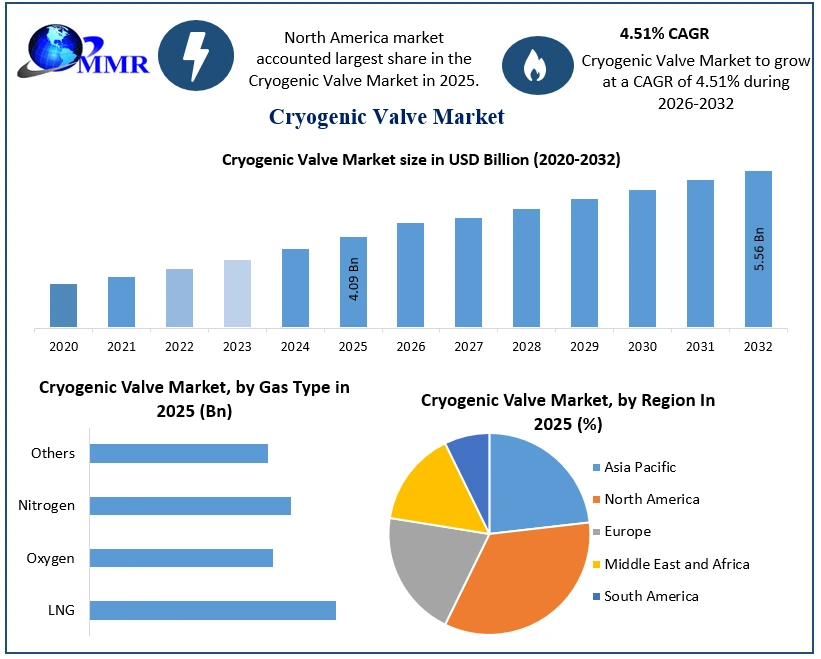
LNG remains the largest demand center for cryogenic valve deployment. Liquefaction facilities, storage terminals, transportation infrastructure, and regasification plants depend on reliable cryogenic flow-control systems. This dominance signals that global energy infrastructure investment continues to be a primary market driver.
Fastest-Growing Segment: LNG and Energy Infrastructure Applications
Expanding LNG investments across emerging and developed economies are creating significant opportunities for cryogenic valve suppliers. The rapid growth of energy infrastructure projects demonstrates how energy security and industrial development priorities are shaping procurement strategies.
Key Technology Trend
Automated valve systems capable of supporting advanced process-control environments are gaining importance. Industrial operators increasingly prioritize equipment compatibility with modern automation architectures and digital operating models.
Regional Growth Story
Asia-Pacific remains central to the market’s growth narrative.
China continues to expand industrial capacity while investing in LNG infrastructure, industrial gases, and manufacturing modernization programs. These investments create sustained demand for advanced cryogenic flow-control systems.
India is strengthening energy infrastructure and industrial production capabilities. Rising industrial activity and growing process-industry investments are increasing demand for reliable low-temperature valve technologies across multiple sectors.
Japan and South Korea continue to play important roles due to advanced manufacturing capabilities, strong LNG utilization, and leadership in industrial automation technologies. Their focus on operational efficiency and plant modernization supports adoption of high-performance cryogenic equipment.
In Europe, Germany’s emphasis on Industry 4.0 and industrial efficiency initiatives reinforces demand for advanced process-control technologies. Manufacturers increasingly prioritize equipment reliability, predictive maintenance, and automation readiness.
The United States remains a major market due to LNG export expansion, industrial gas production, and continuing investment in digital process industries. American operators are among the earliest adopters of predictive maintenance technologies, creating favorable conditions for advanced valve solutions integrated into broader operational technology ecosystems.
Competitive Landscape
Competition is increasingly centered on technology leadership rather than product availability.
Leading manufacturers are focusing on engineering expertise, operational reliability, material innovation, and application-specific performance. The strategic objective is no longer simply selling valves. Companies are positioning themselves as providers of critical infrastructure solutions capable of supporting increasingly automated industrial operations.
This signals a broader transformation within process industries.
Customers are demanding equipment that contributes directly to operational efficiency, safety performance, and maintenance optimization. Suppliers capable of aligning their offerings with Industry 4.0 priorities are strengthening their competitive position.
The market is also witnessing greater emphasis on lifecycle value. Industrial buyers increasingly assess maintenance costs, reliability metrics, process uptime contributions, and long-term operational performance when selecting cryogenic valve technologies.
As digitalization expands across process industries, technology providers that support predictive maintenance programs and process optimization initiatives are likely to gain strategic advantages.
Recent Developments
- Increasing investments in LNG infrastructure projects across major industrial economies.
- Growing deployment of automated process-control systems in cryogenic applications.
- Rising adoption of predictive maintenance strategies across process industries.
- Expanded focus on operational safety and reliability within industrial gas facilities.
- Greater integration of digital monitoring technologies across critical infrastructure assets.
- Continued modernization of energy, chemical, and industrial manufacturing facilities.
- Stronger alignment between process-control equipment procurement and Industry 4.0 objectives.
Strategic Implications
For plant managers, cryogenic valves are becoming reliability assets that directly influence uptime and operational continuity.
For automation engineers, the challenge is ensuring flow-control systems integrate seamlessly with PLC, DCS, SCADA, and digital asset-management platforms.
For industrial technology buyers, procurement decisions increasingly revolve around lifecycle value rather than upfront equipment costs.
For investors, the market reflects broader industrial transformation trends including LNG expansion, factory modernization, process automation, and digital infrastructure development.
Organizations that successfully connect process reliability with automation performance will be best positioned to capture future opportunities.
Future Outlook
The next phase of market evolution will be defined by the convergence of LNG expansion, industrial digitization, predictive maintenance, and autonomous process operations. Cryogenic valves will increasingly serve as critical nodes within connected industrial ecosystems where reliability, safety, and operational intelligence determine competitive advantage.
The defining separation in the coming decade will not be between companies that own cryogenic infrastructure and those that do not—it will be between industrial leaders that integrate cryogenic assets into fully digitized, Industry 4.0-enabled operations and laggards that remain constrained by legacy process architectures.
Analyst Perspective
“The Cryogenic Valve Market is increasingly shaped by the convergence of energy infrastructure investment, industrial automation, and digital process control. Organizations that align cryogenic flow management with predictive maintenance, operational intelligence, and smart manufacturing objectives will capture the greatest long-term value from the next wave of industrial transformation.” — Gaurav Deshmukh
About Maximize Market Research
Maximize Market Research Pvt. Ltd. (MMR) is a global market research and consulting company that provides reliable, data-focused, and practical business insights. The firm serves a wide range of industries, including healthcare, pharmaceuticals, technology, automotive, electronics, chemicals, personal care, and consumer goods. Through market forecasts, competitive analysis, strategic consulting, and industry impact assessments, MMR helps organizations understand changing market conditions, identify growth opportunities, and make informed business decisions for long-term success.
2nd Floor, Navale IT Park Phase 3
Pune Banglore Highway, Narhe
Pune, Maharashtra 411041, India
+91 9607365656
[email protected]