
Key Highlights
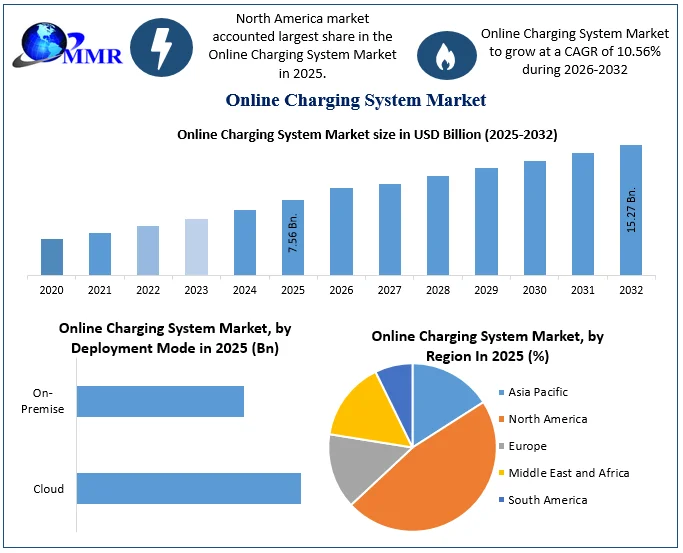
Market Capital Accumulation: The Global Online Charging System (OCS) Market reached a valuation of USD 7.56 Billion in 2025 and is projected to scale to USD 15.27 Billion by 2032.
Compounding Revenue Velocity: The market is expanding at a steady Compound Annual Growth Rate (CAGR) of 10.56% across the 2026–2032 forecast window.
Structural Dependency: Online charging systems have emerged as the core transactional component of carrier provider infrastructure, managing concurrent real-time billing metrics for data, messaging, voice, and third-party digital apps.
Digital Ecosystem Catalysts: Exponential increases in mobile data traffic, smart-device adoption, and subscription-based service frameworks are driving the immediate need for scalable, automated rating engines.
Algorithmic Integration: The deployment of artificial intelligence and machine learning within billing software is significantly increasing revenue assurance and reducing commercial fraud.
Why This Matters Now
The rapid shift toward digital banking, content streaming, and multi-tenant cloud applications has altered the mechanics of network utilization. Traditional billing stacks operate on historical data collection, meaning they cannot enforce dynamic policies or adjust tariff limits instantaneously. If a subscriber or a connected enterprise asset runs out of prepaid credit mid-stream, a legacy system cannot drop the session fast enough, leading to millions of dollars in unrecoverable revenue loss.
The arrival of diverse, multi-variable transaction points from connected devices and streaming media. Why now? Because 5G standalone networks introduce granular service level agreements (SLAs) based on customized latency and throughput, meaning operators must bill for service quality, not just simple data volume. Who benefits? Telecom operators deploying software-defined networks, hyperscale cloud providers running multi-tenant platforms, and enterprise software buyers requiring real-time pricing flexibility. What happens next? A complete industry migration toward distributed, cloud-native online charging frameworks that handle millions of concurrent transactions at the network edge.
Market Overview
The global online charging system market Size has entered a structural expansion phase. Valued at USD 7.56 Billion in 2025, the market’s trajectory to USD 15.27 Billion by 2032 shows that Tier-1 carriers and internet service providers are systematically replacing their traditional billing architectures.
The structural 10.56% CAGR is sustained by the continuous modernization of core telecom infrastructure. As mobile operators face eroding margins on basic voice and text services, they are relying on real-time online charging engines to roll out, track, and monetize sophisticated data packages and partner-driven value-added services (VAS).
Key Trends Driving Growth
The primary driver of the global market is the continuous expansion of the global mobile subscriber footprint and the parallel rise of usage-heavy digital environments. From mobile payment apps to industrial IoT sensors, every endpoint requires continuous session validation and exact metering. Online charging system software functions as the operational heartbeat of this environment, verifying credit balances, applying specific pricing rules, and updating account metrics during an active data session.
At the same time, growing consumer demand for personalized and highly flexible subscription structures is transforming standard product design. Modern subscribers expect custom data tiers, temporary promotional top-ups, and shared family data pools that respond instantly to changes in usage behavior. Online charging engines enable this level of commercial agility, allowing service providers to launch dynamic pricing campaigns and target personalized rewards to specific user profiles in real time.
Segment Insights
Software Solutions [Dominant Segment]: Retaining the largest share of the market, software systems serve as the core engines of the industry. This position reflects an enterprise need for low-latency rating software, voucher management layers, and balance management components that handle immense transaction volumes without introducing network delays.
Telecommunications [Dominant Application Vertical]: This vertical captured the largest share of global market revenue, driven by the operational requirements of mobile network operators (MNOs) and mobile virtual network operators (MVNOs) who deploy online charging platforms to protect margins across prepaid and postpaid user portfolios.
Services [Fastest-Growing Segment]: While software handles the primary transaction volume, services are growing at the highest velocity. Telecom modernizations are highly complex, requiring extensive system integration, custom software tuning, and delicate database migrations from legacy mainframes to hybrid cloud environments.
Cloud-Based Deployment [Fastest-Growing Technology Segment]: Cloud-native architectures are outstripping traditional on-premises installations. Operators are prioritizing cloud-hosted online charging systems to leverage elastic, pay-as-you-grow operational models and achieve the structural scalability required for heavy 5G workloads.
Regional Growth Story
North America represents a major revenue center within the global industry landscape. This market position is sustained by the presence of consolidated telecom giants across the United States, working within established, highly regulated frameworks. Market operators in this geography are investing heavily to adapt their real-time billing pipelines to the massive density of local 5G deployments and residential IoT smart-home devices.
Concurrently, the Asia-Pacific region is tracking as the fastest-growing market block. The massive buildout of next-generation cellular networks in China and India is creating immense demand for scalable online charging software. Because these regions feature a massive volume of prepaid subscribers using data-heavy mobile apps, local operators are forced to deploy highly automated rating tools to manage extreme data traffic peaks without sacrificing revenue assurance.
Competitive Landscape
The competitive environment of the global online charging system market is characterized by a high concentration of established technology vendors and specialized network platform providers. Tier-1 leaders like Amdocs, Oracle, Ericsson, Nokia, CSG International, Optiva, Redknee Solutions, and Cerillion are aggressively updating their product suites to support cloud-native, microservices-driven architectures. The competitive focus has moved away from basic rating software toward building unified, converge-ready business support systems (BSS).
This strategic shift highlights a broader battle over the control of telecom software platforms. Industry heavyweights are designing their billing engines to integrate with automated policy control and network data management frameworks. By linking real-time charging with active policy enforcement, vendors can offer operators a unified system that optimizes network resource allocation based on a subscriber’s live account balance. This architectural capability gives platform vendors significant pricing power, as carriers prioritize complete, end-to-end monetizing solutions that lower total operational overhead.
Recent Developments
Cloud-Native Containerization: Top-tier software providers successfully moved their core charging engines to container platforms like Kubernetes, allowing operators to spin up regional billing instances at the network edge on demand.
AI-Driven Fraud Countermeasures: System developers integrated machine learning models into online charging platforms to identify and block abnormal data consumption and bypass fraud attempts during active data sessions.
Cross-Industry IoT Billing Expansions: Charging platforms expanded their standard API toolkits to support non-telecom use cases, allowing utility providers and connected transportation networks to run real-time, consumption-based billing models.
Real-Time Partner Ecosystem Settlements: The introduction of automated multi-party clearing engines within online charging systems allows telecom operators to calculate and distribute revenue splits to content providers and app developers instantly.
Strategic Implications
The transition to cloud-based real-time billing frameworks forces a profound rewrite of telecom business strategies. For long-term operators, continuing to manage separate, isolated billing lines for prepaid and postpaid accounts creates unsustainable operational friction and high maintenance costs. Modern online charging systems remove this barrier, enabling a single, unified architecture to manage every account type across any access network. Capture High-Velocity Transaction Payloads-Network Level Integration. Ingest live session metadata directly from 5G core network routers and edge computing points as transactions occur. Execute Real-Time Balance and Policy Valuation-Algorithmic Verification. Process incoming data streams through automated rating engines to check account rules, credit limits, and promotional discounts instantly. Apply Immediate Settlement and Session Control-Commercial Resolution. Update subscriber balances and enforce access control policies on active connections to prevent any potential revenue leakage.
This operational capability completely resets the monetization playbook for enterprise technology buyers. Cloud-hosted charging software allows smaller regional providers and niche virtual operators to launch tailored, highly competitive service packages without upfront capital investments in server hardware. Service providers who build their architectures around open APIs and cloud-native databases can adapt to shifting consumer patterns much faster than rivals tied down by legacy billing systems.
Future Outlook
As 5G networks mature into massive, multi-industry connectivity fabrics, real-time online charging architecture will expand from a standard telecom utility into a cross-sector engine for digital transaction processing. The traditional paradigm of rigid billing models will give way to a dynamic marketplace where machines, edge routers, and software agents buy and settle digital resources autonomously. This deep technical shift will separate future digital leaders—who exploit ultra-low latency charging platforms to monetize complex network interactions—from legacy laggards restricted by sluggish, batch-processed billing tools.
Analyst Perspective
“The capital moving into the online charging system market is reacting to a fundamental shift in network economics. In a standalone 5G world, an operator’s commercial agility is completely defined by its billing architecture; if your rating engine cannot calculate, enforce, and settle a transaction in real time, you simply cannot monetize next-generation digital services.”— Yash Ghosalkar
About Maximize Market Research
Maximize Market Research Pvt. Ltd. (MMR) is a global market research and consulting firm known for delivering accurate, actionable, and data-driven insights. Our expertise spans diverse industries — including medical devices, pharmaceuticals, technology, automotive, electronics, chemicals, personal care, and consumer goods. We provide services such as market-validated forecasts, competitive intelligence, strategic consulting, and industry impact analysis, helping businesses navigate market complexities and achieve sustainable growth.
2nd Floor, Navale IT Park Phase 3
Pune Banglore Highway, Narhe
Pune, Maharashtra 411041, India
+91 9607365656
[email protected]