
Key Highlights
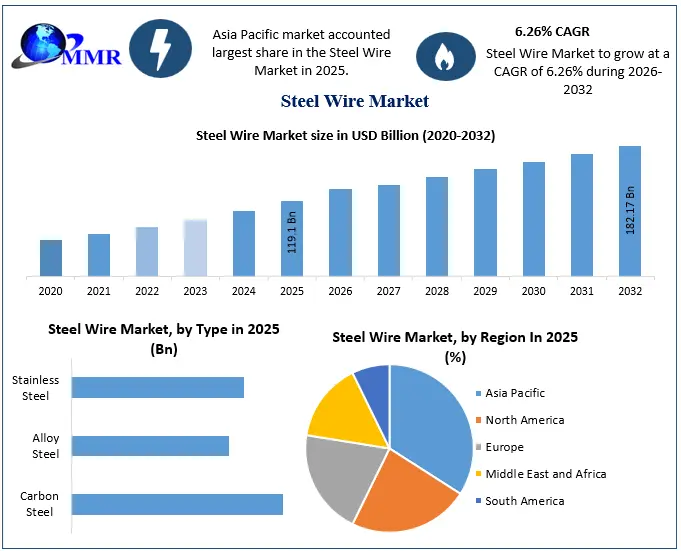
The global steel wire market size is projected to expand from USD 119.1 Billion in 2025 to USD 182.17 Billion by 2032, growing at a 6.26% CAGR.
High carbon steel wire ropes dominate end-user preference due to their superior load-bearing capacity and fatigue endurance under intense mechanical stress.
The construction sector stands as the dominant application segment by volume, fueled by public investments in suspension bridges, flyovers, and transit infrastructure.
Spiral strand steel wire ropes are steadily replacing round strand options because they deliver enhanced crushing resistance and superior long-term wear properties.
Advanced composite plastic ropes are emerging as a potential long-term threat due to their lighter weight and snap-free safety characteristics during tensile failure.
Why This Matters Now
Industrial buyers and infrastructure procurement executives are navigating sudden shifts in structural material availability as global civil engineering projects pick up speed. Governments worldwide are pouring massive capital into complex transportation networks, heavy transit corridors, and long-span suspension bridges. This synchronized push for public infrastructure directly spikes demand for specialized, high-tensile steel cables, creating localized supply pressures and altering historical pricing baselines.
Simultaneously, the technical requirements for industrial wiring are changing rapidly. Downstream users in the automotive, mining, and aerospace sectors are demanding higher abrasion resistance and advanced corrosion coatings to extend the lifecycle of their equipment. Industrial procurement teams cannot view steel wire as a simple bulk commodity anymore; it is now a highly specified engineering asset where material quality directly determines project safety and long-term operating margins.
Market Overview
The global steel wire market Size achieved a valuation of USD 119.1 Billion in 2025 and is on track to reach USD 182.17 Billion by 2032. This trajectory represents a compound annual growth rate (CAGR) of 6.26% over the forecast period. Industrial steel wire is manufactured through a specialized cold-drawing process where thick steel rods are pulled through a series of progressively smaller, high-hardness molds and dies. This intense mechanical reduction deforms the metal, dramatically increasing its tensile strength, cut resistance, and structural density compared to standard biological or glass fibers.
The commercial momentum of this market is tied closely to heavy industrial asset utilization. Steel wire ropes and strands function as critical mechanical links used for lifting, anchoring, and transporting immense loads across suspension bridges, elevators, mining hoists, and deep-sea marine shipping lines. To protect these critical lines from early environmental breakdown, manufacturers are optimizing cold-drawing parameters and expanding the production of specialized galvanized and stainless steel wire options to handle severe operating conditions.
Key Trends Driving Growth
The primary catalyst for volume growth is the massive scale of current public infrastructure spending. Modern suspension bridges rely heavily on integrated steel wire ropes to support massive roadways, transforming heavy downward vertical loads into high-magnitude tension forces distributed across the main cables. Consequently, national transport programs targeting new highways, river crossings, and expanded rail networks are driving high volume consumption of premium, high-strength steel wire.
In addition, product design trends are shifting toward high-performance configurations. Downstream operators are increasingly selecting spiral strand steel wire ropes over traditional round strand designs due to their superior crushing resistance and dense cross-sectional profiles. This commercial transition is supported by steady machinery investments from top steel producers, who are setting up advanced wire drawing and inline thermal treatment assets to meet tight international engineering standards.
Segment Insights
Carbon Steel Wire (Dominant Segment): High carbon steel configurations represent the dominant material choice, preferred by industrial end users for heavy-duty lifting applications where high tensile strength and long-term fatigue resistance are mandatory.
Alloy Steel & Stainless Steel Wires: These segments cater to highly corrosive environments, with stainless steel wire seeing steady growth in marine, chemical processing, and specialized aerospace applications to prevent early rust failures.
Non-Rope Form: This segment includes single-strand wires, wire rods, and structural mesh grids utilized extensively in concrete reinforcement, industrial fencing, and automotive components.
Rope Form (Fastest-Growing Segment): Multi-strand steel wire rope configurations are expanding rapidly due to their high flexibility and load-bearing capacities in heavy crane, mining hoist, and bridge suspension applications.
Construction (Dominant End-Use Segment): Civil engineering leads global consumption, with massive volumes of steel wire deployed in road bridges, flyovers, atomic reactor domes, concrete sleepers, and high-rise structural skeletons.
Automotive & Industrial Segments: These applications drive steady volume for tire cords, control cables, mechanical springs, and high-performance cut-resistant chainmail safety gloves used in industrial meat processing.
Regional Growth Story
The Asia Pacific region maintains a clear dominant position in the global steel wire industry. China stands as the world’s largest individual producer and consumer of steel wire products, a position built on a decade of massive domestic steel output and aggressive investment in lifting and motion civil engineering works. India is experiencing rapid volume growth, driven by extensive national highway programs, affordable housing initiatives, and new rail corridors that require massive quantities of structural steel wire. Indonesia, Thailand, and Malaysia are also contributing to regional volume growth, supported by expanding industrial manufacturing bases and investments in energy transmission grids.
Meanwhile, North America and Europe present a mature but highly technical market environment. While these regions faced temporary production slowdowns due to supply disruptions and plant closures, the long-term outlook is supported by a recovering automotive sector and focused infrastructure modernization. The European market, centered around major automotive assembly hubs, is prioritizing high-value specialty wires like tire cords and spring wires. European producers are utilizing specialized stimulus packages targeting clean mobility to modernize their operations and meet strict performance and safety standards.
Competitive Landscape
The competitive environment is intensifying as major global steel makers shift their focus from commodity structural steel toward high-margin, specialized wire rod portfolios. Industry leaders like ArcelorMittal, Tata Steel, and U.S. Steel are actively investing in advanced wire drawing facilities next to their primary steelmaking plants. This co-location improves capacity utilization, reduces intermediate logistics costs, and ensures strict quality control over raw steel chemistry.
Furthermore, leading companies are focusing on technical differentiation to defend their market share against cheaper, low-grade imports. Steelmakers are tailoring their product development to meet the exact requirements of high-stress industries like mining, crane logistics, and deep-sea shipping. By introducing advanced processing capabilities and specialized coating lines, dominant market players can charge premium pricing for their technical wire products, protecting corporate margins from volatile raw material costs.
Recent Developments
Industrial steel plants are launching premium product lines of specialized wire rods, including Cable Armour Quality Wire Rods, engineered to provide enhanced mechanical defense for high-stress underground and marine utility cables.
Top steelmakers are upgrading their drawing facilities with high-hardness molds and advanced cooling systems to produce finer wire diameters without compromising ultimate tensile strength.
Manufacturing groups are expanding their production of multi-strand galvanized steel ropes to capture growing demand from municipal infrastructure projects and bridge construction lines.
Specialty wire producers are developing heavy-gauge steel wire meshes tailored specifically for extreme cut-resistance safety gloves used in high-risk commercial food processing facilities.
Strategic Implications
The growing demand for high-tensile civil engineering cables requires an immediate update to traditional supply chain strategies. Procurement managers cannot rely on simple spot-market buying from local distributors. As major bridge and infrastructure projects tie up global wire drawing capacity, industrial buyers must secure long-term offtake agreements directly with primary steel mills to guarantee volume access and protect their projects from sudden supply bottlenecks.
For chemical and materials developers, the steady evolution of alternative materials presents a clear long-term competitive threat that requires close monitoring. High-strength plastic composite ropes are becoming lighter and stronger due to ongoing polymer innovations, offering unique safety benefits like snap-free failure modes. To counter this emerging substitute, steel wire manufacturers must continue to invest in advanced metallurgy, hybrid wire-fiber configurations, and superior corrosion coatings to maintain their historical performance and cost advantages in heavy-lift applications.
Future Outlook
The long-term direction of the global steel wire market will be determined by how effectively producers integrate advanced manufacturing technologies with shifting public infrastructure priorities. While emerging Asian markets will continue to drive huge volumes for basic carbon steel construction wires and reinforcement grids, mature Western economies will focus on high-specification alloy wires for advanced automotive and aerospace components. Companies that successfully invest in next-generation wire rod portfolios and optimize their drawing lines for high-tensile, specialized applications will capture dominant market share, while those tied exclusively to standard commodity wire grades will face eroding margins and intense low-cost competition.
Analyst Perspective
“The global steel wire market is moving rapidly beyond its identity as a simple construction commodity and turning into a highly specified technical segment. The synchronized boom in suspension infrastructure and high-load civil engineering works has placed severe performance demands on traditional wire drawing lines. The long-term winners in this space will be the steelmakers that aggressively commercialize premium wire rods with specialized mechanical protection, effectively defending their market share against volatile input costs and the long-term competitive threat of advanced synthetic fiber alternatives.” — Yash Ghosalkar.
About Maximize Market Research
Maximize Market Research Pvt. Ltd. (MMR) is a global market research and consulting company that provides reliable, data-focused, and practical business insights. The firm serves a wide range of industries, including healthcare, pharmaceuticals, technology, automotive, electronics, chemicals, personal care, and consumer goods. Through market forecasts, competitive analysis, strategic consulting, and industry impact assessments, MMR helps organizations understand changing market conditions, identify growth opportunities, and make informed business decisions for long-term success.
2nd Floor, Navale IT Park Phase 3
Pune Banglore Highway, Narhe
Pune, Maharashtra 411041, India
+91 9607365656
[email protected]