
Key Highlights
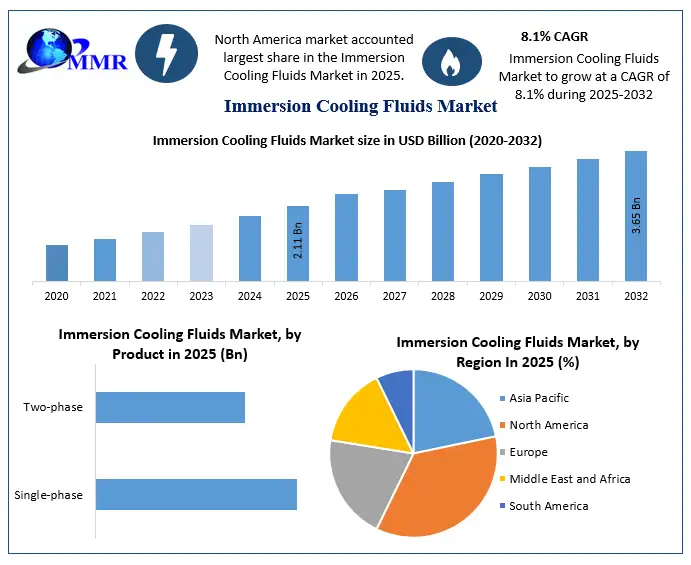
The global immersion cooling fluids market size is projected to expand from USD 2.11 Billion in 2025 to USD 3.65 Billion by 2032.
Mineral oil formulations currently dominate total volume share due to their immediate cost-effectiveness in mainstream server operations.
Synthetic and fluorocarbon-based dielectric fluids are emerging as the fastest-growing segment, preferred for high-density AI infrastructure.
Single-phase immersion systems command the highest market share because of their simplified operational design and lower maintenance friction.
The lack of universal industry standards and comprehensive immersion cooling guidelines remains a primary barrier restricting new market entrants.
Why This Matters Now
Chemical manufacturers, institutional investors, and data center procurement executives are facing an immediate technical disruption as air-cooling infrastructure reaches its physical limits. The rapid rise of artificial intelligence, machine learning, and 5G communications has dramatically increased the thermal output of modern graphics processing units (GPUs) and application-specific integrated circuits (ASICs). Traditional forced-air and legacy water-glycol cooling loops cannot efficiently dissipate the intense heat loads generated by these high-density chip architectures anymore.
This thermal bottleneck turns specialized immersion fluids into a critical, margin-defining asset for the digital infrastructure sector. Data center operators are forced to rapidly transition from standard air management to direct liquid immersion to protect microprocessors from thermal throttling and premature failure. Chemical suppliers that scale up production of high-purity dielectric fluids stand to capture long-term supply agreements, while slower operators risk losing access to the fastest-growing segment of the high-performance computing industry.
Market Overview
The global Immersion cooling fluids market Size reached a valuation of USD 2.11 Billion in 2025 and is projected to hit USD 3.65 Billion by 2032. This trajectory represents a strong expansion as high-density server architectures roll out globally. Immersion cooling involves submerging electronic components directly into non-conductive dielectric liquids, allowing the fluid to absorb and transfer heat with maximum efficiency. This direct thermal contact completely eliminates the need for large metal heatsinks and energy-intensive cooling fans, drastically reducing the facility’s Power Usage Effectiveness (PUE) ratio.
The commercial value of this market is tied closely to broader corporate environmental, social, and governance (ESG) frameworks. By replacing traditional chillers with direct liquid immersion, data center operators can significantly lower their facility power consumption and carbon footprints. Furthermore, immersion cooling systems eliminate heavy water consumption typically lost to evaporation in cooling towers, aligning operations with strict municipal water-use regulations and global resource conservation goals.
Key Trends Driving Growth
The primary driver of market volume is the rapid deployment of next-generation artificial intelligence computing clusters. These advanced AI networks require extreme processing density per server rack, generating thermal loads that standard air-conditioning systems cannot manage. Consequently, cloud service providers and hyperscale operators are redesigning their facility blueprints to integrate dedicated single-phase and two-phase immersion cooling tanks directly into the data center floor.
Simultaneously, the transition toward high-purity synthetic lubricants and advanced fluorochemicals is reshaping the manufacturing landscape. While basic mineral oils provide a cost-effective solution for standard hardware, high-density compute nodes require fluids with enhanced chemical stability, high flashpoints, and long operational lifecycles. This specialized demand is prompting major chemical corporations to invest heavily in specialized synthesis assets to deliver clean, long-lasting dielectric fluids that do not degrade or form sludge under continuous thermal stress.
Segment Insights
Mineral Oil (Dominant Volume Segment): Mineral oil formulations lead the global market by volume due to their low cost and immediate availability across major manufacturing hubs, making them highly attractive for entry-level conversions.
Synthetic Fluids (Fastest-Growing Segment): Engineered synthetic hydrocarbons are expanding rapidly, selected by corporate buyers for their consistent viscosity profiles, superior dielectric strength, and minimal material compatibility risks.
Fluorocarbon-Based Fluids: This segment targets specialized high-density applications, offering exceptional non-flammable characteristics and clean evaporation properties required for advanced two-phase cooling loops.
Single-Phase Product Form (Dominant Segment): Single-phase systems hold the largest share of the market, preferred by operators because the cooling liquid remains in a stable liquid state throughout the entire thermal cycle, simplifying tank maintenance.
Two-Phase Product Form: This method utilizes specialized fluid boiling and condensation cycles to achieve maximum heat dissipation, offering immense cooling capacity for specialized extreme-density processing arrays.
Data Center Infrastructure (Dominant Industry Segment): Hyperscale facilities, banking networks (BFSI), and cloud providers dominate consumption, supplemented by steady growth in telecommunications hubs and automotive electronics testing facilities.
Regional Growth Story
North America stands as the leading region in the global immersion cooling fluids landscape, a position driven by its rapid adoption of advanced high-performance computing technologies. The region host a massive concentration of hyperscale data centers, major AI development firms, and leading semiconductor developers who are aggressively adopting liquid architectures to support intensive model training. This localized demand is supported by strict energy efficiency standards in several states, which penalize inefficient air-cooled facilities and incentivize the adoption of high-efficiency dielectric fluid technologies.
Meanwhile, the Asia Pacific region is expanding its industrial production and consumption capacity. China, India, and Japan are investing heavily in nationwide digital infrastructure, 5G wireless networks, and centralized data hubs to support growing industrial automation. China remains a massive consumer, utilizing local petrochemical assets to manufacture volume-grade mineral fluids for domestic server markets. India is experiencing rapid infrastructure expansion, with massive investments in new data center parks creating long-term opportunities for premium synthetic fluid suppliers.
Competitive Landscape
The competitive landscape is transforming as global lubricant suppliers and specialty chemical corporations move into the high-technology data center thermal management sector. The market structure is shifting away from simple bulk chemical supply toward advanced material science partnerships, where fluid manufacturers work closely with server manufacturers (OEMs) to certify material compatibility. This validation is critical, as the dielectric fluid must come into direct contact with server motherboards, substrates, and solders without causing material degradation or chemical leaching.
Furthermore, leading companies are focusing on technical differentiation to build solid pricing power and capture long-term market share. Producers are tailoring their chemical structures to optimize heat transfer efficiency, minimize fluid degradation, and guarantee high safety margins regarding fire risks. By establishing proprietary fluid blends and securing exclusive certifications from leading server hardware brands, dominant chemical players can insulate their margins from basic commodity oil competition.
Recent Developments
Specialty chemical manufacturers are scaling up production of synthetic base oils derived from advanced gas-to-liquid (GTL) technologies, delivering 99.5% pure dielectric fluids that maintain exceptional thermal tolerance under extreme compute loads.
International lubricant groups are forming strategic partnerships with data center infrastructure builders to deliver integrated, pre-filled immersion tank systems directly to commercial operators.
Materials developers are engineering bio-based synthetic dielectric fluids formulated from renewable plant feedstocks, providing a lower carbon footprint to satisfy strict corporate ESG mandates.
Engineering consortiums are working to establish clearer material compatibility guidelines to help reduce the operational risks associated with long-term fluid exposure.
Strategic Implications
The accelerating shift toward direct liquid immersion requires a total overhaul of legacy chemical procurement and manufacturing frameworks. Sourcing teams at data center firms cannot view immersion fluids as a minor utility item bought on the spot market. Because fluid composition directly impacts server warranty status and hardware performance, procurement leaders must establish long-term quality control agreements with certified chemical producers to guarantee volume consistency and fluid purity.
For chemical manufacturers, this market environment offers an excellent opening to transition low-margin petrochemical streams into high-value specialty products. Investing in advanced filtration, distillation, and chemical stabilization assets allows producers to command premium margins in the fast-growing hyperscale data center market. Companies that fail to secure material compatibility certifications from major hardware developers face being locked out of high-density AI infrastructure projects.
Future Outlook
The long-term trajectory of the global immersion cooling fluids market will be defined by the industry’s ability to establish universal operational standards while managing evolving environmental regulations. While basic mineral oils will continue to support legacy hardware conversions in regional markets, high-density hyperscale installations will increasingly mandate high-purity synthetic and fluorochemical formulations. Chemical companies that successfully secure hardware OEM endorsements and commercialize sustainable, low-carbon synthetic alternatives will capture dominant market share, while suppliers tied exclusively to unrefined commodity oils will face eroding margins and changing market requirements.
Analyst Perspective
“The immersion cooling fluids market is moving rapidly from a niche experimental application into the mainstream core of global data center infrastructure. The sheer thermal density of modern artificial intelligence chips has broken traditional air-cooling models, making direct dielectric fluid contact the only viable pathway for next-generation computing. The long-term winners in this chemical segment will be the advanced material producers who move beyond simple commodity supply to deliver highly engineered, certified synthetic fluids that protect both processing efficiency and hardware lifecycles.” — Yash Ghosalkar, Chemical and Materials Analyst, Maximize Market Research
About Maximize Market Research
Maximize Market Research Pvt. Ltd. (MMR) is a global market research and consulting company that provides reliable, data-focused, and practical business insights. The firm serves a wide range of industries, including healthcare, pharmaceuticals, technology, automotive, electronics, chemicals, personal care, and consumer goods. Through market forecasts, competitive analysis, strategic consulting, and industry impact assessments, MMR helps organizations understand changing market conditions, identify growth opportunities, and make informed business decisions for long-term success.
2nd Floor, Navale IT Park Phase 3
Pune Banglore Highway, Narhe
Pune, Maharashtra 411041, India
+91 9607365656
[email protected]