
Key Highlights
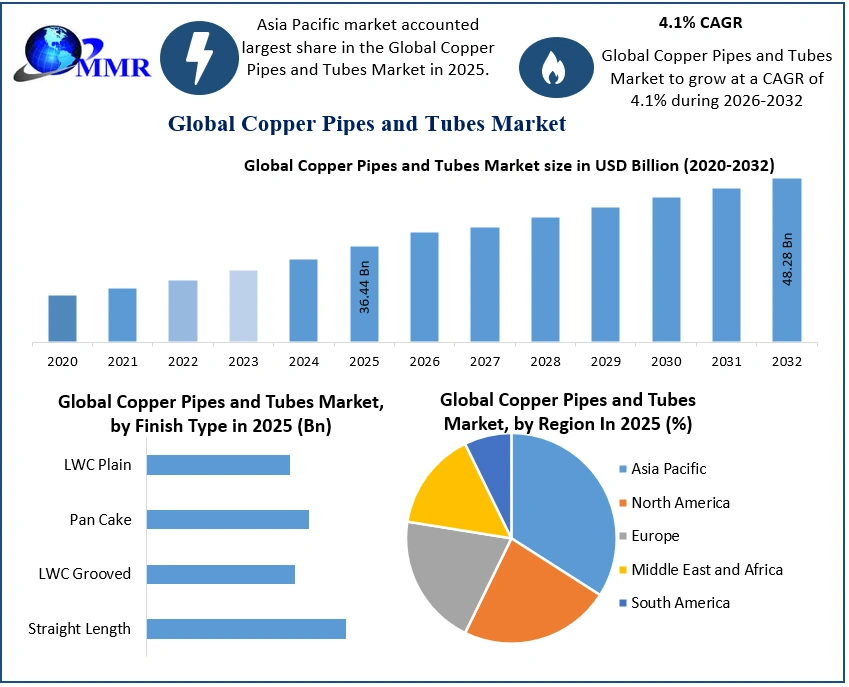
The global copper pipes and tubes market size reached USD 36.44 billion in 2025 and is projected to expand to USD 48.28 billion by 2032.
Market revenue is progressing at a steady 4.1% CAGR across the 2026 to 2032 forecast window.
Copper stands as a highly sustainable engineering material capable of infinite recycling without property degradation.
The industrial heat exchanger application emerged as the dominant structural consumption segment in 2025.
Asia Pacific maintains geographic market leadership, driven by rapid urbanization and infrastructure expansion in China and India.
China serves as a primary processing hub, producing 1.6 million metric tons of mine copper in 2025.
The expansion of electric vehicle platforms is creating new component engineering demands for specialized copper tubing profiles.
Why This Matters Now Procurement operations face immediate exposure to shifting industrial baselines as global infrastructure projects consume historic volumes of refined metallurgical piping. Project managers must rapidly adjust to changing material availability as modern construction specifications mandate infinite recyclability and superior thermal performance. What changed is the structural criteria for industrial conduits, moving copper from standard building plumbing to critical energy-efficient component architectures.
Why now? Industrial heat exchanger expansion and electric vehicle battery thermal regulations are forcing processing majors to scale up highly specialized inner-grooved production runs. This shift benefits integrated metallurgical producers capable of continuous cast extrusion. Conversely, unaligned downstream contractors face immediate exposure to price fluctuations, as global installation costs continue to shift around macro mine-output trends.
Market Overview The global copper pipes and tubes market achieved an industrial valuation of USD 36.44 billion in 2025. Data published by Maximize Market Research indicates that systematic growth will drive total sector revenue to USD 48.28 billion by 2032. This trajectory represents a compounding annual growth rate of 4.1% across the 2026 to 2032 forecast period.
Industrial analysis highlights that copper pipes and tubes are the leading choice for modern contractors managing plumbing, heating, and cooling installations across residential and commercial buildings. Copper functions as an essential engineering material due to its distinctive ability to undergo closed-loop recycling indefinitely without any loss of mechanical strength or chemical purity. The material provides excellent resistance to scaling, structural degradation from UV exposure, high mechanical stress, and aggressive internal corrosion, making it a vital baseline component for multi-decade utility infrastructure.
Key Trends Driving Growth Accelerating investments in public utilities and heavy industrial processing facilities provide strong commercial momentum for the market. Copper tubing is consumed extensively within fossil and nuclear steam-generating electric power plants, chemical manufacturing hubs, marine engineering environments, and global desalination operations. The steady expansion of commercial infrastructure in developing nations requires high-volume deployments of corrosion-free piping networks to manage safe municipal water distribution.
Concurrently, the rapid global evolution of electric vehicle architectures is transforming product development priorities. Component manufacturers are leveraging the material’s high thermal conductivity to design specialized cooling arrays that regulate electric vehicle battery temperatures. Furthermore, a growing trend toward green building certifications encourages developers to adopt eco-friendly, durable copper assemblies over short-lived synthetic alternatives. This structural transition helps protect long-term market valuations from shifting real estate investment patterns.
Segment Insights
Dominant Application Segment: The industrial heat exchanger segment contributed the maximum revenue share to the market in 2025. This leading position stems from widespread utilization in heavy power generation, maritime cooling systems, petrochemical processing, and municipal desalination projects.
Fastest-Growing Product Configuration Segment: The HVAC and refrigeration segment is projected to grow at a lucrative rate over the forecast window. Copper’s excellent malleability and non-pyrogenic properties make it preferred for high-pressure cooling networks.
Form Factor Categorization: Market supply patterns are systematically divided into four distinct structural formats including straight length, level wound coils (LWC) grooved, pancake coils, and plain LWC variants.
Technological Profile Advancements: Manufacturers are shifting production towards grooved LWC profiles to deliver superior internal surface areas, which optimizes heat transfer and enhances resource conservation.
Regional Growth Story The Asia Pacific region held the highest market share in 2025, leading global consumption across volume and revenue metrics. This geographic bloc is positioned to continue driving worldwide market growth due to massive public transport projects and urbanization initiatives in China and India. The region benefits from concentrated manufacturing hubs, an abundant technical workforce, and direct access to primary processed feedstocks.
Domestic supply chains reveal that China remains a primary global force in raw metal processing and component fabrication. In 2025, China produced approximately 1.6 million metric tons of copper from its mining assets. Although this absolute extraction level represents a volume over three times lower than Chile’s leading mine output, China’s concentrated smelting and extrusion capacity allows it to control downstream export flows for finished straight length and LWC tubes across East Asia.
          Global Finished Copper Tube Export & Flow Dynamics (2025)
          ─────────────────────────────────────────────────────────
          [Chilean Primary Mining Base]  ──► Bulk Concentrate Shipments
          [China Smelting & Extrusion]   ──► 1.6 Mn Metric Tons Processed
          [Asia-Pacific Infrastructure]  ──► Dominant Consumer Flow Hub
Competitive Landscape The global copper pipes and tubes market features a consolidated group of major metallurgical corporations and specialized extraction companies. Industry leaders like Furukawa Electric Co., Ltd., Kobe Steel, Ltd., Mueller Industries, Cerroflow Products, Golden Dragon, Mehta Tubes, Qingdao Hongtai Metal Co., Ltd., and Shanghai Hailiang Copper Tubes maintain market share through scale and advanced extrusion technologies. These manufacturers are investing heavily in processing upgrades to satisfy the strict tolerance requirements of global HVAC and automotive procurement teams.
This market structure increases barriers to entry for smaller independent fabricators that lack integrated access to primary copper cathodes. Integrated producers utilize their advanced capacity to manage raw metal spot-market volatility, allowing them to offer stable pricing contracts to tier-one industrial consumers. Smaller operations increasingly focus on local distribution networks or specialized small-diameter plumbing lines to survive competitive price adjustments.
Recent Developments
Processing majors are shifting capital toward advanced inner-grooved tube production lines to maximize heat transfer efficiency in eco-friendly commercial cooling systems.
Refined metallurgical operations in China scaled up automated casting technologies during 2025 to achieve better micro-structural consistency in thin-walled pancake coils.
North American fabrication facilities operated by Mueller Industries updated engineering protocols to support infrastructure replacements in municipal water projects.
Global electric vehicle manufacturing consortia expanded long-term supply contracts for specialized copper cooling components to support high-power battery platforms.
Strategic Implications The rapid adoption of inner-grooved metallurgical profiles reflects a strategic shift toward energy-efficient thermal management systems. Manufacturing majors like Furukawa Electric and Kobe Steel are adjusting their product portfolios to support high-margin industrial heat exchanger lines over basic commodity plumbing tubes. This engineering pivot helps cushion producers against cyclical housing construction slowdowns while capitalizing on strict energy efficiency mandates across the European Union and North America.
Furthermore, China’s ability to refine 1.6 million metric tons of metal highlights the necessity for Western procurement teams to build regional supply buffers. Industrial buyers are structuring long-term contracts with suppliers like Mueller Industries to protect their supply lines from maritime trade disruptions and tariff reclassifications. These strategic investments improve capacity utilization across domestic extrusion mills, driving the market toward automated, precision-engineered products.
Future Outlook The global copper pipes and tubes market will increasingly reward integrated metallurgical processors that can produce high-performance inner-grooved and thin-walled configurations. While steady infrastructure development in the Asia Pacific region provides a strong baseline for bulk commodity tubes, long-term profitability will rely on specialized applications like industrial heat exchangers and electric vehicle thermal management. Manufacturers that master automated, precision extrusion while securing reliable primary metal inputs are best positioned to lead the market as global engineering standards shift toward sustainable materials.
Analyst Perspective “The continuous evolution of electric vehicle battery platforms and advanced HVAC systems is fundamentally redefining the technical expectations for the copper extrusion sector,” stated Ankita Kagawade, Research Analyst at Maximize Market Research. “As modern building regulations and industrial operations demand maximized thermal performance alongside complete material recyclability, precision-engineered grooved copper tubes have shifted from a premium option to an essential structural component.”
About Maximize Market Research
Maximize Market Research Pvt. Ltd. (MMR) is a global market research and consulting company that provides reliable, data-focused, and practical business insights. The firm serves a wide range of industries, including healthcare, pharmaceuticals, technology, automotive, electronics, chemicals, personal care, and consumer goods. Through market forecasts, competitive analysis, strategic consulting, and industry impact assessments, MMR helps organizations understand changing market conditions, identify growth opportunities, and make informed business decisions for long-term success.
2nd Floor, Navale IT Park Phase 3
Pune Banglore Highway, Narhe
Pune, Maharashtra 411041, India
+91 9607365656
[email protected]