
Key Highlights
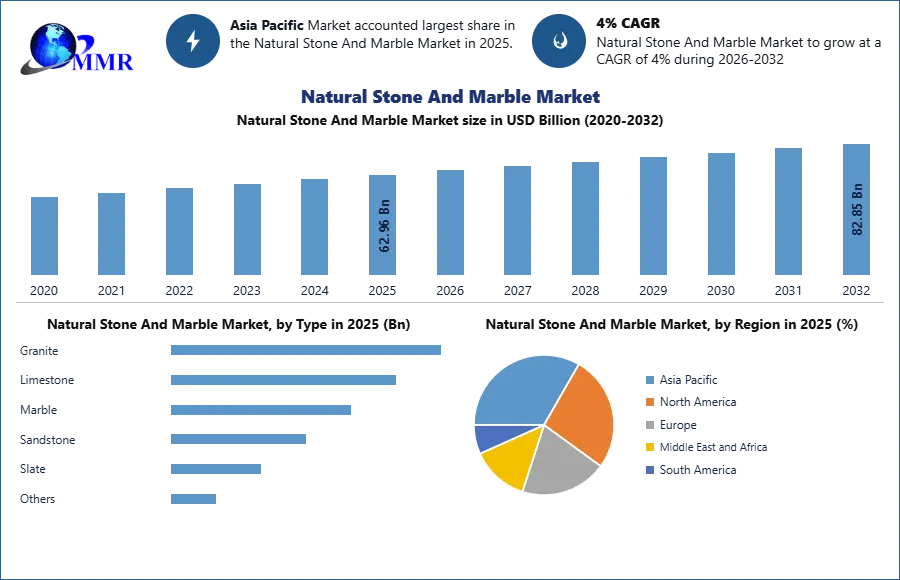
Market valuation reached USD 62.96 Billion in 2025, with revenue projected to hit USD 82.85 Billion by 2032 on a steady 4% CAGR.
Accelerated infrastructure spending and high-end residential projects across emerging economies act as the primary engines for volume growth.
Sustainability mandates and circular economy initiatives force processing plants to adopt advanced water-recycling and stone-dust utilization technologies.
Logistical volatility and rising cross-border freight costs prompt industrial buyers to secure localized supply agreements.
Automation in quarrying equipment minimizes material wastage, directly improving operating margins for major producers.
Why This Matters Now
Volatile cross-border shipping costs and tightening environmental compliance laws are disrupting historical supply lines for premium building materials. Procurement leaders, real estate developers, and industrial buyers can no longer rely on unhedged import strategies for structural and ornamental stone. As carbon-accounting frameworks target the embodied emissions of construction inputs, producers must rapidly transition from high-waste quarrying methods to automated, low-emission processing.
This disruption forces a pivot toward localized supply security and certified eco-friendly materials. Industrial buyers who fail to adapt face severe project delays, margin erosion, and regulatory non-compliance. Conversely, tier-one manufacturers investing in efficient processing technologies stand to capture premium contracts from institutional investors demanding verified sustainable supply chains.
Market Overview
The global Natural Stone and Marble Market Size is undergoing a structural realignment as infrastructure modernization intersects with stricter environmental oversight. Valued at USD 62.96 Billion in 2025, the sector represents a critical foundation for commercial, residential, and institutional development. The market is projected to reach USD 82.85 Billion by 2032, advancing at a compound annual growth rate (CAGR) of 4% from 2026 to 2032. This steady revenue trajectory is fundamentally anchored to the expanding scale of urban development programs across developing economies and a parallel surge in luxury remodeling projects within mature real estate markets.
What changed is the baseline expectation of the buyer. Historically treated as a fragmented, commodity-driven sector, the natural stone market now requires high standardization, precise logistical tracking, and verified sustainability metrics. Why now? Because corporate real estate developers face stringent institutional mandates to reduce the carbon footprint of new builds, changing stone from a simple aesthetic choice into a highly scrutinized industrial asset. Industrial buyers benefit by leveraging long-term supply contracts with automated, high-capacity quarries, while unorganized, high-waste operators face capital starvation. What happens next is an aggressive consolidation of quarry ownership, where well-capitalized firms will acquire smaller operations to secure raw block access and guarantee volume consistency to international markets.
Key Trends Driving Growth
Rapid urbanization across major developing regions stands as the primary structural driver forcing production capacity expansions. As cities expand vertically and horizontally, institutional demand for highly durable, low-maintenance exterior cladding and flooring materials escalates. This structural shift directly boosts the consumption of structural granite and limestone blocks, positioning natural stone as a preferred alternative to synthetic or composite materials in heavy-footprint public infrastructure projects.
Simultaneously, a sharp rise in disposable income across key demographic segments fuels the expansion of the luxury residential sector. High-net-worth consumers increasingly demand premium marble varieties for bespoke interior applications, such as high-end flooring, customized kitchen counter surfaces, and ornate feature walls. This shift toward luxury architecture significantly alters pricing power within the sector. It allows premium quarry operators to command elevated margins on select aesthetic grades, compensating for inflationary pressures tied to labor and energy inputs.
Furthermore, technological advancements in quarrying and stone processing equipment are transforming operational efficiencies across major manufacturing hubs. The integration of diamond wire saw technology, automated CNC fabrication machinery, and advanced resin-treatment lines reduces material cracking during extraction and finishing. This technical evolution minimizes yield loss, allows operators to monetize lower-grade blocks through engineered treatments, and ensures compliance with tight delivery schedules dictated by large-scale infrastructure consortiums.
Segment Insights
Dominant Segment: Marble blocks and slabs constitute the largest market share by material type, driven by continuous consumption across high-end commercial projects, luxury hospitality developments, and premium residential installations.
Fastest-Growing Segment: Granite and engineered natural stone variants represent the fastest-growing categories, accelerating due to their superior structural durability, resistance to environmental weathering, and escalating use in high-traffic public infrastructure and external cladding applications.
Regional Growth Story
The Asia-Pacific region commands the dominant position in the global landscape, anchored by massive production capacities and domestic consumption in China and India. China operates both as a primary consumer and a major processing hub, importing raw blocks globally and exporting finished slabs to international markets. India leverages extensive domestic deposits of granite and marble, supported by expanding industrial parks dedicated to advanced stone processing, which positions the nation as a reliable alternative supply node for Western procurement managers seeking to diversify risks.
In North America, particularly the United States, market momentum is heavily tied to the luxury remodeling sector and institutional commercial construction. The region relies substantially on import flows from Europe and South America, creating vulnerability to freight rate fluctuations and customs adjustments. Meanwhile, European hubs like Italy and Germany remain the gold standard for premium processing technology and high-grade marble exports. European operators face stringent carbon-reduction regulations, forcing them to pioneer circular economy practices, such as converting quarry tailings into aggregate materials, which serves as an operational blueprint for global competitors.
Competitive Landscape
The competitive structure of the natural stone and marble market is transitioning from extreme fragmentation toward targeted consolidation. Tier-one producers are actively acquiring regional quarry operators to secure direct access to rare color veins and high-purity deposits. This strategy effectively locks up premium feedstock availability and prevents smaller, non-integrated processors from competing for high-value architectural contracts.
Moreover, dominant players are aggressively investing in proprietary distribution networks and digital block-selection platforms. By bypassing traditional stone brokers, these integrated manufacturers establish direct-to-specifier communication lines with architects and structural engineers. This structural shift enhances pricing power, optimizes inventory management, and allows producers to align quarrying schedules precisely with real-time downstream demand indicators.
Recent Developments
Leading quarry operators have integrated closed-loop water filtration systems across major processing facilities to comply with strict regional industrial effluent laws.
Global logistics partnerships have been established between major stone exporters and maritime shipping lines to guarantee container availability amid ongoing geopolitical trade disruptions.
Advanced automated scanning systems utilizing artificial intelligence have been deployed on select finishing lines to classify stone slab quality and internal micro-fissures with absolute precision.
Partnerships between stone processors and aggregate manufacturers have expanded to transform quarry waste into raw inputs for the road construction sector.
Strategic Implications
For chemical and material procurement executives, these market shifts dictate an immediate reassessment of traditional purchasing frameworks. Relying on spot-market transactions exposes projects to severe price shocks and lead-time disruptions. To insulate operations from supply-chain shocks, corporate buyers must establish direct, multi-year supply agreements with vertically integrated quarry owners who control their own feedstock processing.
Furthermore, the operational focus must expand to include rigorous auditing of upstream extraction practices. As environmental regulations tighten globally, suppliers operating without verified water-recycling systems or waste-management protocols face sudden regulatory closures. Securing alternative supply nodes in regions like India and South Korea ensures compliance, builds operational resilience, and prevents costly structural material bottlenecks.
Future Outlook
The global natural stone and marble market will increasingly reward highly automated, vertically integrated producers capable of certifying the environmental footprint of their extraction and logistics networks. Operators reliant on inefficient, high-waste processing lines will face escalating compliance penalties and eventual exclusion from premium institutional project tenders. Ultimate market dominance will belong to those firms that successfully merge automated quarrying precision with verified carbon-neutral processing capabilities to deliver volume security to an increasingly demanding global construction sector.
Analyst Perspective
“The global natural stone and marble market is no longer defined solely by aesthetic preference or geographic proximity,” stated Ankita Kagawade, Analyst at Maximize Market Research. “We are observing a fundamental realignment where structural supply chain resilience, automated yield optimization, and certified low-carbon extraction practices dictate which producers secure tier-one international contracts. As institutional buyers tighten procurement compliance, vertical integration from quarry to job site is transitioning from an operational advantage to an absolute market necessity.”
About Maximize Market Research
Maximize Market Research Pvt. Ltd. (MMR) is a global market research and consulting company that provides reliable, data-focused, and practical business insights. The firm serves a wide range of industries, including healthcare, pharmaceuticals, technology, automotive, electronics, chemicals, personal care, and consumer goods. Through market forecasts, competitive analysis, strategic consulting, and industry impact assessments, MMR helps organizations understand changing market conditions, identify growth opportunities, and make informed business decisions for long-term success.
2nd Floor, Navale IT Park Phase 3
Pune Banglore Highway, Narhe
Pune, Maharashtra 411041, India
+91 9607365656
[email protected]