
Key Highlights
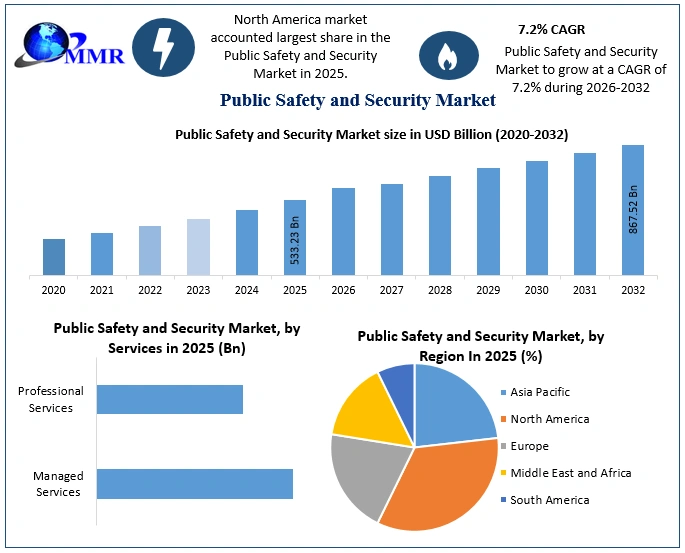
The global public safety and security market achieved a valuation of USD 533.23 Billion in 2025 and is projected to expand significantly by the end of the forecast period.
Global market revenue is on track to reach USD 867.52 Billion by 2032, maintaining a steady compound annual growth rate (CAGR) of 7.2%.
Homeland security remains the dominant vertical segment, capturing the absolute largest market share due to escalating cross-border threat landscapes and critical perimeter mandates.
Transportation systems function as the fastest-growing vertical segment, driven by rapid investments in automated transit tracking and intelligent edge monitoring.
Managed services represent the fastest-growing service category as organizations offload complex continuous monitoring tasks to specialized automation vendors.
North America remains the dominant regional market, while the Asia-Pacific region emerges as the fastest-growing geography due to massive civil infrastructure modernizations.
Why This Matters Now
The convergence of physical infrastructure and open digital networks creates an unprecedented vulnerability landscape for industrial operators, utility networks, and municipal authorities. Legacy security architectures reliant on manual perimeter patrols and disconnected surveillance nodes are completely obsolete against synchronized cyber-physical threats. To secure massive manufacturing assets, transportation networks, and energy grids from catastrophic operational downtime, enterprise leaders are forced to deploy fully automated, proactive threat mitigation systems.
This systemic vulnerability transforms public safety from an auxiliary cost center into a core pillar of automated process control and operational continuity. System integrators, technology buyers, and infrastructure investors are rapidly shifting capital away from standalone hardware toward unified, intelligent security platforms. Systems that merge real-time machine vision, automated access control, and industrial internet of things (IIoT) sensors provide immediate operational protection and resilience. Conversely, operators who delay the modernization of their facility monitoring architectures face severe regulatory penalties, steep insurance premiums, and crushing liability risks if a breach occurs.
Market Overview
The global public safety and security market Size is undergoing an aggressive technological expansion, moving from its 2025 valuation of USD 533.23 Billion to a projected peak of USD 867.52 Billion by 2032. This sustained trajectory represents a solid 7.2% CAGR, illustrating a global mandate to insulate vital civil and industrial nodes from external disruptions. The underlying market data indicates that security infrastructure is no longer managed in isolation but is tightly integrated into corporate enterprise resource planning and smart city networks.
What changed? The historical reliance on localized, unlinked alarm panels has been replaced by cloud-native supervisory control and data acquisition (SCADA) platforms that consolidate threat telemetry across entire continents. Why now? Accelerating infrastructure development, a surge in high-rise commercial complexes, and escalating geopolitical instability have made manual security coordination mathematically impossible at scale. The primary beneficiaries are advanced automation providers and infrastructure developers who can build intelligent, self-healing perimeter protection networks that isolate and neutralize threats automatically before they impact daily operations.
Key Trends Driving Growth
The primary structural trend driving this market is the deep integration of Industry 4.0 principles into civil and industrial surveillance networks. Modern security deployment relies heavily on edge computing nodes and IIoT sensor arrays that stream continuous ambient data to centralized command centers. This interconnected configuration allows operators to monitor perimeter integrity, structural health, and environmental anomalies simultaneously, transforming reactive security into an active process optimization framework.
Furthermore, advancements in critical communication network solutions are altering how emergency services and industrial facilities coordinate during crises. These high-bandwidth, automated communication layers ensure uninterrupted data transmission even during severe power grid failures or targeted network disruptions. By deploying redundant, self-configuring mesh networks, facility managers can maintain absolute visibility over remote programmable logic controllers (PLCs) and automated valve assemblies, preventing secondary industrial disasters during emergency events.
Simultaneously, industrial cybersecurity initiatives have become mandatory to protect integrated operational technology (OT) environments. As modern security tools link directly to municipal networks and corporate IT pipelines, they present attractive entry targets for sophisticated bad actors. To defend these vital gateways, top-tier infrastructure operators are building advanced firewalls, automated intrusion detection software, and zero-trust verification rules directly into their distributed control systems (DCS).
Segment Insights
Vertical Categorization: The market is divided into homeland security, emergency services, and critical infrastructure security and transportation systems, with each category receiving targeted technology upgrades.
Core Market Leader: Homeland security functions as the Dominant Segment by vertical, commanding the largest revenue share in 2025 due to massive national budgets dedicated to border protection and automated port-of-entry screening.
Growth Velocity Leader: Transportation systems operate as the Fastest-Growing Segment by vertical, exhibiting an accelerated CAGR as cities integrate automated machine vision and intelligent rail monitoring to secure expanding urban transit loops.
Service Innovations: Managed services represent the Fastest-Growing Segment within the service classification, expanding rapidly as enterprise operations transfer the maintenance of complex digital twins and analytical security software to external automation partners.
Solution Dynamics: The critical communication network solution category is experiencing explosive procurement velocity compared to other solution segments, reflecting an urgent requirement for secure, fault-tolerant infrastructure links.
Regional Growth Story
North America commanded the absolute largest share of the public safety and security market in 2025, setting the global standard for sophisticated technology implementation. The region benefits from highly integrated emergency response grids and rigid regulatory frameworks that compel industrial operators to protect critical infrastructure nodes continuously. Capital investments across the United States focus sharply on upgrading legacy transit and municipal monitoring hubs with advanced AI-driven automated threat identification software.
Europe holds the second-largest market position, characterized by stringent data privacy mandates and highly coordinated cross-border transportation networks. European deployment focuses heavily on securing automated supply chains and integrating smart factory perimeters into regional emergency response systems. Meanwhile, the Asia-Pacific region is emerging as the fastest-growing automation market, powered by massive, state-backed infrastructure investments in China and India, where newly constructed commercial corridors and smart cities are deploying automated security architectures directly from the blueprint stage.
Competitive Landscape
The competitive landscape is transitioning from physical hardware delivery to unified software orchestration and end-to-end network control. Market value is no longer concentrated in individual camera lenses or automated access barriers; instead, dominance is dictated by a provider’s capacity to ingest, analyze, and secure disparate data streams across sprawling geographies. Key global technology entities including Cisco (US), Ericsson (Sweden), General Dynamics (US), Harris Corporation (US), Hexagon (Sweden), Huawei Technologies (China), IBM (US), and Motorola Solutions (US) are actively competing to deploy the definitive operational operating system for public safety.
This competitive environment signals that standalone, non-interoperable security tools are becoming severe operational liabilities for modern enterprises. When major players launch advanced critical communication modules or edge analytics packages, they are moving to replace fractured legacy frameworks with single-pane-of-glass management environments. Technology providers that can bridge the historical divide between physical facility safety and digital asset protection are carving out highly defensible market positions, while unlinked hardware manufacturers face rapid margin erosion.
Recent Developments
Technology providers are accelerating investments in cloud-hosted, multi-facility critical communication systems to unify emergency data routing across decentralized industrial zones.
Enterprise developers have introduced advanced machine vision filters designed to deploy directly onto factory edge cameras, automating the identification of unauthorized personnel near high-voltage control panels.
Implementation of integrated SCADA and DCS security patch management systems has risen sharply across North American utility networks to counter sophisticated cyber-physical threats.
Strategic Implications
The primary business consequence of this rapid security automation is a permanent increase in operational friction for companies that retain unlinked legacy systems. Facilities that maintain fractured, non-interoperable monitoring configurations suffer from delayed incident response times, which directly amplifies the financial damage of any physical or digital breach. Conversely, smart facilities leveraging automated threat detection minimize incident escalation windows, protecting expensive robotic machinery and capital assets from prolonged downtime.
What happens next is an aggressive market division based on the technical interoperability of corporate security setups. Smaller municipal operators and mid-tier industrial firms that cannot afford to integrate their security nodes into centralized SCADA platforms will struggle with rising operational risk profiles. Long-term market leadership belongs exclusively to forward-thinking executives who treat public safety and asset protection as an automated, continuous process control loop rather than a passive insurance obligation.
Future Outlook
The trajectory of the public safety and security market points toward a future defined by completely autonomous, self-optimizing security operations. Future deployment frameworks will utilize real-time digital twins of entire factory floors and municipal transit systems to run predictive threat simulations continuously. This proactive configuration will allow the central automation system to dynamically re-route automated guided vehicles (AGVs) and lock down critical SCADA zones before an emerging threat can disrupt production schedules.
The final division between industry leaders and lagging enterprises will depend entirely on their speed of digital conversion and OT-IT convergence. The market is approaching a structural milestone where the speed of automated data routing determines physical asset safety. Organizations that construct unified, highly secure, and cloud-connected safety pipelines will protect their production capacities effortlessly, leaving unautomated laggards to manage mounting capital and physical disruptions.
The dividing line across the industry will separate highly integrated enterprises running autonomous, self-healing security networks from fragmented operations trapped in manual monitoring and disconnected legacy hardware.
Analyst Perspective
“The complete convergence of physical security platforms with industrial automation networks represents a fundamental evolution in critical infrastructure protection. To insulate high-value assets from sophisticated modern threats, enterprise leaders must transition away from legacy, non-interoperable hardware and embrace unified, automated IIoT safety architectures.” — Yash Ghosalkar, Research Analyst, Maximize Market Research
About Maximize Market Research
Maximize Market Research Pvt. Ltd. (MMR) is a global market research and consulting company that provides reliable, data-focused, and practical business insights. The firm serves a wide range of industries, including healthcare, pharmaceuticals, technology, automotive, electronics, chemicals, personal care, and consumer goods. Through market forecasts, competitive analysis, strategic consulting, and industry impact assessments, MMR helps organizations understand changing market conditions, identify growth opportunities, and make informed business decisions for long-term success.
2nd Floor, Navale IT Park Phase 3
Pune Banglore Highway, Narhe
Pune, Maharashtra 411041, India
+91 9607365656
[email protected]