
Key Highlights
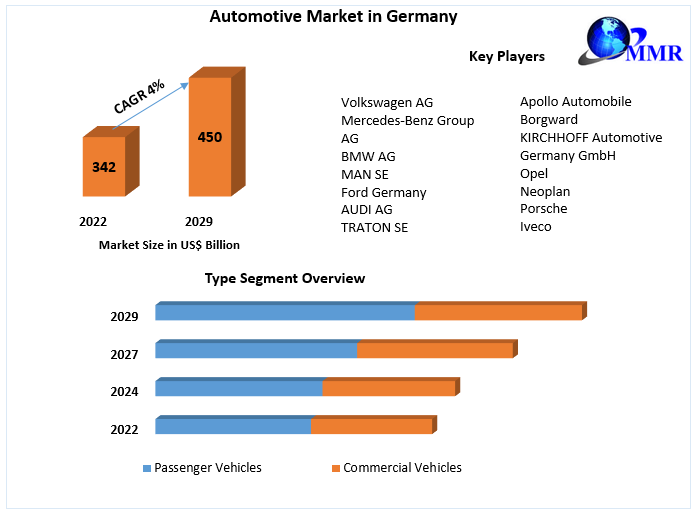
Substantial Valuation Base: The automotive market in Germany reached a baseline valuation of US$ 432 billion in 2022 and is on track to achieve US$ 450 billion by 2029.
Statutory Electrification Mandate: Germany has dictated that 100% of new vehicle registrations must be fully electric by 2030, effectively establishing an outright prohibition on gas-powered internal combustion engines.
Radical Profit Realignment: European automotive profit pools are projected to nearly double from EUR 850 billion in 2016 to EUR 1,400 billion by 2030, led by digital diversification.
Surge in Software Revenue: Data-enabled services and shared mobility systems are expected to capture 27% of total automotive revenues by 2030, rising from a minimal baseline of 0.2% in 2016.
Reversal in Youth Ownership: Driven by shifting preferences, 44% of younger consumers who have never previously owned a vehicle are now actively planning a vehicle purchase.
Why This Matters Now Automotive original equipment manufacturers (OEMs), Tier-1 suppliers, and legacy infrastructure investors face immediate operational obsolescence if they fail to instantly reallocate capital away from internal combustion architectures. Germany’s absolute prohibition on new gas-powered vehicle sales by 2030 creates a hard deadline that leaves zero room for transition delays or extended engineering cycles. At the same time, traditional transactional vehicle sales margins are contracting, forcing companies to instantly build out high-margin digital business units. Supply chains must reorganize around software developers and advanced electrical engineers rather than mechanical assemblers. Companies that do not rapidly adapt their production lines to meet these legal and structural transformations will find themselves completely excluded from the European automotive ecosystem.
Market Overview The global Automotive Market remains fundamentally anchored by Germany, which serves as the largest and most technically advanced production and sales market within Europe. According to Maximize Market Research, the automotive market in Germany was valued at US$ 432 billion in the 2022 base year. Operating at a stable compound annual growth rate (CAGR) of 4% throughout the forecast period from 2023 to 2029, the industry is projected to scale its total valuation to US$ 450 billion by 2029. This expansion represents a resilient recovery and restructuring following severe global supply chain bottlenecks and macroeconomic shocks.
The structural environment within Germany benefits from complete industry value chain integration, a world-class research and development infrastructure, and a highly capable workforce. German automotive brands represent high-value metrics of consumer safety, product reliability, engineering excellence, and design innovation from Asia to the Americas. However, the foundational economic value contribution of this sector must now adapt to secure its long-term significance as a premier global export engine. Traditional business models built purely on classic vehicle distribution and basic mechanical aftermarket operations are experiencing a permanent decline.
The fundamental revenue and profit pools of the entire European automotive ecosystem are shifting toward disruptive, software-defined architectures. Total European automotive profits based on customer expenditure are expected to nearly double, rising from EUR 850 billion in 2016 to EUR 1,400 billion by 2030. This expansion does not reflect a simple increase in vehicle unit volumes, but rather the rapid commercialization of data-enabled services, intelligent transport mobility solutions, and connected automated vehicle platforms.
Key Trends Driving Growth The most disruptive structural trend rewriting the automotive landscape is the aggressive statutory push toward total fleet electrification. The German government has enacted a legally binding mandate requiring all new passenger cars to be entirely electric by 2030, imposing a strict prohibition on traditional gas-powered internal combustion systems. To accelerate consumer adoption and support manufacturing lines, federal authorities introduced a massive EUR 130 billion stimulus package designed to shore up the post-pandemic economy. This package includes specific strategies to double the financial value of existing buying incentives for battery electric vehicles (BEVs).
Simultaneously, a profound and unexpected reversal in consumer behavior is reshaping retail demand dynamics across the globe. Data from a comprehensive study of 11,000 customers across 11 countries—representing 62% of global annual passenger vehicle sales—reveals that interest in individual car possession among individuals under the age of 35 is increasing for the first time in decades. Within this younger demographic, 44% of individuals who have never previously owned a car are actively planning to purchase an individual vehicle. Conversely, consumer demand for shared public transit systems and basic municipal mobility services is declining significantly.
Furthermore, long-haul logistics and commercial surface freight operations are undergoing a parallel technological modernization to meet strict corporate efficiency metrics. Global surface freight intensity is projected to increase by 40% through the year 2050, placing immense pressure on existing highway networks and distribution nodes. In response, industrial planners are establishing intelligent transport mobility solutions designed to fulfill Germany’s strategic vision of a 100% on-time, cost-efficient, and consumer-focused delivery network. This logistics push provides an immediate commercial market for automated commercial vehicles and smart fleet management platforms.
Segment Insights The market architecture is segmented by vehicle type and technology application to monitor shifting capital allocation:
Dominant Segment: Passenger Vehicles remain the dominant segment by value and production volume, driven by high domestic demand, strong export channels, and a significant surge in vehicle acquisition interest among buyers under 35 years old.
Fastest-Growing Segment: Electric and Hybrid Commercial Vehicles represent the fastest-growing segment, accelerated by a projected 40% rise in surface freight intensity through 2050 and the implementation of intelligent transit solutions.
Value Chain Categorization: The market tracks the transition from traditional hardware assembly to advanced data-enabled services and connected autonomous systems.
Propulsion Architectures: The product spectrum details the structural shift away from traditional gas-powered internal combustion engines toward high-efficiency battery electric vehicle (BEV) and hybrid powertrains.
Regional Growth Story Germany maintains its position as the undisputed center of gravity for European automotive manufacturing and technological innovation. The domestic market acts as a primary exporter to major global economic hubs, meaning that regulatory updates implemented within Germany rapidly dictate manufacturing standards across production facilities in the US, China, Japan, and South Korea. The substantial financial grants and doubled buying incentives available within the country are successfully attracting a fresh wave of foreign direct investment into local component manufacturing and battery cell development.
This regional concentration of capital enables local firms to develop cutting-edge systems that address future international mobility needs. While the domestic consumer base demands immediate access to premium, zero-emission passenger vehicles, regional logistics operators are driving the deployment of advanced software platforms. The integration of the local supply chain minimizes transport costs for raw materials, giving German production plants a distinct competitive advantage over decentralized manufacturing hubs.
Competitive Landscape The competitive landscape is defined by aggressive, capital-intensive portfolio restructurings as established legacy automotive groups race to protect their market share from agile software-native entrants. Major manufacturers are completely altering their long-term powertrain strategies to survive the upcoming 2030 internal combustion engine ban. For example, the Daimler Group—the parent entity of Mercedes-Benz—recently declared a comprehensive corporate strategy to integrate advanced electric powertrains across all of its global vehicle brands. This strategic shift signals an industry-wide consensus that fossil-fuel development lines must be permanently decommissioned to safeguard future pricing power.
Concurrently, Europe’s largest automotive entity, Volkswagen AG, alongside premium manufacturers such as AUDI AG and Porsche, are funneling billions into proprietary software stacks to capture emerging digital revenue pools. Commercial vehicle giants like MAN SE, TRATON SE, and Iveco are rapidly upgrading their heavy-duty platforms to integrate the intelligent transport solutions demanded by logistics firms. Independent performance brands and niche developers, including Apollo Automobile and Borgward, are forced to seek out technical partnerships to absorb the high costs of electrification.
Tier-1 component suppliers and specialized manufacturing specialists are consolidating to secure vital positions within the electrified supply chain. Legacy brands like Opel and Ford Germany are leveraging localized value chain integration to optimize their manufacturing costs amidst rising material prices. Mid-sized engineering specialists, such as KIRCHHOFF Automotive Germany GmbH, are retooling their factories to supply lightweight, high-strength structural components optimized specifically for heavy battery packs. This deep industrial alignment ensures that component suppliers are deeply integrated into the initial vehicle design phase.
Recent Developments
Daimler Group Electrification Rollout: The Daimler Group enacted an absolute corporate directive to introduce high-efficiency electric powertrains across all of its operating sub-brands.
Incentive Escalation Strategy: The German federal government formally executed a strategy to double existing consumer buying incentives for battery electric vehicles as part of a broader EUR 130 billion economic package.
Disruptive Profit Migration: Financial metrics confirmed that data-enabled automotive services and shared mobility applications surged toward capturing a projected 27% of total industry revenue.
Freight Efficiency Initiatives: Logistics networks and transit authorities deployed integrated intelligent transport mobility solutions to offset a projected 40% escalation in regional surface freight intensity.
Strategic Implications The permanent migration of profit pools from mechanical hardware to digital ecosystems means that traditional vehicle assembly will soon serve merely as a lower-margin customer acquisition tool for high-margin software subscriptions. OEMs must transform into agile tech firms capable of delivering over-the-air performance updates, real-time predictive diagnostics, and advanced data-enabled services. Tier-1 suppliers must transition away from internal combustion components and secure exclusive intellectual property rights for thermal management systems, power electronics, and sensor fusion modules. Legacy companies that fail to secure these digital competencies will face severe margin compression and eventual exclusion from major municipal transit fleets.
Future Outlook The complete reconfiguration of the European automotive ecosystem guarantees that future market dominance will belong exclusively to entities that successfully monetize vehicular data streams and execute seamless transitions to 100% electric propulsion well ahead of statutory deadlines. The dividing line across the global automotive landscape will permanently separate future leaders who control the digital operating systems and proprietary battery architectures from laggards who remain restricted to assembling legacy mechanical hardware for shrinking, non-compliant markets.
Analyst Perspective “The structural realignment of European automotive profit pools proves that hardware assembly is no longer the primary driver of corporate value,” states Dharati Raut, Analyst at Maximize Market Research. “As statutory electric vehicle mandates collide with a structural resurgence in individual youth car ownership, the manufacturers that control advanced data-enabled services will command absolute pricing power.”
About Maximize Market Research
Maximize Market Research Pvt. Ltd. (MMR) is a global market research and consulting company that provides reliable, data-focused, and practical business insights. The firm serves a wide range of industries, including healthcare, pharmaceuticals, technology, automotive, electronics, chemicals, personal care, and consumer goods. Through market forecasts, competitive analysis, strategic consulting, and industry impact assessments, MMR helps organizations understand changing market conditions, identify growth opportunities, and make informed business decisions for long-term success.
2nd Floor, Navale IT Park Phase 3
Pune Banglore Highway, Narhe
Pune, Maharashtra 411041, India
+91 9607365656
[email protected]