
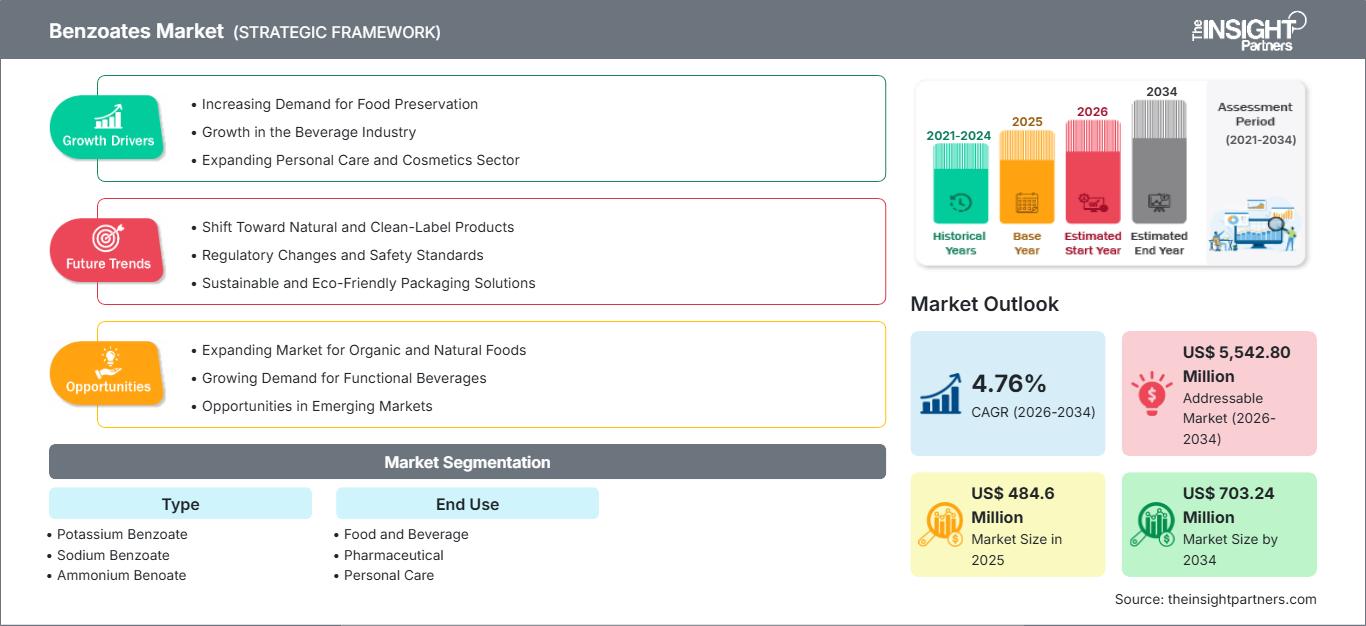
Food safety scares have made shoppers read ingredient labels more carefully than ever before, and preservative choices now shape purchasing decisions in ways they rarely did a decade ago. Against this backdrop, the Benzoates Market is projected to climb from US$ 484.6 Million in 2025 to US$ 703.24 Million by 2034, advancing at a CAGR of 4.76% across the 2026 to 2034 forecast period. That steady climb reflects how deeply benzoate compounds are woven into everyday food, pharmaceutical, and personal care formulations.
What Is the Benzoates Market?
Benzoates are salts of benzoic acid, primarily potassium, sodium, and ammonium variants, used as antimicrobial preservatives and functional additives. They inhibit mould, yeast, and bacterial growth, extending shelf life across beverages, sauces, medicines, and cosmetic formulations while keeping production costs manageable.
Market Drivers
Rising consumption of packaged and ready-to-drink beverages sits at the centre of this growth story. Carbonated soft drinks, fruit juices, and flavoured waters rely heavily on sodium and potassium benzoate to resist microbial spoilage, and as urban consumers in Asia Pacific and South and Central America shift toward convenience foods, demand for reliable, low-cost preservation follows close behind.
Request a Sample Copy of the Report: https://www.theinsightpartners.com/sample/TIPRE00040453
Pharmaceutical applications are adding a second growth layer. Benzoates are widely used in cough syrups, oral suspensions, and topical formulations, where their preservative action protects liquid dosage forms from contamination over extended shelf periods. Generic drug manufacturing has expanded rapidly across emerging economies, and that expansion is pulling benzoate demand along with it.
Personal care is quietly becoming just as important. Lotions, shampoos, and cosmetic creams need protection against microbial growth once water-based formulas are opened repeatedly by consumers, and benzoates offer a cost-effective, well-studied option compared with some alternative preservative systems. What makes this particularly significant is that regulatory bodies in most major markets continue to classify benzoates as safe within defined usage limits, which gives formulators confidence to keep using them even as scrutiny of synthetic additives intensifies elsewhere.
Cost pressure across the food and beverage industry reinforces all of this. Benzoates remain considerably cheaper than many natural preservative alternatives, and for manufacturers balancing margins against consumer expectations, that price gap still matters enormously.
Segments Covered
By Type: Potassium benzoate leads usage in beverages and pharmaceutical liquids owing to its high solubility and mild taste profile. Sodium benzoate remains the most widely produced and applied variant across food processing, valued for its broad-spectrum antimicrobial action. Ammonium benzoate serves smaller, specialised industrial and chemical intermediate applications.
By End Use: Food and beverage dominates consumption, driven by processed foods, condiments, and soft drinks. Pharmaceutical applications continue expanding alongside global generic drug output. Personal care usage is growing steadily as cosmetic manufacturers scale production of water-based formulations.
By Geography: North America and Europe maintain mature, regulation-driven demand, while Asia Pacific and South and Central America are emerging as the fastest-growing regions on the back of rising packaged food consumption and expanding pharmaceutical manufacturing.
Key Market Players
- LANXESS
- Wuhan Youji Industries Co. Ltd.
- Tengzhou Tenglong Chemical Co. Ltd
- Eastman Chemical Company
- Vertellus
- Spectrum Chemical Mfg. Corp.
- Merck KGaA
- Tokyo Chemical Industry Co. Ltd.
These companies span integrated chemical manufacturers and specialty ingredient suppliers, with several expanding production capacity in Asia Pacific to serve regional food and pharmaceutical demand more directly.
Sustainability and Innovation Trends
Manufacturers are investing in cleaner production routes for benzoic acid derivatives, reducing solvent use and effluent generation during synthesis. Beyond that, several suppliers are developing high-purity, low-heavy-metal grades to satisfy tightening pharmacopoeial standards, particularly for injectable and paediatric formulations where impurity tolerances are strict. Interest in bio-based benzoic acid production, derived from renewable feedstocks rather than petrochemical toluene, is also gaining traction as brands look to soften the “synthetic preservative” perception without abandoning benzoates altogether.
Buy Premium Report: https://www.theinsightpartners.com/buy/TIPRE00040453
Regional Outlook
North America holds a mature, stable share supported by strict food safety enforcement and a well-established pharmaceutical manufacturing base. Europe follows a similar pattern, with demand tempered somewhat by consumer preference shifts toward natural preservatives in select product categories. Asia Pacific is the standout growth region, propelled by China and India’s expanding processed food, beverage, and generic pharmaceutical sectors, alongside lower-cost domestic manufacturing capacity. South and Central America is showing consistent gains as packaged food penetration deepens across Brazil and neighbouring markets.
Related Reports
About The Insight Partners
The Insight Partners is among the leading market research and consulting firms in the world. We take pride in delivering exclusive reports along with sophisticated strategic and tactical insights into the industry. Reports are generated through a combination of primary and secondary research, solely aimed at giving our clientele a knowledge-based insight into the market and domain. This is done to assist clients in making wiser business decisions. A holistic perspective in every study undertaken forms an integral part of our research methodology and makes the report unique and reliable.
Contact Us:
If you have any queries about this report or if you would like further information, please contact us:
Phone: +1-646-491-9876
E-mail: [email protected]
Also Available in: Korean | German | Japanese | French | Chinese | Italian | Spanish