
The industrial fluid handling sector is undergoing a significant transformation driven by rapid urbanization, infrastructure expansion, and strict energy efficiency regulations. At the core of this transformation are end suction pumps one of the most widely utilized types of centrifugal pumps globally. Designed with a single suction inlet located at the end of the pump and a discharge outlet positioned at a right angle, these pumps are renowned for their mechanical simplicity, high operational reliability, and cost-effective maintenance.
Get a PDF Sample- https://www.theinsightpartners.com/sample/TIPRE00017197
Key Drivers and Market Dynamics
End suction pumps serve as the backbone for fluid transport in modern industrial and municipal applications. Their popularity stems primarily from their compact footprint and ease of installation compared to multi-stage or split-case alternatives.
Several key factors are driving the expansion of the market:
Expanding Water & Wastewater Management: Governments around the globe are investing heavily in modernizing municipal water infrastructure and building advanced wastewater treatment plants. End suction pumps play a critical role in secondary treatment processes, clear water booster systems, and municipal distribution networks.
Growing HVAC Demand in Commercial Construction: Rapid urban development in emerging economies has fueled a boom in commercial real estate. End suction pumps are integral components of heating, ventilation, and air conditioning (HVAC) systems, facilitating chilled water circulation and condenser water pumping.
Focus on Energy Efficiency and Sustainability: Energy consumption accounts for the vast majority of a pump’s total life-cycle cost. Environmental mandates and rising operational expenses have pushed manufacturers to design high-efficiency hydraulic systems. Modern end suction pumps incorporate variable frequency drives (VFDs) and optimized impellers to meet stringent eco-design standards, significantly reducing energy losses.
Agricultural and Industrial Modernization: Efficient water management in agriculture especially in flood-prone or drought-affected regions demands high-capacity pumping solutions. Additionally, chemical, oil and gas, and manufacturing facilities rely on rugged, corrosion-resistant end suction pumps tailored to handle volatile and corrosive fluids.
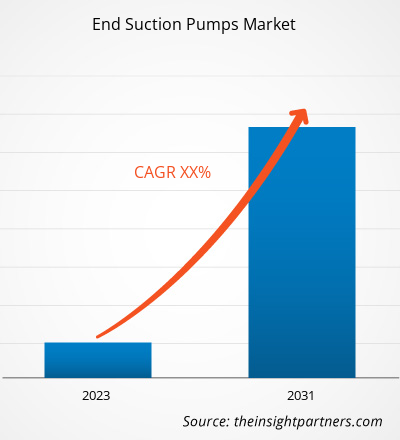
According to the latest research report published by The Insight Partners, the global end suction pumps market size is projected to reach US$ 7.0 billion by 2034 from US$ 4.64 billion in 2025. The market is anticipated to register a CAGR of 4.67% during the forecast period 2026–2034. This sustained growth reflects increasing demand across water treatment, HVAC systems, agricultural irrigation, power generation, and chemical processing sectors.
Market Segmentation Insights
The market for end suction pumps can be analyzed across multiple segments:
By Type: Close-coupled end suction pumps and frame-mounted (long-coupled) end suction pumps. Close-coupled variants are highly favored in commercial and light industrial applications due to their space-saving design and lower initial cost. Frame-mounted pumps, on the other hand, are preferred in heavy industrial environments where high durability and easy seal replacement are paramount.
By Material: Cast iron, stainless steel, bronze, and specialty alloys. Stainless steel models are gaining rapid traction in food and beverage, pharmaceutical, and chemical industries due to their superior resistance to corrosion and contamination.
By End-Use Industry: Municipal water supply, HVAC, building services, agriculture, power generation, chemical processing, and oil & gas. The municipal and HVAC segments together account for a dominant share of market revenue.
Competitive Landscape & Key Players
The global end suction pumps market is characterized by a mix of established international corporations and specialized regional manufacturers. Market leaders are actively investing in research and development, smart monitoring capabilities (IoT integration), and strategic acquisitions to broaden their product portfolios and geographical footprint.
Prominent players operating in the global market include:
ANDRITZ Group
Ebara Corporation
Flowserve Corporation
Grundfos
Kirloskar Brothers Limited
KSB SE and Co. KGaA
Ruhrpumpen Group
Sulzer Ltd.
WILO SE
Xylem Inc.
These industry leaders continuously focus on innovating hydraulic designs, integrating smart sensors for predictive maintenance, and manufacturing pumps with sustainable materials to stay ahead in a competitive market.
Get Full Copy of This Report- https://www.theinsightpartners.com/buy/TIPRE00017197
Future Outlook
The future of the end suction pumps market looks promising, characterized by technological advancements and smart fluid management solutions. Over the next decade, the integration of Industrial Internet of Things (IIoT) frameworks into pumping hardware will transition from a value-added feature to an industry standard. Predictive maintenance capabilities enabled by real-time vibration, temperature, and pressure monitoring will dramatically reduce unplanned downtime and optimize energy consumption for end-users. Furthermore, rising investments in desalination plants, renewable energy facilities, and green building developments worldwide will present lucrative growth opportunities for manufacturers. As global focus shifts toward carbon neutrality and water stewardship, the adoption of high-efficiency, smart end suction pumps will remain a critical priority across industries through 2034 and beyond.
Related Reports-
About Us
The Insight Partners is a one-stop industry research provider of actionable intelligence. We help our clients in getting solutions to their research requirements through our syndicated and consulting research services. We specialize in industries such as Semiconductor and Electronics, Aerospace and Defense, Automotive and Transportation, Biotechnology, Healthcare IT, Manufacturing and Construction, Medical Devices, Technology, Media, and Telecommunications, as well as chemicals and Materials.