
The modern battlespace is undergoing a profound technological transformation, driven primarily by the integration of unmanned systems into strategic and defense operations. Among these, rotary wing military drones commonly referred to as vertical takeoff and landing (VTOL) unmanned aerial vehicles (UAVs) have emerged as indispensable assets for defense forces worldwide. Characterized by their exceptional maneuverability, hover capabilities, and ability to operate in confined or austere environments without needing a dedicated runway, these platforms provide unmatched operational versatility.
Get a PDF Sample- https://www.theinsightpartners.com/sample/TIPRE00018638
Market Drivers and Tactical Advantages
The steady surge in demand for rotary wing military drones stems from several tactical benefits over traditional fixed-wing UAVs and manned aircraft. The defining feature of rotary wing platforms is their vertical takeoff and landing capability. This allows defense personnel to launch and recover units from small naval vessels, dense urban combat zones, rugged mountainous terrain, or forward operating bases where long runways are completely unavailable.
Additionally, these drones excel in stationary hovering, enabling precise, long-duration surveillance over critical infrastructure, border checkpoints, and tactical targets. Modern rotary wing UAVs are increasingly equipped with multi-sensor payloads including electro-optical/infrared (EO/IR) cameras, synthetic aperture radar (SAR), electronic warfare (EW) suites, and laser designators. These advanced payloads support critical mission requirements, including target acquisition, artillery spot-checking, search and rescue (SAR), tactical logistics resupply, and direct force protection.
Market Forecast
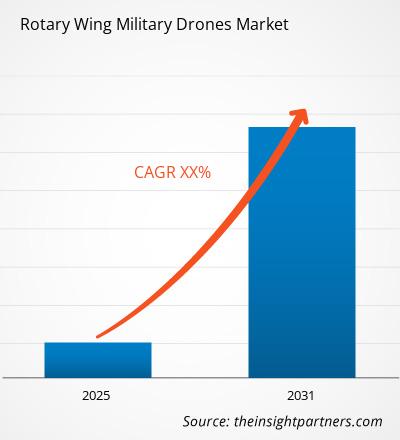
The global Rotary Wing Military Drones Market size is projected to reach US$ 9.73 billion by 2034 from US$ 4.39 billion in 2025. The market is anticipated to register a CAGR of 9.25% during the forecast period 2026-2034. This significant expansion is propelled by escalating geopolitical tensions, defense modernization initiatives, and the increasing demand for advanced real-time intelligence, surveillance, and reconnaissance (ISR) capabilities across maritime, urban, and remote operational theaters.
Competitive Landscape: Leading Key Players
The global rotary wing military drones market is marked by continuous innovation, strategic collaborations, and significant R&D investments by prime defense contractors and specialized aerospace providers. Major players shaping the technological advancements and market dynamics include:
AeroVironment, Inc.
BAE Systems
Elbit Systems Ltd.
General Atomics
Israel Aerospace Industries Ltd.
Lockheed Martin Corporation
Northrop Grumman Corporation
Textron Systems
Thales Group
UAV Navigation
These industry leaders focus on advancing autonomous flight controllers, improving battery and hybrid propulsion efficiency, reducing noise signatures, and integrating modular payload architecture to meet the evolving demands of armed forces worldwide.
Technological Trends Shaping the Market
Several critical technology trends are defining the development trajectory of rotary wing military drones:
Autonomous Flight and AI Integration: Modern units are transitioning from remotely piloted systems to fully autonomous platforms capable of real-time obstacle avoidance, dynamic path planning, and autonomous target recognition using artificial intelligence (AI) and machine learning (ML).
Swarming Capabilities: Research is rapidly advancing toward enabling multiple rotary wing drones to operate as coordinated swarms. This strategy overwhelms enemy air defenses, enhances sensor coverage, and provides redundant mission execution in high-threat contested environments.
Hybrid and Electric Propulsion Systems: To counter the limitations of traditional internal combustion engines, manufacturers are integrating hybrid-electric power systems to extend flight endurance, increase payload capacity, and significantly reduce acoustic and thermal signatures for stealth operations.
Manned-Unmanned Teaming (MUM-T): Integrating rotary wing drones with manned attack or utility helicopters enhances situational awareness while keeping human pilots out of high-risk engagement zones.
Get Full Copy of This Report- https://www.theinsightpartners.com/buy/TIPRE00018638
Regional Market Dynamics
North America currently commands a significant market share due to substantial defense budgets, early adoption of autonomous systems, and major procurement programs by the U.S. Department of Defense. Meanwhile, the Asia-Pacific region is anticipated to experience the fastest growth rate throughout the forecast period. Rapid defense modernization programs in countries such as India, China, Japan, and South Korea, coupled with ongoing maritime security concerns and territorial disputes, are heavily fueling market demand in the region. Europe also remains a vital hub, driven by NATO defense spending targets and cross-border collaborative defense initiatives.
Future Outlook
The future of the rotary wing military drones market points toward unprecedented capability enhancement and deeper integration into multi-domain operations. Over the coming decade, advancements in miniaturized sensor technology, secure satellite communication (SATCOM) links, and resilient navigation systems in GPS-denied environments will further expand the tactical utility of these platforms. As defense forces worldwide increasingly prioritize unmanned solutions to minimize human casualty risks and maximize operational flexibility, rotary wing UAVs will evolve from auxiliary reconnaissance tools into core strategic strike, heavy-lift logistics, and electronic warfare assets. The projected market growth to US$ 9.73 billion by 2034 reflects not merely a financial expansion, but a fundamental shift in global defense strategies toward autonomous and versatile aerial force projection.
Related Report-
Autonomous BVLOS Drones Market
About Us
The Insight Partners is a one-stop industry research provider of actionable intelligence. We help our clients in getting solutions to their research requirements through our syndicated and consulting research services. We specialize in industries such as Semiconductor and Electronics, Aerospace and Defense, Automotive and Transportation, Biotechnology, Healthcare IT, Manufacturing and Construction, Medical Devices, Technology, Media, and Telecommunications, as well as chemicals and Materials.