
Key Highlights
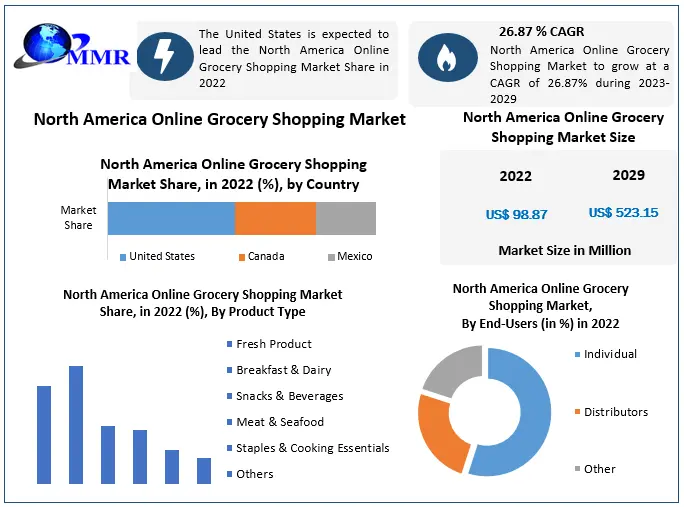
- The North America Online Grocery Shopping Market was valued at USD 98.87 Bn in 2022 and is expected to reach nearly USD 523.15 Bn by 2029, turning digital grocery into a major retail battleground.
- The market is forecast to grow at a 26.87% CAGR from 2023 to 2029, forcing retailers to invest in delivery, fulfillment, apps and customer retention rather than store traffic alone.
- Individuals dominate the end-user segment because they form the largest customer base and drive most online grocery sales.
- The United States holds the largest regional share, making it the priority market for platform investment, grocery partnerships and last-mile execution.
- Walmart held 28.9% of U.S. digital grocery sales, ahead of Amazon at 23.8%, signaling that store networks remain a powerful advantage in online grocery.
Why This Matters Now
Grocery retail is moving from weekly store visits to app-based replenishment. The winners will not be the retailers with the most shelves, but those that can deliver fresh food, trusted quality and predictable time slots at scale.
The market’s jump from USD 98.87 Bn in 2022 to nearly USD 523.15 Bn by 2029 creates a fivefold digital revenue opportunity. It also raises the cost of failure, because weak logistics, poor produce quality and data-security concerns can push consumers back to stores.
Market Overview
The North America Online Grocery Shopping Market covers digital retail purchases of food and household essentials across the United States, Canada and Mexico. The report segments the market by product type, payment method, end user and region, with product categories including fresh produce, breakfast and dairy, snacks and beverages, meat and seafood, staples and cooking essentials, and others.
The category accelerated after COVID-19 as consumers adopted contactless shopping, home delivery and curbside pickup. Traditional retailers and e-commerce firms responded by upgrading online infrastructure, logistics and user interfaces.
Payment methods include online payment and offline cash on delivery. End users include individuals, distributors and others, giving the market both household and business-demand routes.
Key Trends Driving Growth
Convenience is the main growth driver. Busy consumers use online grocery to save time, avoid store visits and receive essentials at home, while flexible delivery choices such as same-day and scheduled delivery let shoppers align orders with daily routines.
Mobile-first grocery is now central to customer acquisition. Smartphone apps allow consumers to browse, order and track deliveries, while personalized offers, loyalty programs and tailored recommendations improve engagement and retention.
AI is changing the basket. Platforms use past purchases to recommend products and offers, including organic choices for health-conscious shoppers. That makes data quality a direct commercial asset for online grocers.
Health and wellness demand is visible through organic, vegan, allergen-free and nutritional products. Clean-label demand is not separately quantified on the public page, but the report identifies health-conscious consumers as a growth opportunity.
Sustainability is becoming a conversion factor. Green consumers seek eco-friendly packaging and sustainable products, while excessive packaging waste can deter environmentally conscious shoppers. That puts packaging discipline inside the online grocery value proposition.
Request a Free Sample Report for Comprehensive Market Insights
Segment Insights
- Dominant Segment Individuals: Individuals dominate because they are the largest consumer base and drive most online grocery sales. Working professionals, students and regular households use platforms for convenience, time saving and access to wider product ranges.
- Fastest-Growing Segment: The public MMR page does not identify a fastest-growing product type, payment method or end-user segment by CAGR. No fastest-growing segment is inferred.
- Product Scope: Fresh produce, breakfast and dairy, snacks and beverages, meat and seafood, staples and cooking essentials, and others are covered. Segment-level revenue shares are not disclosed.
- Payment Scope: Online payment and offline cash on delivery are covered. The public page does not disclose payment-method shares or growth rates.
- Emerging Demand Pools: Seniors, individuals with special needs, rural consumers, businesses, offices and events are identified as opportunity areas for tailored online grocery services.
Regional Growth Story
The United States leads the North America Online Grocery Shopping Market. Amazon Fresh, Walmart Grocery and Instacart are named as major players, while home delivery and curbside pickup are common in urban and suburban areas.
The U.S. market also shows a clear urban-rural divide. Urban areas have higher adoption because delivery services are easier to access, while rural areas face delivery-infrastructure challenges and rely more on physical stores.
Canada is expanding through Walmart Canada and Loblaw’s online ordering and delivery services. Delivery and fulfillment logistics remain a challenge, especially during peak demand or in areas with limited infrastructure.
Mexico is growing steadily, with Walmart, Soriana and Chedraui offering online ordering and delivery. Adoption is driven by convenience and the desire to avoid crowded stores.
Competitive Landscape
The market includes 7-Eleven, Ahold Delhaize, Albertsons, ALDI, Amazon Fresh, FreshDirect, Google, Instacart, Jet.com, Kroger, Peapod, Postmates, Safeway Grocery Delivery, Shipt, Target, Vitacost and Walmart. Competition is defined by fulfillment speed, store networks, product range, app quality and loyalty economics.
Walmart’s 28.9% U.S. digital grocery share signals the power of physical infrastructure in a digital market. Its network of more than 5,000 stores and plan for micro-fulfillment centers gives it a cost and proximity advantage for pickup and rapid fulfillment.
Amazon’s 23.8% share shows digital strength but also a grocery-specific constraint. With just over 500 Whole Foods outlets and 18 Amazon Fresh locations, its limited physical footprint weakens its click-and-collect position versus Walmart.
Kroger sits third and is expected to reach only 53.13% of Amazon’s sales. Its early digital entry and AI-driven fulfillment centers signal a strategy built on automation rather than pure store density.
The report notes increased competition and consolidation, with larger players acquiring smaller specialized companies. Named transaction details are not disclosed, but the signal is clear: scale, fulfillment assets and specialized service capabilities are becoming acquisition targets.
Recent Developments
- Walmart’s Micro-Fulfillment Push: Walmart plans to establish micro-fulfillment centers, signaling a shift toward faster, lower-cost order assembly close to shoppers.
- AI-Driven Fulfillment: Kroger continues to innovate through AI-driven fulfillment centers, showing that automation is becoming a key defense against last-mile cost pressure.
- Platform Expansion: Canada’s Walmart Canada and Loblaw’s, and Mexico’s Walmart, Soriana and Chedraui, are expanding online ordering and delivery, widening regional digital grocery adoption.
Strategic Implications
For grocers, online is now a margin and retention problem. Delivery fees can discourage budget-conscious consumers, while perishable logistics can damage trust if freshness fails.
For FMCG brands, digital grocery changes shelf strategy. Search placement, personalized offers and subscription models can influence repeat purchases more than traditional aisle visibility.
For investors, fulfillment infrastructure is the critical diligence point. Micro-fulfillment centers, last-mile routing, cold-chain discipline and mobile payment reliability will determine whether growth converts into profit.
Future Outlook
The North America Online Grocery Shopping Market is forecast to reach nearly USD 523.15 Bn by 2029 at a 26.87% CAGR. Growth will come from app-based ordering, personalization, loyalty programs, secure payments, rural expansion, organic and allergen-free assortments, meal kits and business-to-business grocery delivery.
The public page does not disclose product-type shares, payment-method shares, fastest-growing segment data, quantified e-commerce penetration beyond the online market itself, or detailed M&A terms. That limits the visible outlook to market size, regional direction, end-user dominance and disclosed competitive signals.
Winners will control freshness, data and fulfillment density; losers will be trapped between high delivery costs, weak trust and customers who can return to stores overnight.
Analyst Perspective
“North America’s online grocery market is becoming a fulfillment-led retail race as consumers demand convenience, freshness and personalization in the same transaction,” said Siddhi Dole, Analyst at Maximize Market Research. “The strongest players will combine store networks, micro-fulfillment, mobile apps, secure payments and data-driven recommendations.”
About Maximize Market Research
Maximize Market Research Pvt. Ltd. (MMR) is a global market research and consulting company that provides reliable, data-focused, and practical business insights. The firm serves a wide range of industries, including healthcare, pharmaceuticals, technology, automotive, electronics, chemicals, personal care, and consumer goods. Through market forecasts, competitive analysis, strategic consulting, and industry impact assessments, MMR helps organizations understand changing market conditions, identify growth opportunities, and make informed business decisions for long-term success.
Contact Us
2nd Floor, Navale IT Park Phase 3
Pune Banglore Highway, Narhe
Pune, Maharashtra 411041, India
+91 9607365656
[email protected]