
Key Highlights
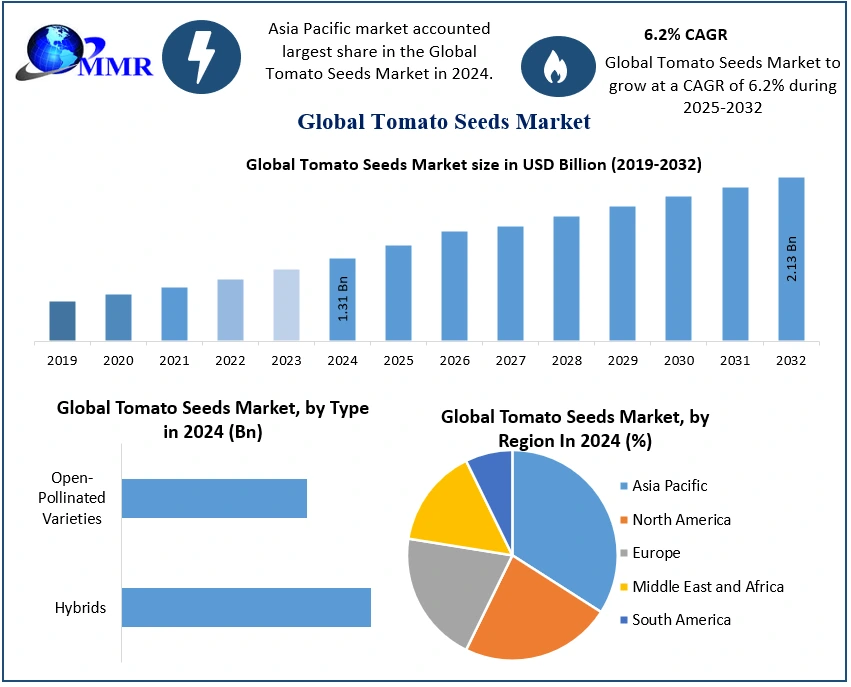
Market valuation reached USD 1.31 billion in 2024 and is projected to hit USD 2.13 billion by 2032, advancing at an annualized growth rate of 6.2%.
Open-pollinated and heirloom seed variants remain the dominant market segment by 2032 due to low initial input costs and reliable yields in marginal environments.
Asia-Pacific represents the fastest-growing regional market, propelled by institutional investments, high-intensity protected cultivation, and plastic mulching infrastructure.
Escalating research and development expenditures by global agricultural leaders are targeting climate-resilient traits and pest resistance to combat declining global arable acreage.
Scepticism among traditional farming communities and capital-intensive development timelines present immediate structural limits to rapid breakthrough commercialization.
Why This Matters Now
Volatile weather patterns and contracting agricultural acreage are creating immediate supply risks for global industrial food processors and corporate agrochemical providers. Agricultural input suppliers can no longer rely on conventional breeding timelines to meet the strict quality specifications demanded by modern commercial buyers. Rising investment in hybrid cultivation represents a necessary operational pivot to protect downstream yield predictability. Agribusinesses that fail to integrate biochemical seed treatments and climate-resilient traits into their supply chains risk losing processing margins to integrated agricultural leaders.
Market Overview
The global Tomato seeds market achieved a baseline valuation of USD 1.31 billion in 2024. Industrial growth is tied to the expanding role of the crop as a baseline contributor to international food security and advanced nutraceutical manufacturing. Beyond basic culinary use, industrial processing sectors extract vital compounds including potassium, digestive amino acids, and vitamin C to formulate dietary supplements and functional skincare products.
This broadening downstream industrial application requires a reliable upstream supply of highly standardized raw agricultural outputs. Agribusiness corporations utilize these distinct genetic variations as foundational biochemical models to advance contemporary genomic, breeding, and general genetic research. Driven by these intersecting industrial and nutritional requirements, the market is on track to reach USD 2.13 billion by 2032, exhibiting a compound annual growth rate of 6.2%.
Key Trends Driving Growth
Declining global arable acreage and erratic climate fluctuations represent the primary catalysts accelerating structural changes across the agricultural input market. Traditional open-field farming operations face compounding exposure to novel pest pressures, erratic seasonal temperatures, and post-harvest preservation deficits. To counteract these structural liabilities, commercial growers are steadily increasing their capital deployment toward advanced high-yielding seed varieties.
This shift is heavily supported by expanding biotech sector investments focused on optimizing seed performance. Agribusinesses are prioritizing the commercialization of specialized hybrid varieties, such as grape tomatoes, which command premium pricing structures in mature Western markets. The compelling return on investment delivered by these highly uniform crops is successfully driving traditional farmers to move away from saved-seed methods, creating recurring procurement demand for commercial seed producers.
Segment Insights
Dominant Segment: Open-pollinated and heirloom seed varieties are projected to maintain the largest volume share of the global marketplace through 2032. This sustained position is due to their straightforward production mechanics and the capacity of single parent plants to generate thousands of viable seeds. These varieties consistently deliver stable economic yields within less favorable environments while requiring fewer expensive chemical crop inputs.
Fastest-Growing Segment: Hybrid seed variations paired with protected cultivation technologies are expanding at the highest rate. This growth is driven by the urgent commercial necessity to maximize crop output per square meter and establish resilience against highly volatile environmental disruptions.
Regional Growth Story
The Asia-Pacific region has established itself as the fastest-growing geographical market for tomato seeds. Agrarian sectors across major regional economies, specifically India and China, are shifting rapidly toward high-intensity vegetable cultivation. This operational change is supported by targeted government infrastructure incentives designed to improve domestic food security and enhance rural cash flows.
To secure higher profit margins relative to traditional field crops, regional growers are rapidly implementing modern agricultural management techniques. These installations include widespread drip irrigation networks, plastic mulching materials, and complex protected greenhouse structures. This systematic modernization has attracted substantial local research and development capital from prominent regional enterprises, including Namdhari Seeds Private Limited, East-West Seed International, and Mahyco, all working to cement localized supply chains.
Competitive Landscape
The global competitive arena is highly consolidated, led by major multi-national chemical and life science conglomerates. Key entities including BASF SE, Bayer Crop Science, Groupe Limagrain, Syngenta AG, and UPL Limited dictate market velocity through deep research pipelines and extensive patent portfolios. These market leaders compete directly against specialized global seed practitioners such as Rijk Zwaan, Enza Zaden BV, Bejo Zaden BV, Sakata Seed Corporation, and Takii & Co Limited.
The prevailing market structure displays a clear division between high-margin specialty hybrid innovations and high-volume commodity open-pollinated seed lines. Top-tier enterprises maintain strong pricing power by embedding advanced genetic traits directly into their proprietary seed offerings. This technical advantage creates high barriers to entry for smaller, domestic seed producers trying to scale up.
Recent Developments
Multi-national market participants are increasing their structural capital investments to construct specialized biotechnology laboratories within developing economic corridors.
Regional suppliers, including Sakata Seed Corporation and Takii & Co Limited, are expanding their localized testing operations across the Asia-Pacific region to screen for regional pest resistance.
Leading players are building targeted cooperative frameworks alongside regional distributors to overcome persistent farmer scepticism regarding the high upfront cost of newer hybrid seed options.
Strategic Implications
The long-term economic returns on hybrid crops are reshaping regional agricultural finance, but high initial procurement costs still present hurdles. Traditional farming communities frequently resist purchasing premium-priced commercial seeds when cheaper, saved open-pollinated alternatives are readily available. Agrochemical companies and seed producers must design clear financial models to demonstrate the value of lower crop loss and predictable processing volumes.
Additionally, long research and development timelines mean seed manufacturers face substantial capital risk when bringing new traits to market. Firms that successfully combine biochemical seed treatments with long-term distribution agreements will capture the largest share of corporate processing contracts.
Future Outlook
The global tomato seeds market will increasingly favor heavily integrated seed and chemical providers that can deliver guaranteed crop performance amid severe climate volatility.
Analyst Perspective
“The global seed sector is moving past traditional breeding toward precision genetics aimed at maximizing industrial crop processing yields,” states Ankita Kagawade, Analyst at Maximize Market Research. “Agronomists and chemical buyers who proactively secure climate-resilient hybrid supply channels will effectively insulate their production facilities from inevitable raw material shortages.”
About Maximize Market Research
Maximize Market Research Pvt. Ltd. (MMR) is a global market research and consulting company that provides reliable, data-focused, and practical business insights. The firm serves a wide range of industries, including healthcare, pharmaceuticals, technology, automotive, electronics, chemicals, personal care, and consumer goods. Through market forecasts, competitive analysis, strategic consulting, and industry impact assessments, MMR helps organizations understand changing market conditions, identify growth opportunities, and make informed business decisions for long-term success.
2nd Floor, Navale IT Park Phase 3
Pune Banglore Highway, Narhe
Pune, Maharashtra 411041, India
+91 9607365656
[email protected]