
Key Highlights
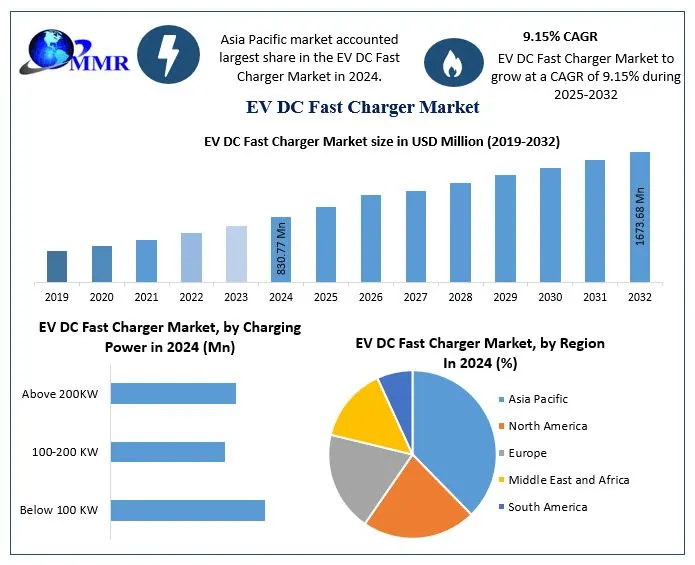
- The Global EV DC Fast Charger Market Size was valued at USD 830.77 Million in 2024, demonstrating accelerating investment in high-power charging infrastructure worldwide.
- The market is expected to reach nearly USD 1,673.68 Million by 2032, creating long-term opportunities for charging equipment manufacturers, utilities, OEMs, and infrastructure developers.
- The market is projected to grow at a CAGR of 9.15% from 2025 to 2032, indicating sustained momentum in global EV infrastructure deployment.
- DC fast charging is becoming a strategic component of public mobility networks, commercial fleet operations, and highway transportation corridors.
- Governments, automotive manufacturers, utilities, and charging operators continue expanding charging ecosystems to support accelerating electric vehicle adoption.
Why This Matters Now
Electric vehicles are no longer constrained by battery technology alone. Charging infrastructure has become the defining factor determining the pace of global EV adoption, influencing consumer confidence, commercial fleet electrification, and national transportation strategies.
The EV DC Fast Charger Market Size, valued at USD 830.77 Million in 2024, highlights the rapid commercialization of high-power charging solutions. Its projected expansion to nearly USD 1,673.68 Million by 2032, growing at a 9.15% CAGR, signals that charging infrastructure is evolving into one of the most strategic investment areas across the automotive and transportation value chain.
Market Overview
The global transportation industry is shifting from vehicle manufacturing alone toward complete mobility ecosystems. Fast charging infrastructure has become a critical link connecting vehicle production, renewable energy integration, digital mobility platforms, and customer experience.
Unlike conventional charging systems, DC fast chargers significantly reduce charging time, making electric vehicles more practical for long-distance travel, commercial transportation, ride-sharing operations, and logistics fleets.
The market also reflects changing investment priorities. Governments continue supporting charging deployment through transportation modernization programs, while OEMs increasingly view charging availability as a competitive advantage influencing vehicle purchasing decisions.
As electric mobility expands across passenger and commercial transportation, fast charging infrastructure is becoming a strategic national asset rather than simply an automotive accessory.
Key Trends Driving Growth
Electric vehicle adoption continues driving demand for high-speed charging solutions. Consumers increasingly expect charging experiences comparable to conventional refueling, encouraging investment in higher-capacity DC charging networks.
Fleet electrification is reshaping infrastructure planning. Commercial operators require rapid vehicle turnaround to maximize asset utilization, making fast charging an operational necessity rather than a convenience.
Battery technology improvements are increasing vehicle range while enabling compatibility with higher charging capacities. This development strengthens demand for advanced charging infrastructure capable of supporting next-generation electric vehicles.
Connected mobility platforms are also transforming charging experiences. Digital applications increasingly integrate charger availability, route planning, payment systems, and energy management into unified customer platforms.
Software-defined vehicles further strengthen the importance of intelligent charging ecosystems. Vehicle connectivity enables smarter charging optimization while improving user convenience and infrastructure utilization.
The global energy transition also supports market expansion. Governments continue prioritizing electrified transportation as part of broader carbon reduction and emissions compliance strategies.
Segment Insights
- Dominant Segment: Information available in the Maximize Market Research report.
- Fastest-Growing Segment: Information available in the Maximize Market Research report.
- Public charging infrastructure continues expanding alongside rising electric vehicle adoption.
- Commercial and fleet charging applications remain an increasingly important growth opportunity for infrastructure providers.
Regional Growth Story
The United States continues expanding nationwide charging infrastructure through public and private investment. Increasing EV adoption and interstate charging corridor development support long-term demand for high-power charging systems.
Germany remains one of Europe’s leading automotive innovation centers. Investments in premium electric vehicles and sustainable transportation continue accelerating deployment of advanced charging infrastructure.
China maintains global leadership in electric vehicle production and charging infrastructure expansion. Large-scale manufacturing capacity, strong domestic EV demand, and integrated industrial policies continue strengthening market growth.
Japan continues emphasizing charging reliability and advanced mobility technologies while supporting broader transportation electrification initiatives.
South Korea benefits from strong battery manufacturing capabilities and advanced automotive technology ecosystems, creating favorable conditions for fast-charging infrastructure expansion.
India is emerging as an important long-term market as electric mobility gains momentum across passenger transportation, commercial vehicles, and urban mobility initiatives. Expanding charging infrastructure remains essential for accelerating nationwide EV adoption.
Across all major automotive markets, charging availability is increasingly influencing vehicle purchasing decisions and long-term transportation planning.
Competitive Landscape
Competition within the EV DC fast charger industry increasingly centers on ecosystem leadership rather than hardware manufacturing alone.
Charging equipment suppliers are competing through higher charging capacity, digital connectivity, network reliability, and integrated energy management solutions. Companies capable of delivering complete charging ecosystems strengthen long-term customer relationships.
Automotive OEM partnerships signal broader strategic positioning. Charging infrastructure providers increasingly become part of manufacturers’ customer ownership strategies, extending relationships beyond vehicle sales into long-term mobility services.
Technology investment also reflects changing competitive priorities. Smart charging software, remote monitoring, predictive maintenance, and grid integration capabilities increasingly differentiate leading providers.
Manufacturing expansion demonstrates confidence in long-term infrastructure demand while strengthening supply chain resilience. Companies investing in scalable production capacity position themselves to benefit from accelerating infrastructure deployment.
The competitive landscape therefore favors organizations capable of combining hardware innovation, software capabilities, network operations, and strategic partnerships across the broader electric mobility ecosystem.
Recent Developments
- Governments continue expanding public charging infrastructure programs supporting electric mobility.
- Automotive manufacturers increasingly collaborate with charging network providers to improve customer accessibility.
- Charging technology continues advancing toward higher power output and improved charging efficiency.
- Fleet electrification initiatives are accelerating investment in commercial charging infrastructure.
- Digital charging platforms continue integrating payment systems, network management, and connected mobility services.
Strategic Implications
For automotive OEMs, fast charging infrastructure has become an essential component of customer acquisition and retention strategies. Vehicle competitiveness increasingly depends on charging convenience alongside vehicle performance.
Charging equipment manufacturers benefit from rising infrastructure investment but face increasing expectations regarding reliability, interoperability, and software integration.
Utilities gain opportunities by supporting transportation electrification while expanding electricity demand through intelligent charging networks and energy management systems.
Fleet operators increasingly evaluate charging infrastructure as a determinant of operational efficiency, route optimization, and total cost of ownership.
Investors should recognize that charging infrastructure represents one of the fastest-growing segments within the broader electric mobility ecosystem. Companies combining hardware manufacturing, digital services, and long-term network operations are positioned to capture recurring revenue opportunities beyond equipment sales.
Future Outlook
The EV DC Fast Charger Market Size is expected to grow from USD 830.77 Million in 2024 to nearly USD 1,673.68 Million by 2032, expanding at a 9.15% CAGR. That trajectory demonstrates that charging infrastructure is becoming a foundational pillar of global transportation modernization.
The next phase of competition will be determined by ecosystem integration rather than charger deployment alone. Companies capable of combining intelligent software, scalable manufacturing, energy management, and strategic OEM partnerships will define the future of electric mobility infrastructure.
As transportation transitions from internal combustion to fully connected electric mobility, organizations building resilient, intelligent, and widely accessible charging ecosystems will become the infrastructure leaders of tomorrow, while those focused solely on hardware deployment risk falling behind in an increasingly software-driven mobility economy.
Analyst Perspective
“Fast charging infrastructure is rapidly becoming one of the most strategic assets within the global electric mobility ecosystem. Organizations that combine advanced charging technologies, digital platforms, and scalable infrastructure deployment will shape the next generation of transportation,” says Tejaswini Kakade, Analyst, Maximize Market Research.
About Maximize Market Research
Maximize Market Research Pvt. Ltd. (MMR) is a global market research and consulting company that provides reliable, data-focused, and practical business insights. The firm serves a wide range of industries, including healthcare, pharmaceuticals, technology, automotive, electronics, chemicals, personal care, and consumer goods. Through market forecasts, competitive analysis, strategic consulting, and industry impact assessments, MMR helps organizations understand changing market conditions, identify growth opportunities, and make informed business decisions for long-term success.
2nd Floor, Navale IT Park Phase 3
Pune Banglore Highway, Narhe
Pune, Maharashtra 411041, India
+91 9607365656
[email protected]