
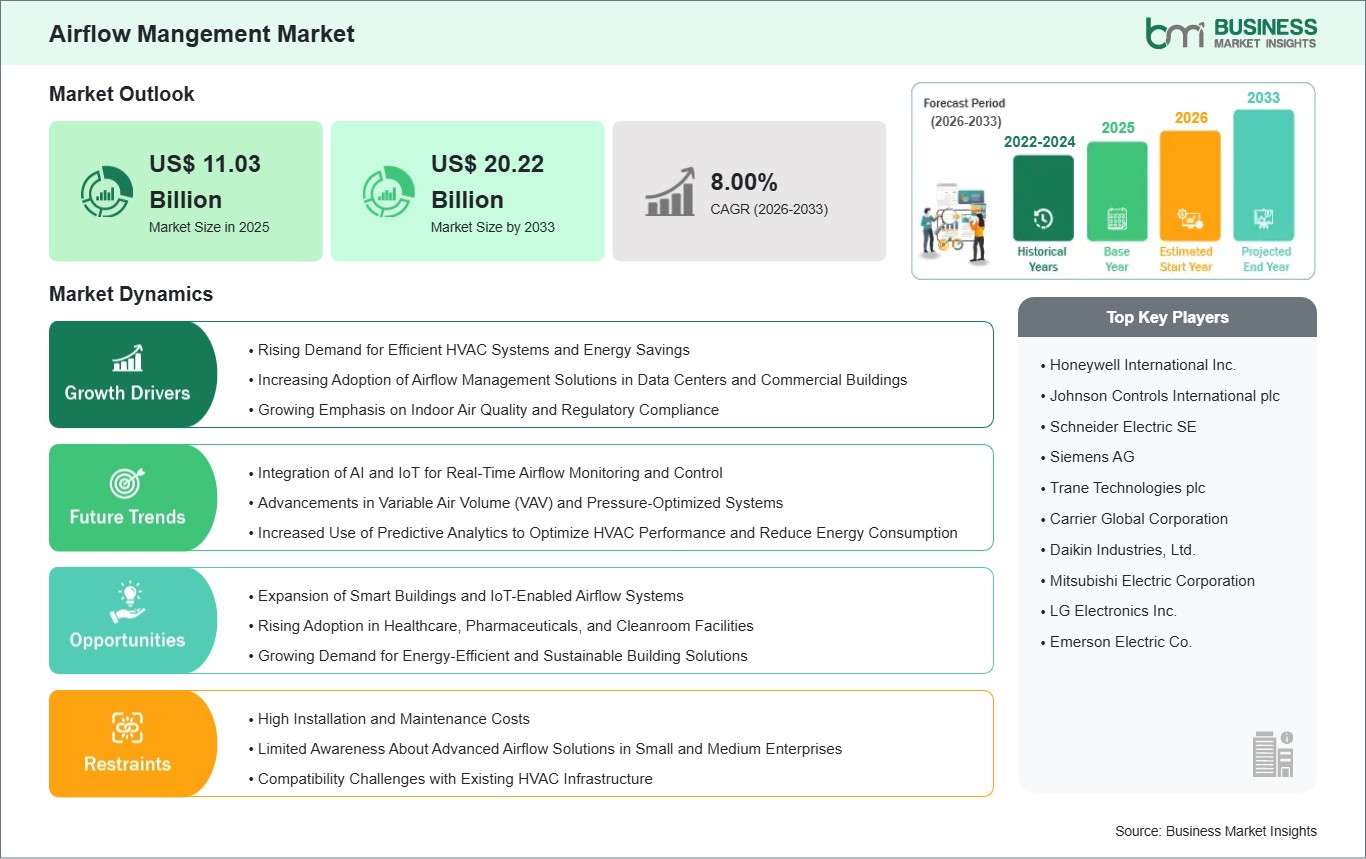
The global Airflow Management Industry is experiencing strong and sustained growth, propelled by the exponential expansion of data centers, surging demand for cloud computing, and the critical need for energy-efficient thermal management solutions.
According to Business Market Insights, the global Airflow Management Market ssize is expected to reach US$ 20.22 Billion by 2033 from US$ 11.03 Billion in 2025. The market is estimated to record a CAGR of 7.87% from 2026 to 2033.
This steady growth is underpinned by the rapid digital transformation across industries, increasing adoption of hyperscale data centers, rising focus on sustainability, and the continuous push for operational cost optimization. As organizations generate and process ever-larger volumes of data, effective airflow management has become essential to avoid overheating, equipment failure, costly downtime, and excessive energy use. Modern data centers with high-density server racks and advanced computing workloads require precise thermal control, making airflow management solutions indispensable.
Download Sample Report : https://www.businessmarketinsights.com/sample/BMIPUB00033256
What Is Airflow Management?
Airflow Management refers to the strategic control and optimization of air movement within data centers and critical facilities. It involves the use of physical barriers, sealing products, containment systems, and intelligent monitoring tools to direct cool air efficiently to server racks while preventing the mixing of hot and cold air streams. Key components include blanking panels that block unused rack spaces, grommets that seal cable openings, raised-floor grommets, and aisle containment solutions (hot aisle and cold aisle containment). These solutions improve cooling performance, reduce the workload on HVAC and chilled water systems, enhance Power Usage Effectiveness (PUE), and extend the lifespan of expensive IT equipment. Services in this market include consulting, design, installation, and ongoing optimization to help operators achieve maximum efficiency and compliance with energy standards.
In an era of AI, big data, and edge computing, proper airflow management is no longer optional but a fundamental requirement for reliable and sustainable data center operations.
Market Drivers
One of the strongest drivers is the increasing data center deployments and expansion of cloud services. The global shift toward cloud computing, big data analytics, streaming services, e-commerce, and digital transformation has triggered unprecedented growth in hyperscale and enterprise data centers. Hyperscale facilities operated by major cloud providers require sophisticated airflow management to handle massive heat loads generated by high-density servers. Without effective solutions, operators face risks of thermal hotspots, reduced equipment reliability, and significantly higher cooling costs.
Another major driver is the rising focus on energy efficiency and cost reduction. Cooling systems can account for up to 40% of a data center’s total energy consumption. Advanced airflow management solutions—such as containment systems and precision air distribution—significantly lower energy use, reduce carbon emissions, and help organizations meet sustainability targets and regulatory requirements. As energy prices rise and environmental regulations tighten, investment in airflow optimization has become a strategic priority for data center operators seeking both cost savings and green credentials.
Technological advancements in predictive monitoring, AI-driven airflow optimization, and modular containment systems are further accelerating adoption. These innovations allow real-time adjustments, predictive maintenance, and improved overall facility performance.
Get More Details: https://www.businessmarketinsights.com/buy/BMIPUB00033256
Market Segmentation
By Offerings
- Component: The dominant segment. Includes physical products such as blanking panels, grommets, containment systems, and raised floor solutions that form the foundation of effective airflow control.
- Services (design, consulting, installation, and optimization)
By Cooling System
- Chilled Water System: The leading segment, preferred for its high efficiency and ability to handle large-scale cooling demands in hyperscale facilities.
- Direct Expansion System
By Data Center Type
- Hyperscale Data Center: The dominant and fastest-growing segment, driven by massive cloud infrastructure investments and the need for scalable, high-efficiency cooling.
- Enterprise Data Center
By Industry
- IT & Telecom: The leading vertical, supported by enormous data processing requirements and continuous infrastructure expansion.
- Banking, Financial Services & Insurance (BFSI)
- Government & Defense
- Healthcare, Retail, Energy, Manufacturing, and others
Regional Insights
- North America currently dominates the market thanks to its high concentration of hyperscale data centers, advanced cloud providers, strong technology infrastructure, and stringent focus on energy efficiency. The United States remains the largest contributor.
- Asia-Pacific is projected to register the fastest growth during the forecast period. Rapid digitalization, government-backed smart city and data center initiatives, booming e-commerce, and expanding cloud adoption in China, India, Japan, and South Korea are creating substantial demand.
- Europe shows steady and mature growth, driven by sustainability regulations, green data center initiatives, and investments in energy-efficient technologies in countries such as Germany, the UK, and France.
- Emerging regions in the Middle East, Africa, and South & Central America are gradually increasing investments as digital infrastructure develops.
Top Players in the Airflow Management Market
The competitive landscape includes global leaders in building automation, cooling, and data center infrastructure solutions. Key companies are focusing on innovation, strategic acquisitions, and comprehensive service offerings to strengthen their market positions.
- Honeywell International Inc.
- Johnson Controls International plc
- Schneider Electric SE
- Siemens AG
- Trane Technologies plc
- Carrier Global Corporation
- Daikin Industries, Ltd.
- Mitsubishi Electric Corporation
- LG Electronics Inc.
- Emerson Electric Co.
Technological Innovations and Trends
Market leaders are introducing intelligent containment systems, real-time airflow sensors, AI-powered optimization software, and modular solutions that adapt to changing server densities. Recent developments include Schneider Electric’s expanded liquid cooling portfolio and Modine’s new destratification fans for industrial spaces. Integration with Building Management Systems (BMS) and predictive analytics is becoming standard, enabling data center operators to achieve lower PUE ratios and higher operational resilience.
Sustainability remains a central theme, with solutions designed to support renewable energy integration and reduced carbon footprints. The trend toward edge computing and smaller, distributed data centers is also creating demand for flexible, scalable airflow management solutions.
Challenges and Future Opportunities
While the market outlook is positive, challenges such as high initial investment costs, complexity of retrofitting existing facilities, and varying regional regulations exist. However, these challenges create opportunities for service providers offering turnkey solutions, consulting, and performance-based contracts.
Looking ahead, the convergence of AI, 5G, edge computing, and sustainability goals will continue to drive innovation. Hyperscale data center expansion, increasing digitalization in emerging markets, and corporate ESG commitments are expected to sustain strong demand through 2033 and beyond. Companies that combine advanced hardware with intelligent software and comprehensive services will be best positioned for long-term success in this dynamic market.
Frequently Asked Questions (FAQs)
What is the projected size of the Airflow Management Market by 2033?
The market is projected to reach US$ 20.22 Billion by 2033, rising from US$ 11.03 Billion in 2025 at a CAGR of 7.87%.
Which offerings segment is dominant?
The Component segment leads due to strong demand for physical airflow management products.
Which data center type is growing fastest?
Hyperscale Data Centers are the fastest-growing segment, fueled by cloud and digital infrastructure expansion.
What are the main factors driving market growth?
Key drivers include data center expansion, cloud computing growth, energy efficiency requirements, and sustainability initiatives.
Which region offers the highest growth potential?
Asia-Pacific is expected to register the highest growth rate during the forecast period.
Browse More Reports:

About Us
Business Market Insights is a market research platform that provides subscription service for industry and company reports. Our research team has extensive professional expertise in domains such as Electronics & Semiconductor; Aerospace & Defense; Automotive & Transportation; Energy & Power; Healthcare; Manufacturing & Construction; Food & Beverages; Chemicals & Materials; and Technology, Media.
Contact Us
If you have any questions about this report or would like further information, please contact us:
Contact person: Ankit Mathur
Email: [email protected]
Phone: +16467917070