
The global aircraft obstruction beacon market plays an indispensable role in maintaining civil and military airspace safety. Designed to warn pilots of potential hazards, aircraft obstruction beacons are installed on tall structures such as telecommunication towers, wind turbines, high-rise buildings, transmission towers, and industrial chimneys to prevent low-altitude mid-air collisions. Strict international aviation standards mandate the installation of these visual safety markers to ensure visibility during both daytime and nighttime flight operations, as well as under adverse weather conditions.
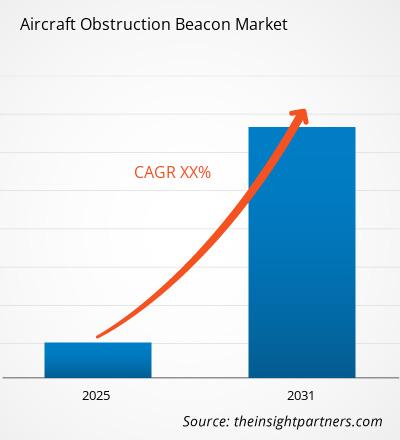
The Aircraft Obstruction Beacon Market size is expected to reach US$ 836.44 Million by 2034 from US$ 502.69 Million in 2025. The market is anticipated to register a CAGR of 5.82% during the forecast period 2026–2034. This sustained growth reflects rising global investments in telecommunication infrastructure, urban development, renewable energy installations, and modern air traffic management infrastructure.
Key Market Drivers and Trends
1. Expansion of Telecommunications and Renewable Energy Networks
The rapid worldwide rollout of 5G infrastructure and expanding 4G networks require hundreds of thousands of new cellular towers globally. Because many of these communication structures cross regulatory height thresholds, they require certified obstruction beacons. Concurrently, the global transition toward clean energy has fueled massive construction of onshore and offshore wind farms. Wind turbines, given their immense height and rotating blades, demand reliable, high-intensity, and medium-intensity obstruction lighting systems to ensure safe navigation for low-flying aircraft and helicopters.
2. Strict Regulatory Compliance Frameworks
Global aviation regulatory bodies including the Federal Aviation Administration (FAA) in the United States and the International Civil Aviation Organization (ICAO) internationally enforce rigorous guidelines governing obstacle marking and lighting. Any permanent or temporary structure reaching specified height thresholds (typically 200 feet / 61 meters or higher) must be fitted with approved obstruction beacons. Stringent penalties for non-compliance and rising safety standards across emerging economies continue to propel demand for certified, high-performance beacon solutions.
3. Transition to Energy-Efficient LED and Solar-Powered Beacons
The market is undergoing a major technological transformation, shifting away from legacy incandescent and xenon lighting systems toward light-emitting diode (LED) technologies. LED beacons offer significant advantages, including reduced power consumption, superior operational lifespans (often exceeding 100,000 hours), lower thermal emissions, and minimal maintenance costs. Furthermore, off-grid locations such as remote telecom towers and offshore platforms are increasingly adopting solar-powered LED obstruction beacons, which provide autonomous, low-cost operations without reliance on local power grids.
Get a PDF Sample- https://www.theinsightpartners.com/sample/TIPAD00002643
4. Integration of Smart Monitoring and IoT
Modern aircraft obstruction lighting systems are increasingly equipped with Internet of Things (IoT) sensors, automated photocells, and remote monitoring software. These smart solutions allow operators to monitor beacon functionality in real time, receive instant alerts during power outages or hardware faults, and schedule predictive maintenance. Remote diagnostic capabilities significantly reduce operational downtime and eliminate costly manual inspections in hard-to-reach locations.
Regional Analysis
North America: Dominates a major share of the global market due to strict FAA compliance standards, a dense network of telecommunication towers, extensive wind farm projects, and early adoption of advanced smart lighting systems.
Europe: Driven by stringent safety directives from the European Union Aviation Safety Agency (EASA), extensive offshore wind farm installations, and strong sustainability initiatives favoring energy-efficient LED systems.
Asia-Pacific: Anticipated to register the highest growth rate during the forecast period, powered by rapid urbanization, high-rise construction, expanding airport infrastructure, and massive telecommunication rollouts across China, India, and Southeast Asian nations.
Rest of the World: Latin America and the Middle East & Africa are experiencing steady adoption as national governments modernize air traffic controls, expand energy grids, and invest in smart city projects.
Key Players
The global aircraft obstruction beacon market features prominent international manufacturers and specialized lighting solution providers. Key industry participants operating in this market include:
Avlite Systems
Clampco Products Inc.
Emerson Electric Co.
Flash Technology
Flight Light Inc.
Obelux Oy
Orga BV
Point Lighting Corporation
TWR Lighting, Inc.
Unimar Inc.
These players focus on continuous product innovation, regulatory certification, ruggedized designs for harsh environments, and expanding their distribution channels across high-growth regional markets.
Get Full Copy of This Report- https://www.theinsightpartners.com/buy/TIPAD00002643
Future Outlook
The future of the aircraft obstruction beacon market remains bright, driven by continuous innovations in intelligent lighting, sustainable energy integration, and smart infrastructure management. Over the coming decade, market growth will be heavily shaped by the deployment of AI-driven predictive maintenance platforms, radar-controlled obstruction lighting systems that activate only when aircraft are in proximity, and ultra-durable solar-hybrid solutions tailored for off-grid and marine environments. As urban landscapes expand vertically and airspace congestion increases with the introduction of commercial drones and urban air mobility (UAM) vehicles, aircraft obstruction beacons will evolve into highly interconnected, energy-efficient safety nodes essential for future aerospace safety and smart city resilience.
Related Reports-
About Us
The Insight Partners is a one-stop industry research provider of actionable intelligence. We help our clients in getting solutions to their research requirements through our syndicated and consulting research services. We specialize in industries such as Semiconductor and Electronics, Aerospace and Defense, Automotive and Transportation, Biotechnology, Healthcare IT, Manufacturing and Construction, Medical Devices, Technology, Media, and Telecommunications, as well as chemicals and Materials.